
Your Weekly Update for Monday, January 19, 2026.
Beacon Rock Wealth Advisors is a dba of BR Capital, Inc. It is a financial planning and registered investment advisory firm in Camas, Washington. We are always available to answer your questions. Give us a call at (360) 735-1900 or send an email.
If you or someone you know is worried about retirement, send us an email or give us a call for a no-obligation Retirement and Social Security Analysis.
If this information is helpful to you, please forward this to a friend and ask them to subscribe at https://newsletters.beaconrwa.com/subscribe.
Have a great week!
Mike Elerath
CERTIFIED FINANCIAL PLANNERTM
CERTIFIED IN LONG-TERM CARE
Mike.Elerath@beaconrwa.com
Bill Roller
NMLS #107972
CHARTERED FINANCIAL ANALYST
CERTIFIED FINANCIAL PLANNERTM
CHARTERED MARKET TECHNICIAN
bill.roller@beaconrwa.com
For more information about Beacon Rock Wealth Advisors, check out our brochure here: https://beaconrwa.com/beaconrockbrochure/
Markets are closed today in honor of Martin Luther King Day!

Click on the image below to go https://youtu.be/0KQeGsXh3wg to see the video from January 16 in which Mike Elerath and Bill Roller discuss the financial markets.

Please give the video a “Like” and check out our other videos and subscribe to the channel at https://www.youtube.com/@beaconrwa.
Summary
Markets were SLIGHTLY DOWN last week. The Dow Jones Industrial Average was DOWN 0.29% to 49,359.33 while the S&P500 ended DOWN 0.38% TO 6,940.01. The Nasdaq Composite FELL 0.66% to 23,515.39. The annual yield on the 30-year Treasury ROSE 2.1 basis point(s) to 4.840%.
Economic data included consumer price inflation coming in steady, but still elevated, as did producer price inflation. Industrial production and retail sales came in positively. New and existing home sales rose, but homebuilder sentiment continued to weaken. Jobless claims fell, reflecting further normalization after year-end.
Equities fared positively around the world last week, with small cap and international outgaining U.S. core large cap. Bonds were largely down as interest rates ticked higher as inflation remained sticky. Commodities were mixed, with precious metals continuing to lead due to geopolitical considerations.
Economic Notes
(0) The Consumer Price Index for December rose 0.3% on a headline level and 0.2% for core, subtracting out food and energy, each being largely on par with expectations. Within the report, the largest factor was shelter, which rose 0.4% (due to some seasonal adjustments from lack of data for Oct.), along with rebounds higher in airfares (5.2%, reversing a drop for the prior few months), hotels (3.5%), and apparel (0.6%), which had fallen in prior months due to government shutdown-related effects. Weaker prices were seen in communications (-1.9%), used cars (-1.1%), and household furnishings (-0.5%).
Year-over-year, headline CPI decelerated a few basis points to still a rounded 2.7%, while core CPI was little-changed at 2.6%. Energy prices rose 2.3%, mostly from utility gas service, while energy commodities fell -3% (along with a substantial drop in crude oil prices), food prices rose 3.1%, while shelter rose 3.2% (mostly OER). Services like medical care remained one of the biggest drivers of inflation for the year, reflected in alternative measures like ‘All items less food, shelter, and energy,’ which was only up 2.2% for the trailing year, pointing to far more normalcy.
(0/-) The Producer Price Index rose 0.1% for October and 0.2% for November on a headline level. On an ex-food and energy basis, core PPI rose 0.4% in Oct. and was unchanged in Nov. (These reports remain a month behind CPI.) On a year-over-year basis ending in Nov., PPI was up 3.0% on both a headline and core basis. Gains for both goods and services were up similarly over the past year, while areas of inflation contribution included capital equipment, transportation, metals, portfolio management (due to a higher stock market), and government services.
(+) Industrial production rose 0.4% in December, exceeding the median forecast calling for 0.1%. Manufacturing production rose 0.2%, led by a 0.8% increase in business equipment which offset a -1.1% drop in auto production. In other segments, utilities production rose by 2.6% (weather-related, especially this time of year), while mining declined -0.7% (along with high oil supplies pulling down urgency). Over the full year, industrial production overall was up 2%, led by a 10% gain in business equipment and high-tech, which can be explained by the massive spend in the domestic semiconductor as well as AI-related data center and infrastructure space. Capacity utilization ticked up by 0.2% in the month to 76.3%.
(+) Retail sales rose 0.6% in November, a tenth ahead of median expectations, and far stronger than the -0.1% decline in the prior October reading. Autos were a leading sector for the month, due to a bounceback after expiring electric vehicle tax credits, while removing autos pulled the gain down to 0.5%, while core/control sales (removing all more volatile categories) trimmed the increase to 0.4%. The increase within core was driven by sporting goods and misc. stores (2% each), and clothing/accessories (1%), all of which appeared to be holiday-related. On the other hand, department store sales fell -3%, and furniture/home furnishings were down minimally. Retail sales were up 3.3% over the past year, representing a small real gain after inflation.
(+) Existing home sales for December rose by 5.1% to a seasonally-adjusted annualized rate of 4.35 mil. units, beyond the 2.2% gain expected, and the highest level in nearly three years. (However, it remains below the 5.25 mil. pace just before the pandemic.) By segment, single-family and condos/co-ops were similar. Every national region experienced a gain, led by the South and West, each up nearly 7%. Year-over-year, existing home sales rose 1.4%. The median sales price rose by 0.4% on a year-over-year basis to $405,400. Inventory fell from the prior month but went up a tenth on the year to 3.3 months’ supply (which remains below the 5.0 level considered a ‘normal’ market). Per the NAR, 2025 was described as “another tough year for homebuyers,” with low transaction activity and record-high prices. However, conditions were noted as better in the fourth quarter, with lower mortgage rates and a deceleration in price change. December sales were described, “after adjusting for seasonal factors,” being the “strongest in nearly three years.”
(0) New home sales rose 1.8% in a combined September/October report to a seasonally-adjusted annualized rate of 737k units, above expectations for 715k. However, new home sales for August were revised down by -89k, which was substantial (and quite old data at this point). Sales rose in the Midwest and South in the higher single-digits for the two-month period, but fell over -13% in the West. Year-over-year, national new home sales are up 19%, led by sharp gains in the South and Midwest, while the Northeast and West have declined sharply. The median new home price was down -8% from a year ago at $392,300, although the median square footage per home also fell by -6% during that time. Inventory was unchanged at 7.9 months’ supply. The 30-year fixed mortgage rate has fallen to 6.06%, per Freddie Mac, the lowest in over three years, which could be helpful for affordability, and driven by the administration’s pledge to buy agency MBS bonds.
(-) The NAHB/Wells Fargo Housing Market Index fell -2 points in January to 37, deeper into negativity (as 50 represents neutral). This consisted of current sales conditions falling a point to 41, sales expectations for the next six months falling -3 points back into contraction at 49, and prospective buyer traffic falling -3 points to a very low 23 level. It appeared that 40% of builders cut prices in January, continuing a trend of recent months, and per other data, likely appeared due to smaller home sizes in addition to incentives needed due to still-high financing rates.
(+) Initial jobless claims for the Jan. 10 ending week fell by -9k to a level of 198k, well below the 215k median forecast. Continuing claims for the Jan. 3 week fell by -19k to 1.884 mil., below the 1.897 mil. expected. Claims declined in a variety of states, with a likely improvement from year-end seasonal distortions. Again, this data does not point to imminent deterioration in labor market conditions or a rise in layoffs, even though hiring has appeared to slow.
Question of the Week: Why is the idea of capping interest rates on credit cards so problematic?
The U.S. administration floated the idea of capping credit card interest rates at 10% for one year. However, any long-term action appears to need Congressional approval, and an executive order alone could see legal challenges. Financial institutions naturally balked, with shares of several firms falling sharply on the news (from -5% to -10% based on their exposure to the credit card business). Politically, this looks appealing to some constituents on the surface, especially in a mid-term election year where a primary voter concern is general unaffordability. So, the announcement could have some value from a signaling standpoint.
In any area of lending and credit, whether it be corporate or individual borrowers, interest rates reflect how much credit risk is assumed to be present. Specifically, a lender cares about (1) being paid back and (2) earning a reasonable return on the investment. If these factors aren’t satisfied, non-government entities wouldn’t be in the lending business. That’s true whether the bank retains the exposure or the credit card receivables are pooled and off-loaded into asset-backed securities (like home mortgages).
From a practical standpoint, lenders calculate the rate of return they feel is reasonable, and tack on an implied ‘spread’ to cardholders to compensate for expected defaults (or ‘charge-offs,’ as they’re known). If this sounds like how corporate bonds are priced, it’s similar to the default math used with below-investment grade high yield. Because credit card debt is revolving (doesn’t mature) and has the unappealing feature of being unsecured (not backed by physical collateral), credit risks are among the highest in the lending world. These issues alone explain why interest rates tend to be commensurately higher than for secured auto or home loans, where there’s a lien on an asset that can be foreclosed on. At the same time, credit card dynamics are extensively modeled quantitatively by lenders, so long-term default rates tend to be surprisingly predictable, when ranked by borrower credit scores (and why those scores were invented in the first place).
Treating the interest rate as the ‘price’ of money implies an open market where lenders will charge as much as they can to earn the highest profits, while borrowers will shop around to find the lowest loan rates. Like anything else, the point where these meet becomes the market clearing price. The abundance of ads for credit cards and personal loans bear out the competitive nature of that industry. The market power of lenders isn’t absolute, although state usury laws don’t tend to apply, since charged card rates are based on the state where they’re issued (explaining the large proportion of cards from financial companies based in South Dakota and Delaware, with more lenient and business-friendly climates).
What could happen to users if credit card rates are capped? It would likely take the natural interest rate below where it should be if set by market forces. If a cap went on long enough, rather than accept it, lenders might just remove credit from lower-rated borrowers altogether, focusing on only higher-rated borrowers, or exit the business altogether, rather than run the risk of assuming losses they aren’t being paid extra yield for. So, instead of easing payment burdens for consumers, it could just reduce borrowing options in the economy for many who have the highest need for short-term borrowing. This comes at a time where U.S. consumer debt in delinquency during Q3-2025 rose to the highest level in five years (per Bloomberg).
Other policies to improve affordability, like instructing Fannie Mae and Freddie Mac to buy $200 bil. of mortgage debt and the ban on institutional buying of single-family homes, are also meant to improve perceptions and ease conditions on the margin. The impacts remain to be determined, especially for the latter. Despite the headlines, institutions represent only a small contingent of owned homes in the massive U.S. housing market. This gets into the same problem of government intervention into free market activity, although it could be argued that the U.S. government has been artificially intervening in U.S. housing market financing with implied guarantees since the creation of the agencies in the 1930s. In later decades, the U.S. government agency mortgage-backed securities market was created, which now represents roughly a quarter of the Bloomberg U.S. Aggregate Bond Index, so these things are hard to unwind once begun.
Market Notes
| Period ending 1/16/2026 | 1 Week % | YTD % |
| DJIA | -0.28 | 2.74 |
| S&P 500 | -0.36 | 1.44 |
| NASDAQ | -0.66 | 1.19 |
| Russell 2000 | 2.05 | 7.92 |
| MSCI-EAFE | 1.40 | 3.45 |
| MSCI-EM | 2.26 | 5.78 |
| Bloomberg U.S. Aggregate | -0.14 | 0.01 |
| U.S. Treasury Yields | 3 Mo. | 2 Yr. | 5 Yr. | 10 Yr. | 30 Yr. |
| 12/31/2025 | 3.67 | 3.47 | 3.73 | 4.18 | 4.84 |
| 1/9/2026 | 3.62 | 3.54 | 3.75 | 4.18 | 4.82 |
| 1/16/2026 | 3.67 | 3.59 | 3.82 | 4.24 | 4.83 |
U.S. stocks fell back on net for the week, with better results from value and small cap stocks, which outperformed large cap growth. By sector, gains were strongest in consumer staples, industrials (defense stocks), and energy, while communications (Meta mostly) and financials (large banks) pulled back by a few percent. Real estate also gained several percent, despite a rise in interest rates across the yield curve.
Monday started off negatively, as the Department of Justice opened a criminal probe into Fed chair Powell. Specially, this was related to allegedly misleading testimony to Congress about the Fed’s expensive ($2.5 bil.) building renovations, although the resistance to the administration’s wishes for even lower interest rates has kept Powell out of favor for some time. This was seen as perhaps another blow to the Fed’s independence, which markets found unsettling. Separately, the administration’s idea to cap credit card interest rates for one year at 10% was also unsettling to banks, in addition to a proposed 25% tariff on imports from countries doing business with Iran.
Earnings season for Q4 has started, with JPMorgan and Citigroup lagging due to lackluster earnings reports, while Morgan Stanley and Goldman Sachs fared better. Per FactSet, Q4-2025 year-over-year earnings growth is pegged to be 8.2%, with leadership from technology, materials (due to higher metals prices), and financials, while consumer discretionary and energy earnings are assumed to decline. Full year 2025 earnings growth is estimated at 12.4%, which is roughly double the long-term average since the late 1980s. Q1-2026, growth is assumed to be 12.2%, with largely the same sector contributors/detractors. Looking even further out, full year 2026 earnings growth is estimated to be 14.9%, with full year 2027 at 15.6%. Obviously, these are quite optimistic, but are hinged on last year’s OBBBA corporate incentives and tax policy, which is assumed to provide a fiscal boost to the economy over the next several years. As ‘stock prices follow earnings,’ as it’s put, that would represent a bullish case for stocks if that held true, despite higher current valuations.
Foreign stocks continued to fare positively, with Japan and the emerging markets leading Europe. Japanese stock sentiment seemed to benefit from optimism that the popular PM will call a snap election in early Feb., taking advantage of this popularity, and seeking a majority for her ruling party bent on economic growth and normalization. Germany ended a two-year minor recession, with slight growth in Q4. In emerging, gains in Mexico, Turkey, South Africa, South Korea, and Taiwan outshined minimal changes in the larger nations, with some of these materials-exposed nations faring well in light of continued rallies for metals/mining, in addition to AI-exposed technology.
Bonds were mixed, with total returns down for U.S. governments, as yields ticked up across most U.S. Treasury maturities, with investment-grade corporates little-changed, and small gains in high yield. International bonds were mixed by currency exposure, as the U.S. dollar rose a bit for the week.
Commodities gained overall for the week, led by precious metals up several percent (with a continued rally in silver), and energy to some degree, which offset declines in industrial metals and agriculture. Crude oil spiked mid-week, which netted out to being only a fraction of a percent higher last week to $59/barrel. This was blamed on the worsening situation in Iran, where government forces have killed up to thousands of protesters, and the U.S. threatening intervention. Iran is more of a near-term large producer, which explains the far stronger impact of that news as opposed to the Maduro arrest in Venezuela earlier. Should the regime be toppled, the lack of clear succession into a new government raises risks of a more chaotic situation, which affects regional stability on top of the oil question (and explains strength in precious metals, which tend to fare well under crises). Threats from the U.S. administration have been a key factor in raising market uncertainty, with prices moving higher vs. pulling back based on various threats.
Mortgage Rates
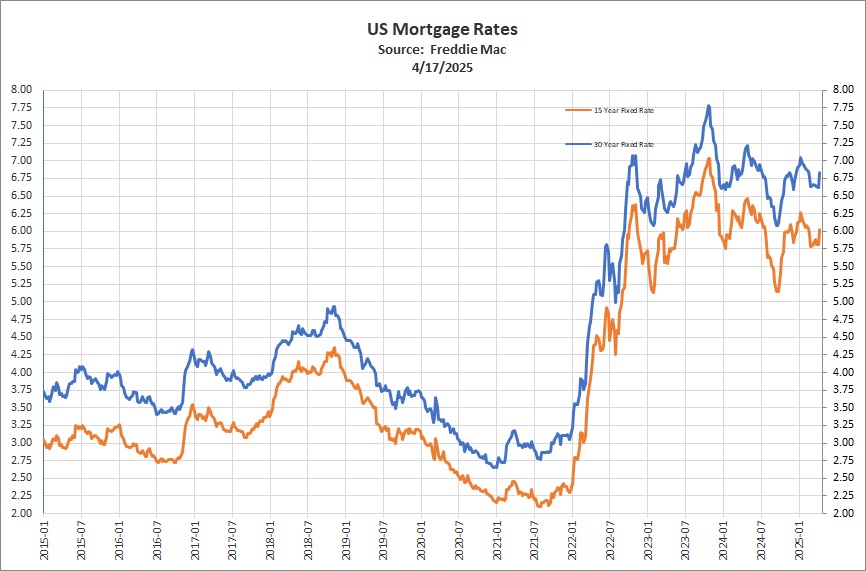
“Late last week, mortgage rates dropped, driving the weekly average down to its lowest level in more than three years,” said Sam Khater, Freddie Mac’s Chief Economist. “The impacts are noticeable, as weekly purchase applications and refinance activity have jumped, underscoring the benefits for both buyers and current owners. It’s clear that housing activity is improving and poised for a solid spring sales season.”
The 30-year FRM averaged 6.06% as of January 15, 2026, down from last week when it averaged 6.16%. A year ago at this time, the 30-year FRM averaged 7.04%.
The 15-year FRM averaged 5.38%, down from last week when it averaged 5.46%. A year ago at this time, the 15-year FRM averaged 6.27%.
Selected Cryptocurrencies
| Symbol | Name | Price | 24h % | 7d % | Market Cap | Volume(24h) |
| BTC | Bitcoin | $92,879.97 | -2.44% | 2.67% | $1,855,549,961,128 | $38,335,667,552 |
| ETH | Ethereum | $3,210.93 | -3.84% | 4.08% | $387,542,268,312 | $28,677,094,537 |
| BNB | BNB | $925.02 | -2.34% | 3.27% | $126,138,010,461 | $3,108,351,252 |
| XRP | XRP | $1.97 | -3.84% | -3.74% | $120,289,750,262 | $3,840,941,930 |
| SOL | Solana | $133.57 | -6.22% | -4.09% | $75,549,058,211 | $5,413,951,695 |
| TRX | TRON | $0.31 | -1.62% | 4.97% | $29,566,886,732 | $758,793,752 |
| DOGE | Dogecoin | $0.13 | -6.49% | -5.12% | $21,679,798,022 | $2,005,747,979 |
| ADA | Cardano | $0.37 | -6.08% | -3.95% | $13,294,165,936 | $1,035,909,833 |
| BCH | Bitcoin Cash | $590.08 | -0.14% | -4.55% | $11,791,523,194 | $486,796,564 |
| XMR | Monero | $625.38 | 5.97% | 10.10% | $11,536,325,242 | $354,724,006 |
| LINK | Chainlink | $12.84 | -6.93% | -1.26% | $9,094,358,382 | $621,754,111 |
| LEO | UNUS SED LEO | $8.91 | -1.79% | -1.20% | $8,218,393,756 | $2,879,599 |
| HYPE | Hyperliquid | $23.69 | -8.46% | 1.37% | $7,158,799,746 | $231,062,714 |
| XLM | Stellar | $0.22 | -4.49% | -1.13% | $6,986,254,130 | $236,348,205 |
| USDe | Ethena USDe | $1.00 | -0.03% | 0.05% | $6,469,068,743 | $317,164,849 |
| ZEC | Zcash | $377.26 | -4.19% | -5.04% | $6,222,511,008 | $590,877,883 |
| SUI | Sui | $1.55 | -12.75% | -11.80% | $5,880,579,575 | $1,243,850,439 |
| AVAX | Avalanche | $12.73 | -6.29% | -5.48% | $5,488,971,179 | $448,174,055 |
Information current as of 6:35 AM PST, Monday, January 19, 2026. Source: https://coinmarketcap.com
Check us out at https://beaconrwa.com. We recently updated our affiliated website at https://reverse-mortgages.us. If you know someone age 62 or over who is feeling stressed financially and considering a reverse mortgage please send them to this site. An excellent piece with general information about reverse mortgages is available at: https://beaconrwa.com/reversemortgageguidebrwa/
Sources: Ryan Long, CFA, FocusPoint Solutions, American Association for Individual Investors (AAII), Associated Press, Barclays Capital, Bloomberg, Citigroup, Deutsche Bank, FactSet, Financial Times, Goldman Sachs, JPMorgan Asset Management,
MarketfieldAsset Management, Morgan Stanley, MSCI, Morningstar, Northern Trust, Oppenheimer Funds, PIMCO, Standard & Poor’s, StockCharts.com, The Conference Board, Thomson Reuters, T. Rowe Price, U.S. Bureau of Economic Analysis, U.S. Federal Reserve, Wall Street Journal, The Washington Post. Index performance is shown as total return, which includes dividends, with the exception of MSCI-EM, which is quoted as price return/excluding dividends. Performance for the MSCI-EAFE and MSCI-EM indexes is quoted in U.S. Dollar investor terms.
The information above has been obtained from sources considered reliable, but no representation is made as to its completeness, accuracy or timeliness. All information and opinions expressed are subject to change without notice. Information provided in this report is not intended to be, and should not be construed as, investment, legal or tax advice; and does not constitute an offer, or a solicitation of any offer, to buy or sell any security, investment or other product. FocusPoint Solutions, Inc. is a registered investment advisor.
Notes key: (+) positive/encouraging development, (0) neutral/inconclusive/no net effect, (-) negative/discouraging development.