
Your Weekly Update for Monday, January 12, 2026.
Beacon Rock Wealth Advisors is a dba of BR Capital, Inc. It is a financial planning and registered investment advisory firm in Camas, Washington. We are always available to answer your questions. Give us a call at (360) 735-1900 or send an email.
If you or someone you know is worried about retirement, send us an email or give us a call for a no-obligation Retirement and Social Security Analysis.
If this information is helpful to you, please forward this to a friend and ask them to subscribe at https://newsletters.beaconrwa.com/subscribe.
Have a great week!
Mike Elerath
CERTIFIED FINANCIAL PLANNERTM
CERTIFIED IN LONG-TERM CARE
Mike.Elerath@beaconrwa.com
Bill Roller
NMLS #107972
CHARTERED FINANCIAL ANALYST
CERTIFIED FINANCIAL PLANNERTM
CHARTERED MARKET TECHNICIAN
bill.roller@beaconrwa.com
For more information about Beacon Rock Wealth Advisors, check out our brochure here: https://beaconrwa.com/beaconrockbrochure/
Click on the image below to go https://youtu.be/LYGVXjka9R4 to see the video from January 9 in which Mike Elerath and Bill Roller discuss the financial markets.

Please give the video a “Like” and check out our other videos and subscribe to the channel at https://www.youtube.com/@beaconrwa.
Summary
Markets were UP last week. The Dow Jones Industrial Average was UP 2.32% to 49,504.07 while the S&P500 ended UP 1.57% TO 6,966.28. The Nasdaq Composite ROSE 1.88% to 23,671.37. The annual yield on the 30-year Treasury FELL 4.5 basis point(s) to 4.819%.
Economic data included improvements in ISM services, mixed results for housing starts and the December employment situation report. On the more lackluster side, ISM manufacturing and JOLTs job openings declined.
Equities gained globally last week as the New Year started with optimism and a lack of bad news. Bonds were higher in the U.S. and mixed abroad. Commodities gained in every segment last week, with oil markets in focus after the regime change in Venezuela.
Economic Notes
(0/-) The ISM manufacturing index fell by -0.3 of a point to 47.9 in December, below an expected improvement to 48.4. The overall index has been in contraction for 10 straight months, with the Dec. being a 13-month low, with only 11% of industries reporting expansion (those related to electronics and computers, in keeping with the data infrastructure buildout theme). Under the hood, new orders rose by a fraction of a point, as did employment, but both remained in contractionary territory. Production fell by a half-point as well, to a just-expansionary 51 reading. Prices paid were flat at just over 58, still solidly expansionary, while inventories fell by -4 points to 45, implying some runoff in existing materials. Tariffs were mentioned about ten times in the press release, which was largely on par with the prior month, and respondents noting that “component costs are increasing” due to tariffs, and, perhaps even more importantly, the “lost revenue” has held back companies’ ability to “offer bonuses” and “create and hire for new positions,” which alludes to the carryover from such policies into labor markets.
(+) The ISM services/non-manufacturing index for December rose by 1.8 points to 54.4, above expectations of a slight drop to 52.2, and pointing to solid expansion. With roughly two-thirds of industries in expansion, December overall was a high point for 2025, with most of the year being in expansion. Within the details of the report, business activity, new orders and employment all saw gains of several points in expansion. Prices paid fell by about a point to 64, remaining elevated but a low point for recent months. The ISM press release used descriptions such as “healthy” and “high business activity” during the holiday season, which was offset by “continuing uncertainty and apprehension” about tariff policy and potential inflation impacts. Tariffs have been mentioned steadily less as time goes on, which could be taken as a positive, and certainly less so than in the manufacturing survey, where tariffs on goods represent a more direct problem.
(0) Housing starts for September/October fell by -1.7% to a seasonally-adjusted annualized rate of 1.246 mil. units, below expectations of 1.330 mil., but a less severe change than the -9% drop in Aug., the last reading. While single-family starts rose by just under a half-percent, multi-family pulled it down by falling over -4%. Regionally, starts in the Northeast (29%) led, while those in the West (-10%) lagged the most. Housing starts have declined -8% over the past year. Building permits, on the other hand, rose 3.1% for the two months to a level of 1.412 mil., above forecasts for 1.350 mil. Here, multi-family rose 7%, while single-family gained 1%. Homebuilding continues to underperform relative to U.S. needs, from the levels of demographics (with offsetting impacts from recent immigration changes), scrappage, and affordability, particularly in certain regions negatively affected by zoning rules. Completing existing projects appears to be a priority as opposed to beginning new projects.
(-) Initial jobless claims for the Jan. 3 ending week rose by 8k to 208k, below the 212k median forecast, and were mixed by state, with few large outliers. Continuing claims for the Dec. 27 week rose by 56k to 1.914 mil., just above the 1.900 mil. level expected, and reversing a similarly-sized drop the prior week. As has been the case in recent weeks, claims have been affected by seasonality effects and adjustment challenges, which should dissipate in coming weeks.
(+) The preliminary Univ. of Michigan index of consumer confidence for January rose by 2.1% to 54.0, above the 53.5 expected, and back up from an all-time low for the survey in December. That was led by a 4% increase in the assessments of current conditions, while future expectations rose 1%. Inflation expectations for the coming 1 year were unchanged at 4.3%, while those for the next 5 years rose by 0.2% to 3.4%. It was noted by the sponsor that consumer focus continued to be on “high prices” and “softening labor markets,” although worries about tariffs seem to be “gradually receding,” seeing some “modest improvement in the economy over the past two months.” At the same time, they “remain guarded” about the conditions of “business conditions and labor markets.”
(-) The JOLTS report for November showed a decrease of -303k job openings to 7.146 mil., well below the median forecast calling for an increase to 7.648 mil. Openings were strongest in retail (121k) and construction (90k), which were offset by declines in food/lodging (-148k) and transportation (-108k). The job opening rate fell by -0.2% to 4.3%, as did the hiring rate to 3.2%. On the departure side, the layoff rate fell by a tenth to 1.1%, while the quits rate ticked up by a tenth to 2.0%.
(0) The ADP employment report for December saw a rise of 41k, below the 50k expected, but stronger than the -29k decline of the prior month. Services jobs rose by 44k on net, which included gains in education/health services (39k) and leisure/hospitality (24k), offset by a decline in professional/business services (-29k). Goods-producing jobs fell by -3k, all of which was in manufacturing.
(0/-) The employment situation report for December was decent to uneventful, eliciting neither a positive nor negative response, although offset by prior month revisions. As a whole, 2025 marked the worst year of job growth in five years, although the added chances of Fed rate cuts due to labor weakness and lack of catastrophic layoff announcements have seemed to keep sentiment stable. Nonfarm payrolls gained 50k, below the 70k gain expected, and led by leisure/hospitality (47k), health care (21k), social assistance (17k), and local government (18k). On the downside, retail jobs fell (-25k), as did construction (-11k), and professional/business services (-9k). There was little change on net elsewhere, including federal government employment, which fell -9% for the year as a whole (at the largest pace in over 30 years). However, November jobs were revised down by -8k to 56k, and October more substantially by -68k to -173k, which were convoluted a bit it appeared by seasonal factors and likely residual normalization from the government shutdown to some degree, as well as a drop in the size of the labor force. The U-3 unemployment rate fell a tenth from a revised 4.5% back to 4.4%, while the U-6 underemployment rate fell from 8.7% to 8.4%, although the counts have been skewed by the government shutdown period. The ‘Sahm rule,’ a recession indicator based on the rate of change in the unemployment rate, hasn’t triggered, so remains tilted to ‘no recession’ as opposed to recession at this point. Average hourly earnings rose by 0.3%, and 3.8% over the last 12 months. The average workweek length ticked down by -0.1 to 34.2 hours,
(+) In an earlier report, the preliminary measure of nonfarm productivity for Q3 came in at a pace of 4.9% on a quarter-over-quarter annualized basis, up from a 4.1% rate the prior quarter. The year-over-year measure reaccelerated by 0.4% to 1.9%. Notably, this was over twice the pace of the average productivity growth of 2.0% since just before the pandemic (Q4-2019). Unit labor costs declined by an annualized rate of -1.9% in Q3, well below the forecast of a -0.1% decline, but a less severe drop than the -2.9% of the prior quarter. Over the past year, labor costs decelerated by -0.8% to a gain of 1.2%.
Question of the Week: How should investors interpret the Venezuela news?
The arrest of Pres. Nicolas Maduro over the prior weekend was shocking to many, although the groundwork had been laid for months, with effectively a naval blockade of the country and selected targeting of suspected drug boats. The U.S. bounty on Maduro had reached $50 mil., based on U.S. narco-terrorism and related charges, and represented clearly a high and rising priority of the administration.
Background. The administration’s spin was carefully not postured as an ‘invasion,’ which could have brought even more scrutiny about potential interference with national sovereignty, presidential vs. congressional legal authority, and political pushback in the U.S. around possible financial cost and duration of any military occupation, if it came to that. This is particularly sensitive around the world in light of the Russian invasion of Ukraine, and long-term concerns of a Chinese takeover of Taiwan. It is also regionally sensitive based on the involvement of the U.S. in a variety of Central and South American activities for two centuries, including several in the 1980s under President Reagan, and movement away from the U.S. wanting to be viewed as an overbearing colonial force. Instead, it was described as a targeted ‘law enforcement’ operation, in bringing Maduro to New York to face U.S. courts. Military damage was limited to communications, air defense, a U.S. cyberattack on parts of the Venezuelan power grid, and Maduro’s Cuban-led personal protection force. Importantly, oil facilities and other infrastructure were not disturbed, in keeping with objectives of U.S. involvement in ultimately getting production back up to a functional level. Not losing the ‘hearts and minds’ of the Venezuelan population (and sizable diaspora abroad) appeared to be an important factor as well.
Geopolitical backdrop. This was seen by some as a bit of a return to the U.S. ‘Monroe Doctrine,’ a policy first crafted in the 1820s that warned the world about further colonization, expansion, or interference in the Americas. In the modern era, the policy has implied that, from a superpower standpoint, everything in the Western hemisphere should be under the influence of the U.S. only. From early on, that policy was designed to keep outside powers away from the U.S. doorstep. Those included Europe in the 19th century, the Soviet Union in the 20th century, and now specifically China and Russia, as well as their proxies, which includes Cuba. Maduro was the 2013 successor to Hugo Chavez, who had run the country as President since 1999 and attempted a variety of socialist reforms, including a re-nationalization of oil company assets (and confiscation of some U.S. energy property, with another objective being financial payback for this).
Natural resources (mostly oil). This is especially important in a world where natural resources are again top of mind, with Venezuela’s massive oil reserves (around 300 billion barrels, thought to be among the largest in the world, at just under 20% of total global estimated reserves), as well as rare earth minerals, which could provide the U.S. supply diversification away from China. The oil issue is a big one, especially for Venezuelans, where it represents one of their most important national assets. Venezuela has sold oil to China, as well as illicitly to non-U.S. ally nations—so the Maduro ouster has shifted leverage toward the U.S. A sticking point is that Venezuelan crude oil is ‘heavy,’ with thicker viscosity and higher sulfur content, so it’s more costly and time-consuming to refine, explaining why it’s priced at a discount to higher-quality oil grades. Refineries on the U.S. Gulf Coast are equipped to handle that type of crude, and the administration has already been in talks with U.S. energy companies on public-private partnerships. Venezuelan facilities have suffered from underinvestment and misallocation, with current production at only 1% of total global output, so modernization is likely a multi-year process, but a lot of potential upside.
Current oil environment. This also comes at a time when global oil markets appear oversupplied going into 2026, which led to a -20% drop in per barrel market prices during 2025. Lower oil prices in general tend to be positive for economic growth (except for massive oil exporters), since it lowers industrial and transportation input costs, especially in contrast to the headwind created by high prices seen at various times in history. While more oil isn’t needed at this moment, supply assets being brought online in the next several years are assumed to help improve the flex factor if/when those barrels could come in handy to bring prices down.
Sovereign bonds. Venezuela is considered at the edge of the emerging/frontier market universe, with prior exposure in EM bond indexes years ago in the 0.5-1.0% range, but sanctions have effectively dropped the country from the mainstream index, due to low liquidity for this debt. However, the bonds remain popular with hedge funds and other speculators, due to their very high yields and hopes for an eventual upgrade, which could boost prices. The elevated current yields are driven by a history of credit weakness (likw a $60 bil. default in 2017), and weak internal controls, but bond prices did rise 10 points (30%) immediately upon news of Maduro’s capture, upon higher likelihood of a debt restructuring and perhaps some recovery of nearly a decade of owed interest. Improvement in economic and political stability (i.e., getting paid back) also raises odds of an improved borrowing environment and lower interest rates/higher bond prices, which is a goal of most governments.
Non-economic impact. The removal of a highly unpopular authoritarian leader raises hopes for change toward a freer democracy there, which is also aligned with traditional U.S. policy towards such things (particularly in the region during the 1980s, and struggles against socialist/communist influences). The Maduro regime was assumed to support and have active dealings with a variety of foreign terrorist organizations, as well as drug cartels in Latin America. A fall in economic relevance since the 1970s created a hyperinflationary environment and economic instability, which could be improved under new leadership. While in the news frequently for geopolitical reasons, Venezuelan GDP as a percentage of world GDP has fallen from around 1% in the 1970s to 0.1% today. The economic difficulties have led to a strong outflow of migrants from Venezuela (including to the U.S.) in recent years, which could slow upon domestic conditions improving. For now, the current vice president, Delcy Rodriguez, has taken over, but U.S. diplomatic involvement to prevent a power grab by military officials or criminal groups is likely ongoing, but represents a risk to near-term stability. There are opposition leaders in exile as well, claiming seats at the table, with the hoped-for outcome being a fair democratic election at some point.
Perhaps as much as anything, the big picture view of the removal of one negative is why financial markets cheered as opposed to fretted, but this was certainly not a market-shaking event. Though it could be meaningful as a longer-term factor in the Western hemisphere’s geopolitical and economic backdrop.
Market Notes
| Period ending 1/9/2026 | 1 Week % | YTD % |
| DJIA | 2.34 | 3.03 |
| S&P 500 | 1.58 | 1.80 |
| NASDAQ | 1.88 | 1.86 |
| Russell 2000 | 4.63 | 5.75 |
| MSCI-EAFE | 1.42 | 2.03 |
| MSCI-EM | 1.61 | 3.44 |
| Bloomberg U.S. Aggregate | 0.35 | 0.15 |
| U.S. Treasury Yields | 3 Mo. | 2 Yr. | 5 Yr. | 10 Yr. | 30 Yr. |
| 12/31/2025 | 3.67 | 3.47 | 3.73 | 4.18 | 4.84 |
| 1/2/2026 | 3.65 | 3.47 | 3.74 | 4.19 | 4.86 |
| 1/9/2026 | 3.62 | 3.54 | 3.75 | 4.18 | 4.82 |
U.S. stocks started the first trading week of the year positively, led by a rally in economically-sensitive small cap names. Economic data was mixed, but perhaps not strong enough to push off several expected Fed interest rate cuts in 2026. By sector, gains of 4-6% in consumer discretionary (Amazon and Home Depot, among others) and materials led for the week, while utilities fell by over a percent. Real estate was up slightly.
In real estate, the big news was an announcement that the U.S. administration would seek to block further institutional ownership of single-family homes. While they still only own a small fraction of such homes, institutional buying of home rentals (like in private equity funds) is a populist political issue in a period of low inventories and high unaffordability. Players in that space, such as Blackstone, fared poorly in the wake of the news, despite little detail so far. With mid-term elections on the horizon, policies to help the key affordability issue could come at a greater clip, but there aren’t often quick and easy solutions to those problems.
Foreign stock returns were largely in line with those of U.S. large caps last week, despite the headwind of the U.S. dollar gaining nearly a percent. Japanese stocks gained over 2%, beating both Europe and emerging markets. European stocks saw some improvement in economic data, pointing to a potential turnaround. In EM, returns were mixed with strong gains in South Korea and Turkey, while India pulled back.
Bonds saw gains across the board, although rate changes were mixed across the U.S. Treasury yield curve, although higher base yields now provide a stronger positive starting point to returns generally. High yield outperformed investment-grade corporates and Treasuries slightly. Foreign bonds were mixed, and dependent on exposure to the stronger dollar last week.
Commodities fared positively for the week, led by continued gains in precious metals and industrial metals, as well as energy and agriculture. Crude oil rose 3% last week to $59/barrel, with some concern over intensifying protests in Iran towards the current regime, with the removal of Pres. Maduro in Venezuela barely moving the needle.
Mortgage Rates
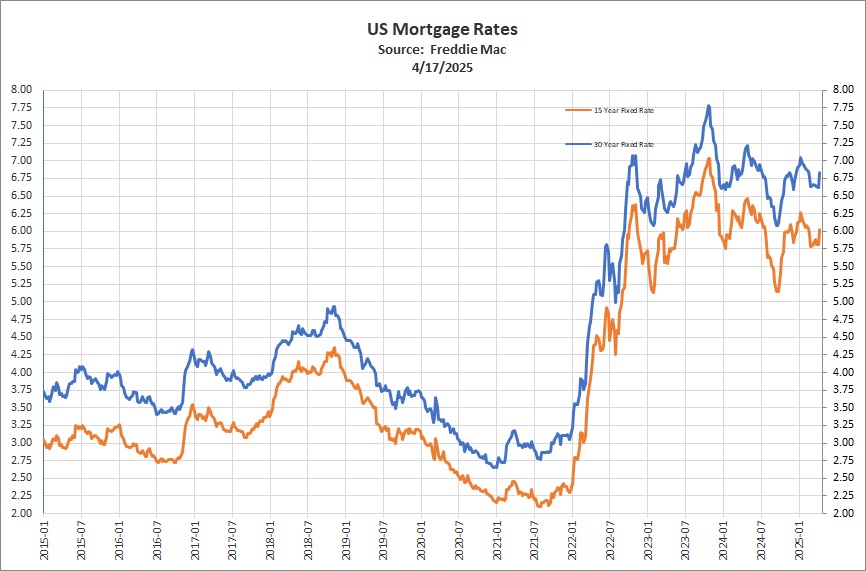
“In the first full week of the new year, mortgage rates remained within a narrow range, hovering close to the 6% mark,” said Sam Khater, Freddie Mac’s Chief Economist. “The combination of solid economic growth and lower rates has led to improving momentum in for-sale residential demand, with purchase applications up over 20% from a year ago.”
The 30-year FRM averaged 6.16% as of January 8, 2026, up slightly from last week when it averaged 6.15%. A year ago at this time, the 30-year FRM averaged 6.93%.
The 15-year FRM averaged 5.46%, up from last week when it averaged 5.44%. A year ago at this time, the 15-year FRM averaged 6.14%.
Selected Cryptocurrencies
| Symbol | Name | Price | 24h % | 7d % | Market Cap | Volume(24h) |
| BTC | Bitcoin | $90,542.76 | -0.28% | -2.37% | $1,808,492,526,746 | $31,604,025,941 |
| ETH | Ethereum | $3,105.71 | -0.05% | -1.59% | $374,843,512,325 | $17,422,840,006 |
| XRP | XRP | $2.04 | -2.39% | -3.49% | $124,284,341,958 | $3,301,257,823 |
| BNB | BNB | $899.12 | -1.46% | -0.49% | $123,839,527,187 | $2,008,369,691 |
| SOL | Solana | $139.50 | 1.80% | 3.92% | $78,763,714,248 | $5,563,938,683 |
| TRX | TRON | $0.30 | -0.41% | 1.68% | $28,155,608,942 | $508,598,155 |
| DOGE | Dogecoin | $0.14 | -3.14% | -7.75% | $22,883,048,729 | $1,295,244,634 |
| ADA | Cardano | $0.38 | -2.69% | -4.30% | $13,791,800,798 | $561,852,082 |
| BCH | Bitcoin Cash | $624.26 | -4.14% | -3.95% | $12,472,759,312 | $747,116,664 |
| XMR | Monero | $569.70 | 14.77% | 32.62% | $10,509,281,783 | $398,221,191 |
| LINK | Chainlink | $13.10 | -0.86% | -2.72% | $9,277,689,367 | $366,850,684 |
| LEO | UNUS SED LEO | $9.01 | -0.38% | -0.26% | $8,313,636,910 | $1,223,621 |
| HYPE | Hyperliquid | $23.77 | -3.19% | -8.44% | $8,066,485,393 | $162,555,529 |
| XLM | Stellar | $0.22 | -4.23% | -5.76% | $7,069,531,230 | $155,498,190 |
| SUI | Sui | $1.77 | -2.35% | 5.61% | $6,734,840,838 | $704,988,876 |
| ZEC | Zcash | $401.21 | 1.46% | -18.62% | $6,613,114,707 | $664,989,136 |
| USDe | Ethena USDe | $1.00 | -0.01% | 0.00% | $6,374,843,600 | $78,721,160 |
| AVAX | Avalanche | $13.58 | -1.72% | -3.78% | $5,845,639,972 | $404,196,228 |
Information current as of 5:35 AM PST, Monday, January 12, 2026. Source: https://coinmarketcap.com
Check us out at https://beaconrwa.com. We recently updated our affiliated website at https://reverse-mortgages.us. If you know someone age 62 or over who is feeling stressed financially and considering a reverse mortgage please send them to this site. An excellent piece with general information about reverse mortgages is available at: https://beaconrwa.com/reversemortgageguidebrwa/
Sources: Ryan Long, CFA, FocusPoint Solutions, American Association for Individual Investors (AAII), Associated Press, Barclays Capital, Bloomberg, Citigroup, Deutsche Bank, FactSet, Financial Times, Goldman Sachs, JPMorgan Asset Management,
MarketfieldAsset Management, Morgan Stanley, MSCI, Morningstar, Northern Trust, Oppenheimer Funds, PIMCO, Standard & Poor’s, StockCharts.com, The Conference Board, Thomson Reuters, T. Rowe Price, U.S. Bureau of Economic Analysis, U.S. Federal Reserve, Wall Street Journal, The Washington Post. Index performance is shown as total return, which includes dividends, with the exception of MSCI-EM, which is quoted as price return/excluding dividends. Performance for the MSCI-EAFE and MSCI-EM indexes is quoted in U.S. Dollar investor terms.
The information above has been obtained from sources considered reliable, but no representation is made as to its completeness, accuracy or timeliness. All information and opinions expressed are subject to change without notice. Information provided in this report is not intended to be, and should not be construed as, investment, legal or tax advice; and does not constitute an offer, or a solicitation of any offer, to buy or sell any security, investment or other product. FocusPoint Solutions, Inc. is a registered investment advisor.
Notes key: (+) positive/encouraging development, (0) neutral/inconclusive/no net effect, (-) negative/discouraging development.