
Your Weekly Update for Monday, January 26, 2026.
Beacon Rock Wealth Advisors is a dba of BR Capital, Inc. It is a financial planning and registered investment advisory firm in Camas, Washington. We are always available to answer your questions. Give us a call at (360) 735-1900 or send an email.
If you or someone you know is worried about retirement, send us an email or give us a call for a no-obligation Retirement and Social Security Analysis.
If this information is helpful to you, please forward this to a friend and ask them to subscribe at https://newsletters.beaconrwa.com/subscribe.
Have a great week!
Bill Roller
NMLS #107972
CHARTERED FINANCIAL ANALYST
CERTIFIED FINANCIAL PLANNERTM
CHARTERED MARKET TECHNICIAN
bill.roller@beaconrwa.com
For more information about Beacon Rock Wealth Advisors, check out our brochure here: https://beaconrwa.com/beaconrockbrochure/
To all the friends of Beacon Rock Wealth Advisors: I’m very sorry to inform you that Mike Elerath passed away on Monday, January 19, 2026. He was a great friend and we will miss him. We send heartfelt condolences to his friends and family.
Click on the image below to go https://youtu.be/0KQeGsXh3wg to see the video from January 16 in which Mike Elerath and Bill Roller discuss the financial markets.

Please give the video a “Like” and check out our other videos and subscribe to the channel at https://www.youtube.com/@beaconrwa.
Summary
Markets were SLIGHTLY DOWN last week. The Dow Jones Industrial Average was DOWN 0.53% to 49,098.70 while the S&P500 ended DOWN 0.35% TO 6,915.61. The Nasdaq Composite FELL 0.06% to 23,501.24. The annual yield on the 30-year Treasury FELL 0.7 basis point(s) to 4.833%.
On a holiday-shortened week, economic data included an upward revision for 3rd quarter U.S. GDP, gains in personal income and spending, expansionary showings for S&P manufacturing and services, and some improvement in consumer sentiment.
Equities were mixed globally, with slight declines in the U.S. offset by gains internationally, with help from a weaker U.S. dollar. Bonds were little-changed along with minimal change in yields. Commodities gained broadly, mostly in precious metals and especially natural gas, for weather-related reasons.
Economic Notes
(+) In the third and final release, U.S. 3rd quarter GDP was revised up a tenth to 4.4%. This largely was driven by a revision upward for exports growth (to nearly 10%), as well as business fixed investment growth (about a half-percent to 3.2%, most of which was in structures), while consumer spending was unchanged at 3.5%, as was government spending at 2.2%. Unfortunately, housing investment growth was revised down another -2% to 7.1%. The GDP deflator changed minimally at a strong 3.77% annualized rate, 2.71% on a Q4-to-Q4 basis, and year-over-year to 2.98%.
The Atlanta Fed’s GDPNow measure for Q4 pointed to growth of 5.4%, as of last week, having popped up from the initial 3%-ish figure in early January. Consumer spending was responsible for 2.1% of this, which tends to be the most durable growth driver, although the spikes in net exports (1.9%) and inventories (0.9%) provided significant additions (although they also tend to be the most sporadic quarter-to-quarter as the segments tend to self-correct over time).
(0) In another combined ‘catch-up’ report, personal income rose 0.1% for October and 0.3% in November. Personal spending rose by 0.5% each for Oct. and Nov. The personal saving rate came in at 3.7% and 3.5%, respectively, for the two months. Year-over-year, personal income and spending were up 4% and 5%, respectively. Headline PCE inflation rose by a rounded 0.2% in each month, as did core PCE ex-food and energy. On a year-over-year basis, headline and core PCE each rose 2.7% ending in October, and each were up 2.8% for the year ending in November. Over the past 12 months, services inflation continued to lead, up 3.4% through Nov., while goods inflation only rose 1.4%.
(+) The preliminary S&P Global U.S. manufacturing PMI ticked up by 0.1 of a point to 51.9 for January, just under the 52.0 expected. The composition was mixed, with output rising a point, further into expansion, and new orders up 2 points, back into expansion. However, employment fell by a point, but also stayed in expansion. Input and output prices expanded further into expansion around the 60 level, which shows continued inflation pressures in materials, some of which are no doubt tied to strong gains in metals prices. The future output index rose nearly 2 points to a very strong 70 level.
(0/+) The preliminary S&P Global U.S. services PMI for January was unchanged at 52.5, just short of the 52.9 that was expected by consensus. Under the hood, new business rose a point, further into expansion at 52, as did employment. Input and output prices both fell by up to several points, although each remained in the expansionary upper 50’s range. The future output index fell by -0.5 of a point to 63.0, which is still quite strong.
S&P’s commentary was optimistic, noting that “flash PMI brought news of sustained economic growth at the start of the year,” however, there remain “further signs that the rate of expansion has cooled” over year end compared to a faster pace of last fall. Also, the growth in jobs was described as “already disappointing,” as “businesses worry about taking on more staff” in a period of “uncertainty, weak demand and high costs.”
(0) A combined and somewhat stale construction spending report showed conditions largely offsetting, with a -0.6% drop in September being offset by a 0.5% increase in October. For the latter, private residential spending rose over a percent, while private non-residential fell in both months. Public non-residential spending rose a bit, while public residential fell by nearly -2% for the combined period. Construction costs fell by about a half-percent in both months, taking ‘real’ spending growth to flat for September and a gain of nearly a percent in October.
(x) The final Univ. of Michigan index of consumer sentiment for January showed a 6.6% increase over the prior month to 56.4, above consensus calling for 54.0. This included a 10% rise in current economic conditions, and a 4% rise in future expectations. Gains were seen broadly across all groups, by age, income level, and political party, it appeared. Over the past year, the overall index remains down -21%, most of which was due to weakness in the assessments of current conditions, with consumers reporting “pressures on their purchasing power stemming from high prices and the prospect of weakening labor markets,” although foreign developments do not appear to be weighing on them. Inflation expectations for the next year fell by -0.2% to 4.0%, while those for next 5 years ticked up a tenth again to 3.3%. Both are still high, but well down from the peaks earlier in the year.
(+) Initial jobless claims for the Jan. 17 ending week ticked up by 1k to 200k, below the 209k expected. Continuing claims for the Jan. 10 week fell by -26k to 1.849 mil., well under the 1.890 mil. expected. Claims were again mixed by state, but minimal, showing a lack of negative layoff activity and likely continued adjustment back to normal from year-end seasonality adjustments.
Market Notes
| Period ending 1/23/2026 | 1 Week % | YTD % |
| DJIA | -0.50 | 2.23 |
| S&P 500 | -0.34 | 1.10 |
| NASDAQ | -0.06 | 1.13 |
| Russell 2000 | -0.32 | 7.58 |
| MSCI-EAFE | 0.14 | 3.60 |
| MSCI-EM | 1.09 | 6.93 |
| Bloomberg U.S. Aggregate | 0.07 | 0.08 |
| U.S. Treasury Yields | 3 Mo. | 2 Yr. | 5 Yr. | 10 Yr. | 30 Yr. |
| 12/31/2025 | 3.67 | 3.47 | 3.73 | 4.18 | 4.84 |
| 1/16/2026 | 3.67 | 3.59 | 3.82 | 4.24 | 4.83 |
| 1/23/2026 | 3.70 | 3.60 | 3.84 | 4.24 | 4.82 |
U.S. stocks fell back last week, largely due to the inability to fully recover from being down -2% early Tuesday, which represented the worst single day decline in several months. The focus was on the intensification of U.S. ambitions towards Greenland, with an initial announcement of a 10% tariff on imports from eight European countries (Denmark, Norway, Sweden, France, Germany, U.K., the Netherlands, and Finland) effective Feb 1, with an added 200% tax on French wine (which tends to be symbolic), coming after French president Macro rejected a seat on the ‘Board of Peace,’ created at the Davos World Economic Forum last week. How these would affect already-existing tariffs was less clear to markets. But, as with several other tariffs, they were viewed as bargaining chips as opposed to being set in stone. That appeared to indeed be the case by Wed., when a low-probability military invasion threat was taken off the table, along with the European tariffs, as the U.S. administration and NATO initiated the “framework of a future deal with respect to Greenland.” Decent economic data later in the week helped a bit, but didn’t make up the brunt of Tuesday’s activity.
By sector, energy and materials stocks gained roughly 3%, bookended by declines of a few percent in financials, utilities, and industrials. Real estate was also down -2%, with most sub-sectors down for the week, despite little change in yields.
S&P earnings reports continue to roll in for Q4. Per FactSet, 13% of firms have now reported, so it’s still early in the season, with the blended year-over-year growth rate remaining at 8.2%. Leadership remains focused on technology (with exceptionally strong revenue growth and profit margins from the hyperscalers in the Magnificent 7 group) and materials (due to stronger metals prices and rising demand from infrastructure, including data centers), with financials and communications also faring at above-average rates.
Foreign stocks were down in local terms, which turned into gains for the week in Europe and the U.K. thanks to a weaker U.S. dollar, while Japan declined outright along with rising yields and proposed unfunded tax cuts. European positivity was helped by decent to continued improvement in economic activity, although still at a modest pace. Emerging markets fared best of all groups for the week, led by a 10% gain in Brazil, helped by easing global trade tensions and strong commodity prices, followed by continued strength in South Korea and Taiwan (technology-oriented) and South Africa (mining).
Bonds were little-changed with minimal changes in yields on the U.S. Treasury curve. Early declines in U.S. Treasury prices/rising yields were in keeping with a drop in confidence along with the administration’s ambitions for Greenland, although those also largely recovered. A drop in the U.S. dollar of around -2% was helpful to foreign local unhedged debt, while hedged bonds were flatter. Japanese government bond yields rose sharply last week (the 10yr rising by nearly a half-percent to 2.3%, the highest level in over 26 years), and the 30yr bond having risen in yield by 3% over the past three years. The recent week’s moves were due to higher inflation breakevens and the popular new prime minister threatening to help affordability by cutting the consumption tax on food (for two years, from 8% to 0%). While politically popular, and in the same lines as other global leaders looking for ways to improve affordability, it also cuts a key revenue source and raises deficits in a country with an already high debt-to-GDP ratio. In response to recent yen weakness against the dollar over the past six months (down nearly -10%), the NY Fed has been performing ‘rate checks,’ which are considered an important verbal first step before implementing any currency intervention. Not unprecedented, but still rare.
Commodities gained across the board last week, with precious metals again leading, with geopolitical concern over Greenland certainly playing a role, followed by energy. Crude oil prices rose 3% last week to $61/barrel. However, the main story of the week was natural gas, where prices soared by over 60% in just a few days in advance of a severe winter storm expected across a substantial portion of the U.S. Midwest and East Coast, and available supply appeared to be a little short.
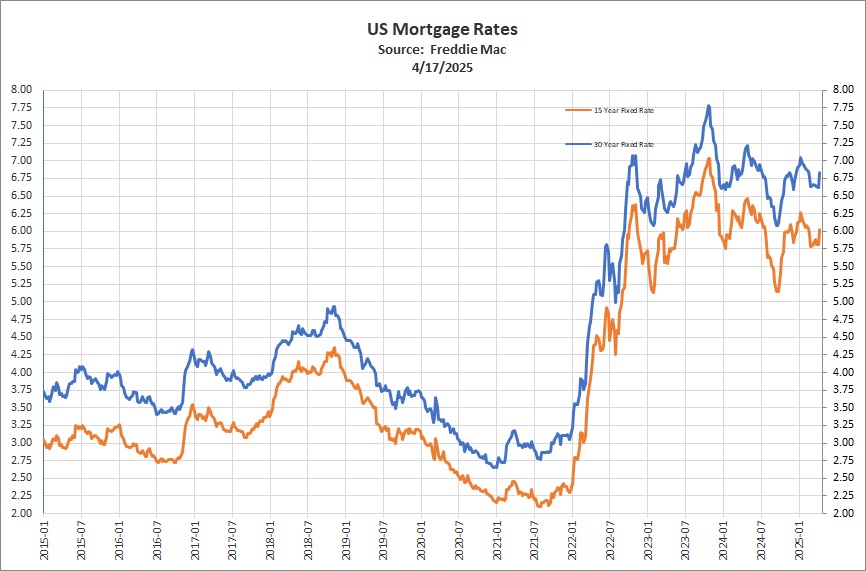
Mortgage Rates
“With the economy improving and the average 30-year fixed-rate mortgage nearly a percentage point lower than last year, more homebuyers are entering the market,” said Sam Khater, Freddie Mac’s Chief Economist. “Buyers always should shop around for the best rate, as multiple quotes can potentially save them thousands.”
The 30-year FRM averaged 6.09% as of January 22, 2026, up from last week when it averaged 6.06%. A year ago at this time, the 30-year FRM averaged 6.96%.
The 15-year FRM averaged 5.44%, up from last week when it averaged 5.38%. A year ago at this time, the 15-year FRM averaged 6.16%.
Selected Cryptocurrencies
| Symbol | Name | Price | 24h % | 7d % | Market Cap | Volume(24h) |
| BTC | Bitcoin | $87,850.96 | -0.75% | -5.60% | $1,755,325,363,778 | $47,879,653,588 |
| ETH | Ethereum | $2,907.97 | -0.95% | -9.79% | $350,976,423,337 | $31,964,552,513 |
| BNB | BNB | $872.89 | -0.68% | -5.70% | $119,027,726,094 | $2,299,712,876 |
| XRP | XRP | $1.89 | -0.08% | -3.83% | $115,484,550,601 | $3,371,407,381 |
| SOL | Solana | $122.72 | -3.09% | -8.28% | $69,454,677,143 | $6,362,908,273 |
| TRX | TRON | $0.29 | -0.72% | -6.32% | $27,933,413,105 | $553,036,758 |
| DOGE | Dogecoin | $0.12 | -1.47% | -4.85% | $20,431,758,938 | $1,351,683,414 |
| ADA | Cardano | $0.35 | -2.26% | -5.31% | $12,528,305,673 | $644,378,936 |
| BCH | Bitcoin Cash | $577.67 | -1.51% | -1.96% | $11,545,480,049 | $362,099,837 |
| XMR | Monero | $456.07 | -5.15% | -28.13% | $8,413,131,529 | $144,117,680 |
| LINK | Chainlink | $11.83 | -1.80% | -7.13% | $8,379,425,279 | $486,101,303 |
| LEO | UNUS SED LEO | $9.06 | 0.72% | 0.05% | $8,353,236,883 | $843,773 |
| HYPE | Hyperliquid | $22.29 | -1.02% | -7.28% | $6,735,867,139 | $236,009,269 |
| XLM | Stellar | $0.21 | -0.79% | -3.06% | $6,735,752,995 | $141,000,184 |
| USDe | Ethena USDe | $1.00 | 0.05% | -0.07% | $6,589,083,368 | $199,569,755 |
| ZEC | Zcash | $353.72 | -2.00% | -5.01% | $5,836,088,642 | $532,807,743 |
| CC | Canton | $0.15 | -6.08% | 32.97% | $5,597,728,934 | $17,436,013 |
| SUI | Sui | $1.43 | -2.17% | -7.25% | $5,455,005,256 | $814,024,904 |
Information current as of 6:35 AM PST, Monday, January 26, 2026. Source: https://coinmarketcap.com

We recently updated our affiliated website at https://reverse-mortgages.us. If you know someone age 62 or over who is feeling stressed financially and considering a reverse mortgage please send them to this site. An excellent piece with general information about reverse mortgages is available at: https://beaconrwa.com/reversemortgageguidebrwa/
Sources: Ryan Long, CFA, FocusPoint Solutions, American Association for Individual Investors (AAII), Associated Press, Barclays Capital, Bloomberg, Citigroup, Deutsche Bank, FactSet, Financial Times, Goldman Sachs, JPMorgan Asset Management,
MarketfieldAsset Management, Morgan Stanley, MSCI, Morningstar, Northern Trust, Oppenheimer Funds, PIMCO, Standard & Poor’s, StockCharts.com, The Conference Board, Thomson Reuters, T. Rowe Price, U.S. Bureau of Economic Analysis, U.S. Federal Reserve, Wall Street Journal, The Washington Post. Index performance is shown as total return, which includes dividends, with the exception of MSCI-EM, which is quoted as price return/excluding dividends. Performance for the MSCI-EAFE and MSCI-EM indexes is quoted in U.S. Dollar investor terms.
The information above has been obtained from sources considered reliable, but no representation is made as to its completeness, accuracy or timeliness. All information and opinions expressed are subject to change without notice. Information provided in this report is not intended to be, and should not be construed as, investment, legal or tax advice; and does not constitute an offer, or a solicitation of any offer, to buy or sell any security, investment or other product. FocusPoint Solutions, Inc. is a registered investment advisor.
Notes key: (+) positive/encouraging development, (0) neutral/inconclusive/no net effect, (-) negative/discouraging development.