
Your Weekly Update for Monday, June 8, 2026.
Beacon Rock Wealth Advisors is a dba of BR Capital, Inc. It is a financial planning and registered investment advisory firm in Camas, Washington. We are always available to answer your questions. Give us a call at (360) 735-1900 or send an email.
If you or someone you know is worried about retirement, send us an email or give us a call for a no-obligation Retirement and Social Security Analysis.
If this information is helpful to you, please forward this to a friend and ask them to subscribe at https://newsletters.beaconrwa.com/subscribe.
Have a great week!
Bill Roller
NMLS #107972
CHARTERED FINANCIAL ANALYST
CERTIFIED FINANCIAL PLANNERTM
CHARTERED MARKET TECHNICIAN
bill.roller@beaconrwa.com
Summary
Markets were DOWN last week. The Dow Jones Industrial Average was DOWN 0.32% to 50,866.78 while the S&P500 ended DOWN 2.59% to 7,383.74. The Nasdaq Composite FELL 4.68% to 25,709.43. The annual yield on the 30-year Treasury ROSE 0.6 basis point(s) to 4.999%.
Last Week
Closing Market Summary: Tech weakness, rising yields ends S&P 500 win streak at nine weeks
The stock market faced a considerable retreat Friday, with losses across the S&P 500 (-2.6%), Nasdaq Composite (-4.2%), and DJIA (-1.4%), resulting in lower weekly finishes for each index. For the S&P 500, this week’s lower finish ends an impressive win streak at nine weeks.
The major averages faced a combination of pressures today as tech stocks extended yesterday’s slide, while the Employment Situation report for May (172,000; Briefing.com consensus 96,000) beat headline expectations by a wide margin, placing upward pressure on Treasury yields amid rising expectations for a rate hike. The CME FedWatch Tool now assigns roughly a 71% probability to a rate hike at the December FOMC meeting, up from around 50% yesterday.
Growth-oriented pockets of the market generally lagged as a result, which compounded with yesterday’s selloff across semiconductor stocks. The PHLX Semiconductor Index finished 10.3% lower, weighing heavily on the information technology sector (-5.3%).
Weakness was broad across the semiconductor group, with Broadcom (AVGO 385.74, -33.17, -7.92%) extending its post-earnings skid, memory names such as Micron (MU 864.01, -131.99, -13.25%) facing double-digit retreats, and other large chipmakers, including Intel (INTC 99.17, -12.61, -11.28%) and NVIDIA (NVDA 205.11, -13.55, -6.20%), moving sharply lower.
Software stocks also lagged, with Oracle (ORCL 213.41, -22.93, -9.70%) a notable decliner ahead of its earnings report next week. The iShares GS Software ETF finished 4.2% lower.
The consumer discretionary (-2.4%) and communication services (-1.7%) sectors also lagged as their mega-cap components, including Tesla (TSLA 391.00, -27.45, -6.56%) and Meta Platforms (META 593.00, -34.57, -5.51%) faced sharp retreats of their own.
The Vanguard Mega Cap Growth ETF finished 3.7% lower, contributing to the underperformance of the market-weighted S&P 500 (-2.6%) compared to the S&P 500 Equal Weighted Index (-1.5%).
On the earnings front, lululemon athletica (LULU 114.23, -10.69, -8.56%) was a notable laggard in the consumer discretionary sector after cutting its full-year outlook.
More defensive-oriented pockets of the market did garner some rotational interest today, but it was nowhere near enough support to keep the major averages from a lower finish. The consumer staples sector (+1.6%) led the way, while the utilities (+0.8%) and health care (+0.7%) sectors also posted gains.
Elsewhere, the real estate sector (+0.7%) notched a similar gain, while the financials sector (+0.1%) finished slightly higher.
Outside of the S&P 500, the Russell 2000 (-3.5%) underperformed amid the spike in Treasury yields.
Overall, today’s selloff reflected the combination of an ongoing unwind across semiconductor stocks and a sharp repricing of Fed expectations following the stronger-than-expected employment report. Rising Treasury yields amplified pressure on growth-oriented areas of the market, while the limited rotation into defensive sectors was not nearly enough to offset the broad weakness across technology and mega-cap stocks.
U.S. Treasuries finished the week with sharp losses in most tenors, sending the 2-yr yield to a fresh closing high for the year while yields in the belly finished at two-week highs. The 2-year note yield settled up 11 basis points to 4.16% (+4 basis points this week) and the 10-year note yield settled up six basis points to 4.54% (-2 basis points this week).
- Russell 2000: +14.2% YTD
- S&P Mid Cap 400: +11.8% YTD
- Nasdaq Composite: +10.6% YTD
- S&P 500: +7.8% YTD
- DJIA: +5.8% YTD
Reviewing Friday’s data:
- May Nonfarm Payrolls 172K (Briefing.com consensus 96K); Prior was revised to 179K from 115KMay Nonfarm Private Payrolls 120K , (Briefing.com consensus 89K); Prior was revised to 177K from 123K, May Unemployment Rate 4.3% (Briefing.com consensus 4.3%); Prior 4.3%, May Average Hourly Earnings 0.3% (Briefing.com consensus 0.3%); Prior 0.2%, May Average Workweek 34.3 (Briefing.com consensus 34.3); Prior 34.3. The key takeaway from the report is that it is manna for headline writers but still lacks some important sustenance to suggest it is a marker of an economy running on a full stomach. To wit: real average hourly earnings on a year-over-year basis are down 0.4%; there were job losses in the retail trade (-1,100), information (-2,000), and financial (-22,000) industries; and the percentage of unemployed workers for 27 weeks or more increased to 27.5% from 25.3%, which we will assume speaks to the difficulty of finding a new job with comparable compensation to the prior one.
- Consumer credit increased by $20.7 billion in April (Briefing.com consensus: $17.5 billion) following a downwardly revised $22.3 billion increase (from $24.9 billion) in March. The key takeaway from the report is that revolving credit growth outpaced nonrevolving credit growth in April, suggesting households may be using short-term borrowing to offset pressure from slowing real income growth and depleted savings. If this trend persists, it could support spending in the near term but raise concerns about household balance-sheet stress later.
This Week
S&P futures vs fair value: +56.00. Nasdaq futures vs fair value: +379.00.
Equity futures point to a higher opening this morning after a tech-driven selloff on Friday that snapped a nine-week win streak for the S&P 500.
Investors are stepping in to Friday’s weakness this morning, with many of the largest chipmaker names poised for solid opening gains.
On the geopolitical front, Israel and Iran exchanged strikes over the weekend, which sent oil prices higher, but they are now retreating after Iran’s state media said Iran’s armed forces will end military operations against Israel.
There is no economic data of note on the calendar today, but this week will feature the May CPI report (Breifing.com consensus 0.5%) on Wednesday, with PPI (Briefing.com consensus 0.7%) to follow on Thursday. The inflation readings will be of particular interest given that newly minted Fed Chairman Kevin Warsh will head his first FOMC meeting later this month.
In an interview with NBC News, President Trump said he doesn’t want to have a big influence on Fed Chairman Kevin Warsh, though he added there is “no reason” to increase interest rates and says rates should be lowered.
In corporate news:
- Apple (AAPL70, +1.36, +0.4%) will introduce a new artificial intelligence strategy today, according to Bloomberg.
- Marvell Technology (MRVL11, +22.64, +8.6%) trades higher in the premarket following news it will join the S&P 500.
- NVIDIA (NVDA29, +4.19, +2.1%) CEO Jensen Huang said the recent selloff in tech is a good buying opportunity, according to Bloomberg
Reviewing overnight developments:
Equity indices in the Asia-Pacific region began the week on a broadly lower note with South Korea’s Kospi (-8.3%) deepening last week’s reversal from a record high. Japan’s Nikkei: -3.9%, Hong Kong’s Hang Seng: -1.3%, China’s Shanghai Composite: -1.7%, India’s Sensex: -1.0%, South Korea’s Kospi: -8.3%, Australia’s ASX All Ordinaries: HOLIDAY.
In news:
- There were some renewed concerns about the direction of the conflict between Iran and the U.S., reflected by a rebounding price of oil.
- China’s President Xi made a State visit to North Korea.
- Japan’s Q1 GDP was left unrevised at the headline level (0.5% qtr/qtr) while GDP Deflator was revised down to 3.2% from 3.4%.
In economic data: Japan’s Q1 GDP 0.5% qtr/qtr, as expected (last 0.3%), Q1 GDP Annualized 1.8% qtr/qtr (expected 2.1%; last 0.7%). Q1 GDP Price Index 3.2% yr/yr (expected 3.4%; last 3.4%), Q1 GDP Capital Expenditure -0.7% qtr/qtr (expected 0.3%; last 0.1%), Q1 GDP Private Consumption 0.3% qtr/qtr, as expected (last 0.1%), Q1 GDP External Demand 0.3% qtr/qtr, as expected (last 0.0%). April Current Account surplus JPY4.21 trln (expected JPY3.26 trln; last JPY3.90 trln), May Bank Lending 5.7% yr/yr (expected 5.6%; last 5.4%), and May Economy Watchers Current Index 43.6 (expected 41.9; last 40.8)
Major European indices trade on a mostly lower note while Italy’s MIB (+0.6%) outperforms, holding a modest gain. STOXX Europe 600: -0.3%, Germany’s DAX: -0.3%, U.K.’s FTSE 100: +0.1%, France’s CAC 40: UNCH, Italy’s FTSE MIB: +0.6%, Spain’s IBEX 35: +0.2%.
In news:
- Germany reported a sharper-than-expected drop in April Factory Orders (-3.8%; expected -2.2%), though the market still expects a 25-basis point rate hike from the European Central Bank on Thursday.
- Italy’s Intesa Sanpaolo offered EUR30.6 bln to purchase Monte dei Pachi di Siena, looking to form the second-largest lender in the eurozone.
In economic data:
- Eurozone’s June Sentix Investor Confidence -13.4 (expected -13.8; last -16.4)
- Germany’s April Factory Orders -3.8% m/m (expected -2.2%; last 4.5%)
Mortgage Rates
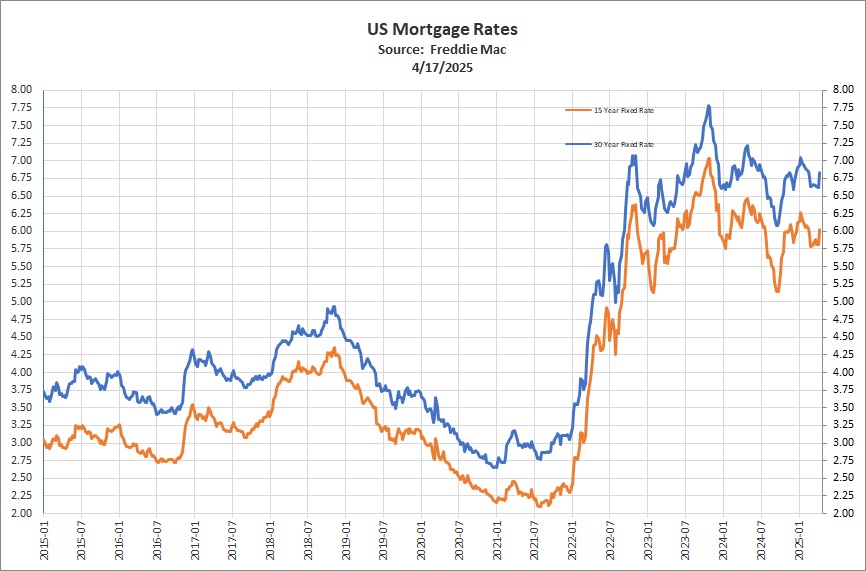
“The 30-year fixed-rate mortgage decreased to 6.48% this week,” said Sam Khater, Freddie Mac’s Chief Economist. “With mortgage rates in the mid-6% range and income growth outpacing home price growth, housing affordability is marginally improving.”
The 30-year FRM averaged 6.48% as of June 4, 2026, down from last week when it averaged 6.53%. A year ago at this time, the 30-year FRM averaged 6.85%.
The 15-year FRM averaged 5.79%, down from last week when it averaged 5.87%. A year ago at this time, the 15-year FRM averaged 5.99%.
Selected Cryptocurrencies
| Symbol | Name | Price | 24h % | 7d % | Market Cap | Volume(24h) |
| BTC | Bitcoin | $63,763.31 | 1.85% | -12.16% | $1,277,758,686,559 | $34,343,891,557 |
| ETH | Ethereum | $1,691.39 | 3.72% | -14.66% | $204,125,199,530 | $16,298,878,484 |
| BNB | BNB | $602.72 | 1.56% | -13.77% | $81,237,219,249 | $1,224,181,880 |
| XRP | XRP | $1.16 | 2.15% | -10.95% | $72,099,772,326 | $1,979,074,347 |
| SOL | Solana | $66.85 | 3.02% | -17.51% | $38,739,438,185 | $2,630,476,058 |
| TRX | TRON | $0.33 | -0.43% | -6.48% | $31,035,061,469 | $492,074,164 |
| HYPE | Hyperliquid | $62.20 | 5.27% | -15.35% | $15,785,510,807 | $781,591,455 |
| DOGE | Dogecoin | $0.09 | 2.30% | -13.49% | $13,371,056,234 | $775,917,001 |
| LEO | UNUS SED LEO | $9.54 | -0.10% | -4.46% | $8,788,334,793 | $726,647 |
| ZEC | Zcash | $436.62 | 6.57% | -20.01% | $7,295,147,166 | $1,187,150,112 |
| XLM | Stellar | $0.20 | -1.64% | -22.65% | $6,831,795,544 | $386,050,224 |
| CC | Canton | $0.16 | -7.71% | 1.23% | $6,065,501,288 | $34,390,867 |
| ADA | Cardano | $0.17 | 1.62% | -27.70% | $6,062,301,736 | $492,264,982 |
| XMR | Monero | $315.86 | 4.12% | -14.01% | $5,826,646,303 | $102,632,158 |
| LINK | Chainlink | $7.98 | 2.98% | -11.56% | $5,802,704,998 | $345,666,231 |
| TON | Toncoin | $1.73 | 1.33% | -9.82% | $4,646,493,724 | $210,961,412 |
| USD1 | World Liberty Financial USD | $1.00 | -0.06% | 0.05% | $4,605,910,214 | $1,046,245,271 |
Data as of 4:20 AM PDT, Monday, June 8, 2026. Source: https://coinmarketcap.com
If you know someone age 62 or over who is feeling stressed financially and considering a reverse mortgage please send them this excellent piece with general information about reverse mortgages at: https://beaconrwa.com/reversemortgageguidebrwa/
Sources: Bill Roller, BR Capital, Inc. dba Beacon Rock Wealth Advisors American Association for Individual Investors (AAII), Associated Press, Barclays Capital, Bloomberg, Briefing.com, Citigroup, Deutsche Bank, FactSet, Financial Times, Goldman Sachs, JPMorgan Asset Management, MarketfieldAsset Management, Morgan Stanley, MSCI, Morningstar, Northern Trust, Oppenheimer Funds, PIMCO, Standard & Poor’s, StockCharts.com, The Conference Board, Thomson Reuters, T. Rowe Price, U.S. Bureau of Economic Analysis, U.S. Federal Reserve, Wall Street Journal, The Washington Post. Index performance is shown as total return, which includes dividends, with the exception of MSCI-EM, which is quoted as price return/excluding dividends. Performance for the MSCI-EAFE and MSCI-EM indexes is quoted in U.S. Dollar investor terms.
The information above has been obtained from sources considered reliable, but no representation is made as to its completeness, accuracy or timeliness. All information and opinions expressed are subject to change without notice. Information provided in this report is not intended to be, and should not be construed as, investment, legal or tax advice; and does not constitute an offer, or a solicitation of any offer, to buy or sell any security, investment or other product BR Capital, Inc. dba Beacon Rock Wealth Advisors is a registered investment advisor.
Notes key: (+) positive/encouraging development, (0) neutral/inconclusive/no net effect, (-) negative/discouraging development.