
Your Weekly Update for Monday, October 6, 2025.
Beacon Rock Wealth Advisors is a dba of BR Capital, Inc. It is a financial planning and registered investment advisory firm in Camas, Washington. We are always available to answer your finance questions. Give us a call at (360) 735-1900 or send an email.
If you or someone you know is worried about retirement, send us an email or give us a call for a no-obligation Retirement and Social Security Analysis.
If this information is helpful to you, please forward this to a friend and ask them to subscribe at https://newsletters.beaconrwa.com/subscribe.
Have a great week!
Mike Elerath
CERTIFIED FINANCIAL PLANNERTM
CERTIFIED IN LONG-TERM CARE
Mike.Elerath@beaconrwa.com
Bill Roller
NMLS #107972
CHARTERED FINANCIAL ANALYST
CERTIFIED FINANCIAL PLANNERTM
CHARTERED MARKET TECHNICIAN
bill.roller@beaconrwa.com
For more information about Beacon Rock Wealth Advisors, check out our brochure here: https://beaconrwa.com/beaconrockbrochure/
Click on the image below to go to https://youtu.be/OEDWbE2455Y to see the video from October 3 in which Mike Elerath and Bill Roller discuss the financial markets.

Please give the video a “Like” and check out our other videos and subscribe to the channel at https://www.youtube.com/@beaconrwa.
Summary
Markets were UP last week. The Dow Jones Industrial Average was UP 1.10% to 46,758.28 while the S&P500 ended UP 1.09% TO 6,715.79. The Nasdaq Composite ROSE 1.32% to 22,780.51. The annual yield on the 30-year Treasury FELL 5.2 basis point(s) to 4.714%.
Economic data included an improvement in the ISM manufacturing report, although it stayed in contraction, while ISM services fell to neutral. Several reports weren’t published because of the Federal government shutdown, including the closely-watched employment situation report.
Equities saw gains last week globally, led by international markets over U.S. Bonds fared positively as well, as assumed plans for Federal Reserve easing and the government shutdown pulled down yields. Commodities were mixed, with strength in metals and weakness in energy.
Economic Notes
Special note: Due to the U.S. Federal government shutdown, the following reports were on hiatus: construction spending, jobless claims, and the September employment situation report (including nonfarm payrolls and the unemployment rate). With the shutdown in place for an unknown period of time, private reports and mosaics of data will be the only numbers available for economic review, which puts a limit on information to analyze.
(0) The ISM manufacturing PMI index rose by 0.4 of a point to 49.1 in September, exceeding expectations of 49.0, remaining just below the 50.0 neutral level. By industry, two-thirds reported contraction. Under the hood, the composition was mixed, with new orders falling by over -2 points back to contraction at 49, while production and employment both rose several points, although employment remained in contraction as well. Prices paid fell by -2 points, but stayed robust at 82. Trade in both directions fell, unsurprisingly, going deeper into contraction. Tariffs were still mentioned in the official release 15 times, although that’s less than the prior month, with respondents noting that their businesses continue to be negatively impacted by tariff-related costs and uncertainty around them. The final S&P Global US manufacturing PMI for Sept. was steady at 52.0, showing slight expansion in contrast to the ISM figure. New orders were revised up slightly, to just over 51, as was output to 52, with employment revised down a point to 52. These show a mixed picture, but roughly ‘neutral’ on net, neither growth nor contraction really.
(0/-) The ISM services/non-manufacturing PMI index for September came in at a neutral 50 level, neither expanding nor contracting, below the 51.7 level expected, and down -2 points from the August expansionary reading. Under the hood, new orders fell sharply, down -6, but stayed in expansion at just over 50. Business activity fell -5 points, but moved into contraction, at a tenth below 50, the first such reading in over five years. Employment ticked up by over a half-point, but remained in contraction at 47. Prices paid stayed robust, ticking up a bit and staying above a robust 69. Overall, more industries showed expansion than contraction, the gap narrowed from the prior month. This has gone along with other economic data that points to slowing in conditions. Respondents noted that they’re beginning to see impacts from tariffs on imported goods, uncertainty around tariffs continues to weigh on business activity, and areas like new residential construction are struggling, although AI- and cloud-related tech areas continue to see robust demand. The final S&P Global services PMI for Sept. was revised up by 0.3 of point to 54.2, moving further into expansion.
(-) The S&P Case-Shiller 20-city home price index for July fell by -0.1% on a seasonally-adjusted basis, and -0.3% without adjustment, with 15 of 20 cities falling in price. Year-over-year, the national index rose 1.8%, with New York’s 6%+ gain leading the way, followed by Chicago and Cleveland at 4-6%; on the negative side, prices in Tampa fell -3%, while Miami and Dallas each fell a bit over -1%. The index sponsor noted that the annual gain was one of the weakest over the past decade, and that home prices have essentially stagnated in after-inflation terms, reversing the boom years of the pandemic and with the geographic composition of positive house price areas far different than in those years, when the Sun Belt ruled, with leadership now from the Northeast and Midwest. They also acknowledged that smaller gains on an annual basis represent a “healthier trajectory” and better balance (“stability” over “sizzle” as they put it) compared to past recent years with gains of 15-20%.
(-/0) The FHFA house price index fell by -0.1% in July on a seasonally-adjusted basis, which ranged from a 0.3% in East North Central (Great Lakes states) and -1.2% in Middle Atlantic (NY/PA/NJ). Over the trailing 12 months, the national index rose 2.3% (in sharp contrast to the 4.8% gain for the previous year ending in July 2024), with the outliers being Middle Atlantic up 5%, while the Pacific region gained a few tenths of a percent, essentially rounding to zero. This is a more comprehensive index, encompassing every state and over 400 cities, so captures more of the non-urban element. Overall, there’s no doubt that higher mortgage financing rates, lock-in effects for current homeowners, a still-persistent lack of new building, and regional changes have affected overall pricing.
(+) The JOLTS job openings report for August showed an increase of 19k to 7.227 mil., exceeding the median forecast of 7.200 mil. By segment, leading the way were leisure/hospitality (97k) and private education/health services (94k), which offset declines in construction (-115k) and professional business services (-39k). The job opening rate was unchanged at 4.3%, while the hiring rate fell by -0.1% to 3.2%. On the departure side, the layoff rate was unchanged at 1.1%, while the quits rate fell by -0.1% to 1.9%. The government hiring and layoff rates were relatively stable as a portion of the total, although that may change with a government shutdown.
(x) The Conference Board index of consumer confidence fell by -3.6 points to 94.2 in September, below the 96.0 level expected. Assessments of the present situation fell by -7 points, a bit more than expectations for the future, which only fell by a point. The labor differential ticked town, in fact to its lowest level in over four years, as the percentage of respondents noting that jobs were ‘plentiful’ fell a few percent to 27%, while those saying jobs were ‘hard to get’ was unchanged at just under 20%. Inflation expectations for the coming year eased by -0.3% to 5.8%—no doubt a continued still-high level. In their release, The Conference Board commented that consumer opinions of business conditions were “much less positive than in recent months.” Anecdotally, comments written in noted “prices” and “inflation” rising, as the “main topic” influencing consumer views of the economy, although “tariffs” specifically were not mentioned as much.
(-) In place of the federal government employment situation report, looking at the ADP private sector employment data for September showed that jobs fell by -32k, in contrast to the 51k gain expected, and further than the -3k drop of the prior month. The bulk of the decline came from a decline in services jobs of -28k, including leisure/hospitality (-19k) and professional business services (-13k) offset by a rise in education/health services (33k). Goods-producing jobs fell by -3k, mostly in construction (-5k). Some of this decline was attributed to their quarterly benchmark revision. The correlation of ADP to the nonfarm payrolls report is seen as lower than it used to be, on a month-to-month basis anyway, but the data remains useful and shows general labor market slowing.
Question of the Week: How have U.S. government shutdowns affected financial markets?
Historically, they haven’t been meaningful, but every environment features a different economic and political backdrop. For a host of reasons, there has always been a great deal of political pressure to find a bipartisan deal that leads to appropriations bills to keep a shutdown as short and painless as possible for government workers and the economy. An additional element is the military payroll date on Oct. 15, which has never been breached in the U.S., and is considered something important to avoid by many in Congress. (Historically, since antiquity, not paying the military on time has been seen as a serious faux pas, at the very least.)
On the economic side, most critical is the length of the shutdown, as lessened government activity from particular segments imply no contributions towards GDP growth during the shutdown period. (However, as growth is a relative point-to-point measure, a ‘recovery’ after a shutdown ends can result in positive growth later as furloughed pay is awarded and activity re-starts.) Total government activity represents about 17% of the U.S. economy, the bulk of which is state and local government, leaving 6% of the total originating from the Federal government. That isn’t insignificant, but it also pales in comparison to the private sector, which isn’t affected as directly. Though, in contrast to past events, if the current shutdown ends up with permanent job cuts, as threatened by the administration, labor market impacts could be larger than normal. There are indirect impacts, though, as Federal employees consume private goods and services, which may not happen to the same degree if paychecks are delayed.
A variety of economists have published estimates of roughly -0.1% to -0.2% in negative GDP growth impact for each week the government is shut down, which could begin to add up if this carries on for a longer period. For perspective’s sake, the most recent Atlanta GDPNow estimate points to 3.8% for Q3, a quarter now over, while estimates for Q4 from private sources point to a far weaker 1.0-1.5% potential range, where losing a tenth or two could matter a lot more.
This marks the 11th shutdown since 1980, with all but a handful lasting just a few days. Prior to that year, funding gaps allowed government agencies to still function, but a 1980 decision restricted agencies from spending money without it being appropriated by Congress first, other than for essential services. That led to shutdowns becoming increasingly common in recent decades. On average, since 1980, they’ve lasted 9 days, but the last four since the mid-1990s lasted 18 days, and the 2018-19 shutdown in the first Trump administration lasted 34 days. So, they appear to be growing longer and more contentious. Hopes are for a “continuing resolution” of some sort that may re-open the government on a temporary basis for a few weeks/months, but would need to be replaced by a more permanent funding resolution.
Per data compiled by First Trust, financial markets have tended to shrug off shutdowns since 1980, with average S&P 500 price returns having seen decent gains for the periods afterward: 3% over 1 month, 6% over 3 months, and 12% over 6 months. Returns for other assets were mixed, including gold and the U.S. dollar, showing no clear pattern on average. As stock markets climb their proverbial ‘wall of worry,’ a resolved government crisis would appear to be one less thing to worry about.
Market Notes
| Period ending 10/3/2025 | 1 Week % | YTD % |
| DJIA | 1.11 | 11.34 |
| S&P 500 | 1.11 | 15.32 |
| NASDAQ | 1.33 | 18.57 |
| Russell 2000 | 1.78 | 12.20 |
| MSCI-EAFE | 2.70 | 27.13 |
| MSCI-EM | 3.67 | 30.18 |
| Bloomberg U.S. Aggregate | 0.46 | 6.39 |
| U.S. Treasury Yields | 3 Mo. | 2 Yr. | 5 Yr. | 10 Yr. | 30 Yr. |
| 12/31/2024 | 4.37 | 4.25 | 4.38 | 4.58 | 4.78 |
| 9/26/2025 | 4.02 | 3.63 | 3.76 | 4.20 | 4.77 |
| 10/3/2025 | 4.03 | 3.58 | 3.72 | 4.13 | 4.71 |
U.S. stocks fared positively, despite the rising odds of a government shutdown at quarter-end (and reality on Oct. 1), being offset by weaker labor data, which perpetuated the assumption of another Federal Reserve cut late in October. Artificial intelligence sentiment and momentum also remained high. By sector, gains were strongest in health care, followed by utilities and technology. In health care, up 7%, this was led mostly by Pfizer, after an agreement between the firm and the U.S. administration to lower prescription drug prices in the Medicaid program in exchange for tariff relief. Declines were most pronounced in energy and communications, with the latter being due to falling oil prices. Real estate ticked up slightly for the week, with declines in interest rates. Earnings results for Q3 will be rolling out next week, which could take some of the attention away from other macro events.
Foreign stocks outperformed U.S. stocks for the week, helped by a weaker U.S. dollar, with Europe beating Japan. Europe’s gains appeared to be partially due to ECB comments about inflation appearing more balanced and ‘contained.’ Emerging markets also fared positively, with gains in China (and ETF surrogates, as Chinese markets are closed for holiday for a week), in addition to continued strength in South Korea and Taiwan, which are especially tied to U.S. technology sentiment.
Bonds fell back for the week, in keeping with prior U.S. government shutdown episodes. This propelled U.S. Treasuries and investment-grade corporates higher, while high yield and floating rate bank loans also gained to a lesser degree. International bond benefited from a decline in the U.S. dollar, in addition to falling yields.
Commodities were mixed, with gains in precious (gold, in continued momentum) and industrial metals (copper, due to a mine disruption) offset by declines in energy. Crude oil prices fell over -7% last week to $61/barrel, due to continued concerns over high supply inventories and tepid demand, and specifically early reports of an OPEC+ production increase for November. A fire in a Southern California refinery late in the week didn’t negatively affect prices for gasoline right away, but this could be a factor in the coming week. Refinery capacity is somewhat limited in certain locations, making these especially sensitive to supply disruptions.
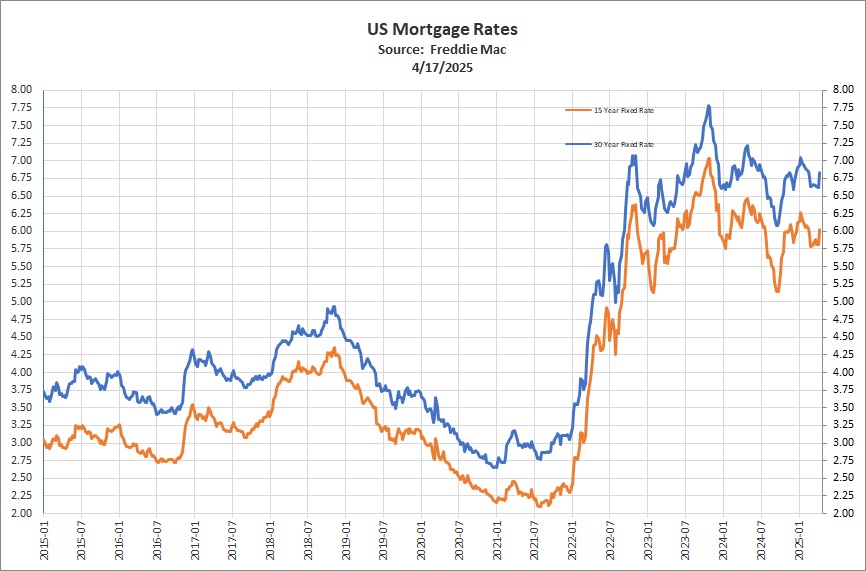
Mortgage Rates
“The 30-year fixed-rate mortgage increased again this week but remains below its 52-week average of 6.71%,” said Sam Khater, Freddie Mac’s Chief Economist. “The last few months have brought lower rates and as indicated by the recently reported increase in pending home sales, homebuyers are feeling more confident to get into the market.”
The 30-year FRM averaged 6.34% as of October 2, 2025, up from last week when it averaged 6.30%. A year ago at this time, the 30-year FRM averaged 6.12%.
The 15-year FRM averaged 5.55%, up from last week when it averaged 5.49%. A year ago at this time, the 15-year FRM averaged 5.25%.
Selected Cryptocurrencies
| Symbol | Name | Price | 24h % | 7d % | Market Cap | Volume(24h) |
| BTC | Bitcoin | $124,395.08 | 1.06% | 10.82% | $2,478,970,427,774 | $54,970,924,014 |
| ETH | Ethereum | $4,578.75 | 0.93% | 11.39% | $552,670,070,459 | $32,643,043,197 |
| XRP | XRP | $3.00 | -0.28% | 5.03% | $179,663,730,098 | $4,730,772,849 |
| BNB | BNB | $1,234.99 | 5.72% | 22.94% | $171,892,057,098 | $4,667,518,483 |
| SOL | Solana | $233.70 | 0.98% | 13.01% | $127,484,412,842 | $5,929,897,410 |
| DOGE | Dogecoin | $0.26 | 1.29% | 12.77% | $39,407,856,496 | $2,618,378,178 |
| TRX | TRON | $0.34 | 0.34% | 2.94% | $32,481,347,146 | $686,690,352 |
| ADA | Cardano | $0.85 | -0.50% | 7.37% | $30,558,388,761 | $1,139,370,432 |
| HYPE | Hyperliquid | $48.54 | -0.79% | 5.31% | $16,344,168,730 | $450,195,207 |
| LINK | Chainlink | $22.30 | -1.16% | 5.57% | $15,122,598,913 | $809,346,102 |
| USDe | Ethena USDe | $1.00 | 0.03% | -0.07% | $14,821,114,371 | $374,957,634 |
| SUI | Sui | $3.62 | 0.87% | 12.32% | $13,150,814,157 | $997,447,271 |
| XLM | Stellar | $0.41 | 1.57% | 10.91% | $12,973,489,142 | $281,533,923 |
| AVAX | Avalanche | $30.58 | 1.50% | 3.68% | $12,915,264,648 | $684,904,260 |
| BCH | Bitcoin Cash | $599.84 | 0.37% | 8.78% | $11,958,015,063 | $287,491,783 |
| HBAR | Hedera | $0.22 | 1.94% | 4.86% | $9,512,997,641 | $227,849,659 |
| LTC | Litecoin | $119.91 | 0.11% | 13.46% | $9,158,943,234 | $614,174,471 |
| LEO | UNUS SED LEO | $9.64 | -0.27% | 0.10% | $8,896,312,755 | $674,371 |
Information current as of 5:45 AM PDT, Monday, October 6, 2025. Source: https://coinmarketcap.com
Check us out at https://beaconrwa.com and our affiliated website at https://reverse-mortgages.us.
Sources: Ryan Long, CFA, FocusPoint Solutions, American Association for Individual Investors (AAII), Associated Press, Barclays Capital, Bloomberg, Citigroup, Deutsche Bank, FactSet, Financial Times, Goldman Sachs, JPMorgan Asset Management,
MarketfieldAsset Management, Morgan Stanley, MSCI, Morningstar, Northern Trust, Oppenheimer Funds, PIMCO, Standard & Poor’s, StockCharts.com, The Conference Board, Thomson Reuters, T. Rowe Price, U.S. Bureau of Economic Analysis, U.S. Federal Reserve, Wall Street Journal, The Washington Post. Index performance is shown as total return, which includes dividends, with the exception of MSCI-EM, which is quoted as price return/excluding dividends. Performance for the MSCI-EAFE and MSCI-EM indexes is quoted in U.S. Dollar investor terms.
The information above has been obtained from sources considered reliable, but no representation is made as to its completeness, accuracy or timeliness. All information and opinions expressed are subject to change without notice. Information provided in this report is not intended to be, and should not be construed as, investment, legal or tax advice; and does not constitute an offer, or a solicitation of any offer, to buy or sell any security, investment or other product. FocusPoint Solutions, Inc. is a registered investment advisor.
Notes key: (+) positive/encouraging development, (0) neutral/inconclusive/no net effect, (-) negative/discouraging development.