
Your Weekly Update for Monday, October 13, 2025.
Beacon Rock Wealth Advisors is a dba of BR Capital, Inc. It is a financial planning and registered investment advisory firm in Camas, Washington. We are always available to answer your finance questions. Give us a call at (360) 735-1900 or send an email.
If you or someone you know is worried about retirement, send us an email or give us a call for a no-obligation Retirement and Social Security Analysis.
If this information is helpful to you, please forward this to a friend and ask them to subscribe at https://newsletters.beaconrwa.com/subscribe.
Have a great week!
Mike Elerath
CERTIFIED FINANCIAL PLANNERTM
CERTIFIED IN LONG-TERM CARE
Mike.Elerath@beaconrwa.com
Bill Roller
NMLS #107972
CHARTERED FINANCIAL ANALYST
CERTIFIED FINANCIAL PLANNERTM
CHARTERED MARKET TECHNICIAN
bill.roller@beaconrwa.com
For more information about Beacon Rock Wealth Advisors, check out our brochure here: https://beaconrwa.com/beaconrockbrochure/
Banks and the bond market are closed in honor of Columbus Day, but the stock market is open!

We were travelling last Friday, but click on the image below to go to https://youtu.be/OEDWbE2455Y to see the video from October 10 in which Mike Elerath and Bill Roller discuss the financial markets.

Please give the video a “Like” and check out our other videos and subscribe to the channel at https://www.youtube.com/@beaconrwa.
Summary
Markets were DOWN last week due to a flash crash on Friday. The Dow Jones Industrial Average was DOWN 2.73% to 45,479.54 while the S&P500 ended DOWN 2.43% TO 6,552.51. The Nasdaq Composite FELL 2.53% to 22,204.42. The annual yield on the 30-year Treasury FELL 8.0 basis point(s) to 4.634%.
Although the U.S. government shutdown continued through last week, it was a period with little economic data scheduled to be released anyway, so there wasn’t much to be missed.
Equities fared negatively last week around the world, but only due to a trade-related downturn on Friday. Bonds were mixed, with Treasuries higher and credit lower. Commodities saw gains in precious metals offset by declines elsewhere.
Economic Notes
(0) The preliminary Univ. of Michigan index of consumer sentiment for October declined by -0.1 of a point to a level of 55.0 staying above the 54.0 expected by consensus. Data under the hood was similarly little-changed, with assessments of current conditions rising 1% while expectations for the future fell by -1%. Over the past year, the overall sentiment index has fallen -22%, largely led by consumer expectations, which were down -31%. Inflation expectations for the coming year fell by -0.1% to 4.6%, while 5-10 year expectations were unchanged at 3.7%. Per the survey sponsor, interviews conducted noted that the federal government shutdown “reveal little evidence” of having moved consumers’ views of the economy at this point. While there few changes in attitude from the prior month, “pocketbook issues like high prices and weakening job prospects remain at the forefront of consumers’ minds,” and consumers “do not expect meaningful improvement in these factors.”
(0) The FOMC minutes from the September meeting were released, and while they chose to cut rates, supported by “almost all” committee members, “a few” saw “merit” in keeping rates unchanged at that meeting, with “some” noting a “cautious approach” was warranted going forward. However, “most” members felt that further easing would likely be appropriate this year. Difference of opinion between members continued in the two mandate areas of labor and inflation. On the labor side, “a few” participants were concerned that conditions had been softening “for longer than was previously reported,” and that downside risk had increased in a variety of indicators, other data “did not show a sharp deterioration” in conditions. At the same time, a “majority” of members saw inflation risks also tilted to the upside, with data “moving further from 2 percent,” although debate remained about how much this was due to look-through inflation caused by one-time tariff-driven price level changes, relative to other factors like stronger productivity growth that could act to dampen long-term inflation influences. Based on how long the U.S. government shutdown lasts, key data points for both labor and inflation may or may not be available, although the start of rate cuts in September points to further cuts this year as opposed to a ‘one and one’ narrative, per past history.
Question of the Week: The SEC has moved toward approving ‘ETF share classes’ for mutual funds. How does that change things?
That started as a product workaround Vanguard technically invented years ago for a variety of its index funds. The multi-class structure was protected by patent, which expired in 2023, which now opens it up to the rest of the industry (with Dimensional Fund Advisors/DFA being the first to file with the SEC, along with 80 other firms). For decades, standard open-end mutual funds have offered a variety of share classes tied to a shared pool of assets, with classes carved off to account for differences in fees and distribution pipelines. In Vanguard’s case, instead of creating distinct new funds, the index ETFs were just built on as separate classes of the primary master funds (e.g., VOO is part of the long-standing Vanguard 500 Index Fund, albeit over time becoming the largest single slice of that pie).
An important distinction is in the treatment of capital gains distributions. Under the Internal Revenue Code’s Regulated Investment Company (RIC) rules, mutual fund net gains from sales done in securities within the fund are required to be paid out to shareholders at least annually, which often happens in November and December. ETFs can technically have capital gain distributions as well (since they’re also funds), but have an embedded creation/redemption mechanism that allows in-kind transfers of underlying security holdings back and forth between the ETF and authorized participants (‘AP’). The advantage is that gains can essentially be transferred away, at least for larger funds with substantial AP activity. Smaller and less liquid ETFs still have capital gains distributions if AP activity isn’t sufficient, or the securities aren’t the types that can be moved back and forth in-kind. As was the case with Vanguard’s funds and ETFs, the new rule would allow capital gains to be pushed into the ETF share class, where they can be dissipated by that creation/redemption mechanism. However, that process isn’t a guaranteed way to eliminate all capital gain distributions for every ETF, but could serve to at least reduce them. Apparently, the Dimensional Funds application (seen as an industry legal template) includes a right to a one-time tax-free conversion from a classic mutual fund share class to a new ETF share class for shareholders, but details haven’t been released at this point.
This practice could adjust the capital gains distributions that are paid out, concentrating these back on the classic mutual fund shares. Those are a non-issue for qualified investors in IRAs and 401k’s, but a positive for taxable investors, many of whom find these to be an annoyance at the least since they’re taxable in the year paid, whether received in cash or reinvested. For investors in the ETF class, unrealized capital gains would pile up instead. The long-term trend for the past decade includes investor flows moving away from mutual funds into ETFs for a variety of reasons, including their obvious tax-efficiency in taxable accounts, but also intraday trading liquidity for investors wanting that, as well as transparency of portfolio holdings. They’ve also had lower fees generally, notably for the index ETF products, although the newer batch of active and niche ETFs have seen their fees creep upward again. The recent regulatory change could potentially add several hundred new ETFs to the market, in addition to the over 4,500 tickers already available in the U.S. (per Morningstar, as of 9/30/2035). Still, total assets and trading volume remain heavily top-weighted to the largest original providers, as opposed to the flurry of newer thematic and other unique strategies unveiled over the past few years. For perspective’s sake, note that there are now nearly as many ETFs as there are individual company common stocks trading on the NYSE and NASDAQ exchanges.
The U.S. Treasury may not be as thrilled with this trend longer-term, as it reduces tax revenue, which brings up chatter from time to time of the ETF creation/redemption mechanism being adjusted to close the tax loophole vs. regular mutual funds, but nothing has happened at this point. Then again, and for better or worse, many retail investors are also trading more, now that commissions have largely gone away, which creates more taxable realized gain/loss activity.
Market Notes
| Period ending 10/10/2025 | 1 Week % | YTD % |
| DJIA | -2.70 | 8.34 |
| S&P 500 | -2.41 | 12.54 |
| NASDAQ | -2.53 | 15.57 |
| Russell 2000 | -3.28 | 8.52 |
| MSCI-EAFE | -1.86 | 24.77 |
| MSCI-EM | -0.58 | 29.42 |
| Bloomberg U.S. Aggregate | 0.33 | 6.75 |
| U.S. Treasury Yields | 3 Mo. | 2 Yr. | 5 Yr. | 10 Yr. | 30 Yr. |
| 12/31/2024 | 4.37 | 4.25 | 4.38 | 4.58 | 4.78 |
| 10/3/2025 | 4.03 | 3.58 | 3.72 | 4.13 | 4.71 |
| 10/10/2025 | 4.02 | 3.52 | 3.65 | 4.05 | 4.63 |
Despite a benign start, U.S. stocks suffered its most negative week in a few months. Early in the week, a deal for AMD to supply AI chips to OpenAI boosted the stock by 20%. However, a tranquil week ended Friday, as stocks pulled back as the U.S. administration threatened a ‘massive tariff increase’ on China (upwards of 100% as well as controls on exported critical software), in addition to threats of cancelling an upcoming diplomatic meeting. This was in response to China tightening export controls on some rare earth metals, imposing new port fees on U.S. ships, an antitrust review into Qualcomm, and halting buys of U.S. soybeans. In addition, federal worker layoffs were announced by the administration in the midst of the ongoing government shutdown, which shows no signs of ending in the next few days. By sector, defensive utilities and consumer staples led with gains, while all other sectors declined, led by cyclicals energy and consumer discretionary down -3% to -4% each. Real estate also fell by over -3%.
This coming week marks the start of the Q3 earnings season. Per FactSet, estimates for the S&P 500 earnings growth rate year-over-year are starting at 8.0%. This would mark the 9th consecutive quarter of positive earnings, above the Q2 growth rate of 7.3%, and remains above-average for the past thirty years. Leading sectors in the estimates include information technology (again, with strong revenue and profit margin fundamentals), followed by utilities (helped by AI buildout), and materials (from a lower base), while energy and consumer staples are bringing up the rear with expected earnings declines of -3% to -4%. Overall revenue growth is expected to be robust again as well, up 6.3% for the index, led by technology and communications.
Foreign stocks fell back to an even greater degree than U.S. stocks, again mostly due to Friday’s bad day, and a stronger U.S. dollar. The U.K. and Europe fared a bit better than Japan and emerging markets. Over the prior weekend, Japan elected its first likely upcoming female prime minister, Sanae Takaichi. Markets appeared quite satisfied with the choice, despite it being a surprise, and from a minority party, as she was known for not being keen on the BOJ hiking interest rates. As has been the case in a variety of developed countries, voters were frustrated with rising inflation, although it appeared in Japan a bit later than other locations. As a key member of former PM Abe’s administration, she is expected to continue the ‘three arrows’ economically stimulative and pro-shareholder policies of his administration that ended in 2020. She also looks to former British PM Margaret Thatcher as a role model, being pseudo-libertarian, pro-innovation, anti-regulation, which markets also appreciated. Within hours of new Japanese leadership, the French PM resigned after only two weeks, as the governing coalition couldn’t agree on a cabinet. The key takeaway is that France has been increasingly perceived as the more volatile political environment in continental Europe, a role traditionally held by Italy, with bond spreads widening as a reflection of this. Then again, the political situation in Europe have always been more ‘fluid’ than the set election pattern of the U.S. In EM, Chinese stocks led the declines (mostly tracked via ETF as local markets were closed for Golden Week holiday until Thurs.), negatively affected by the trade rhetoric with the U.S., while other nations were down to slightly lesser degrees, affected by potentially more trade disruptions and the dollar’s impact.
Bonds were mixed, with yields not changing by much as might be expected for a downturn in stocks. U.S. Treasuries led with gains for the week, investment-grade corporates were little-changed, while high yield and floating rate bank loans fell back. Foreign bonds were driven in both directions, with the U.S. dollar rising by over a percent.
Commodities were down for the week, with lower energy and agriculture prices offset by gains in precious metals. Crude oil fell by -3% last week to $59/barrel, as output remains high relative to economic uncertainty, which is more closely related to expected demand. The price of gold reached $4000/oz. for the first time, which generated further excitement, on top of existing positive momentum. Gold’s strength has been propped up by the economic policy uncertainty surrounding tariff impacts, but even more so by the ramped-up buying of emerging market central banks, seeing it as insurance against any potential U.S. sanctions, after the 2022 episode between the U.S and Russia. Expected easier Fed policy has given it a bit of a second wind, as lower-yielding Treasuries offer less competition for risk hedges than when yields are higher.
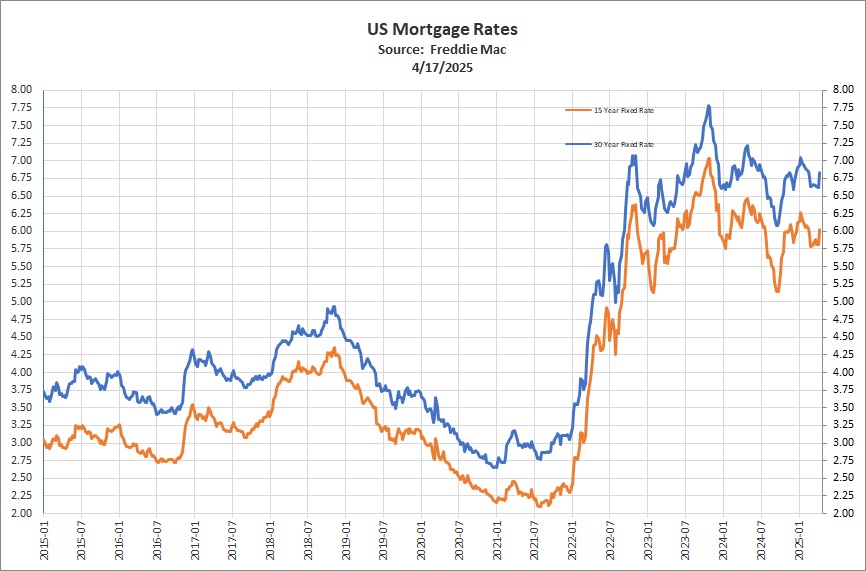
Mortgage Rates
“Mortgage rates decreased this week,” said Sam Khater, Freddie Mac’s Chief Economist. “Over the last few weeks, mortgage rates have settled in at their lowest level in about a year. There is growing evidence that homebuyers are digesting these lower rates and gradually are willing to move forward with buying a home, which is boosting purchase activity.”
The 30-year FRM averaged 6.30% as of October 9, 2025, down from last week when it averaged 6.34%. A year ago at this time, the 30-year FRM averaged 6.32%.
The 15-year FRM averaged 5.53%, down from last week when it averaged 5.55%. A year ago at this time, the 15-year FRM averaged 5.41%.
Selected Cryptocurrencies
| Symbol | Name | Price | 24h % | 7d % | Market Cap | Volume(24h) |
| BTC | Bitcoin | $114,639.24 | 2.53% | -7.88% | $2,285,207,904,143 | $95,830,656,890 |
| ETH | Ethereum | $4,123.98 | 7.56% | -10.06% | $497,778,519,304 | $62,692,172,746 |
| BNB | BNB | $1,303.48 | 0.00% | 5.31% | $180,969,105,208 | $13,200,351,128 |
| XRP | XRP | $2.58 | 7.22% | -13.88% | $155,062,049,393 | $10,732,558,122 |
| SOL | Solana | $194.04 | 6.36% | -17.16% | $106,058,815,110 | $11,991,606,933 |
| DOGE | Dogecoin | $0.21 | 0.00% | -20.46% | $31,141,065,746 | $5,965,285,322 |
| TRX | TRON | $0.32 | 1.90% | -6.29% | $30,445,925,942 | $1,191,147,859 |
| ADA | Cardano | $0.72 | 10.39% | -16.25% | $25,659,554,518 | $2,001,451,205 |
| HYPE | Hyperliquid | $40.49 | 6.87% | -17.15% | $13,634,894,173 | $844,680,973 |
| LINK | Chainlink | $19.51 | 11.19% | -12.52% | $13,231,378,918 | $1,539,308,997 |
| USDe | Ethena USDe | $1.00 | 0.04% | 0.01% | $12,604,453,438 | $430,814,363 |
| XLM | Stellar | $0.34 | 4.89% | -15.88% | $11,027,048,663 | $399,557,742 |
| BCH | Bitcoin Cash | $542.02 | 3.50% | -9.66% | $10,807,068,968 | $409,681,050 |
| SUI | Sui | $2.80 | 10.10% | -22.67% | $10,185,490,269 | $2,575,333,221 |
| AVAX | Avalanche | $22.29 | 4.61% | -27.27% | $9,413,334,303 | $1,670,236,868 |
| LEO | UNUS SED LEO | $9.65 | -0.17% | 0.22% | $8,905,150,979 | $1,056,538 |
| HBAR | Hedera | $0.19 | 8.24% | -16.88% | $7,902,100,371 | $407,304,974 |
| LTC | Litecoin | $96.80 | 1.13% | -19.51% | $7,450,080,131 | $1,453,842,273 |
Information current as of 5:35 AM PDT, Monday, October 13, 2025. Source: https://coinmarketcap.com
Check us out at https://beaconrwa.com and our affiliated website at https://reverse-mortgages.us.
Sources: Ryan Long, CFA, FocusPoint Solutions, American Association for Individual Investors (AAII), Associated Press, Barclays Capital, Bloomberg, Citigroup, Deutsche Bank, FactSet, Financial Times, Goldman Sachs, JPMorgan Asset Management,
MarketfieldAsset Management, Morgan Stanley, MSCI, Morningstar, Northern Trust, Oppenheimer Funds, PIMCO, Standard & Poor’s, StockCharts.com, The Conference Board, Thomson Reuters, T. Rowe Price, U.S. Bureau of Economic Analysis, U.S. Federal Reserve, Wall Street Journal, The Washington Post. Index performance is shown as total return, which includes dividends, with the exception of MSCI-EM, which is quoted as price return/excluding dividends. Performance for the MSCI-EAFE and MSCI-EM indexes is quoted in U.S. Dollar investor terms.
The information above has been obtained from sources considered reliable, but no representation is made as to its completeness, accuracy or timeliness. All information and opinions expressed are subject to change without notice. Information provided in this report is not intended to be, and should not be construed as, investment, legal or tax advice; and does not constitute an offer, or a solicitation of any offer, to buy or sell any security, investment or other product. FocusPoint Solutions, Inc. is a registered investment advisor.
Notes key: (+) positive/encouraging development, (0) neutral/inconclusive/no net effect, (-) negative/discouraging development.