
Your Weekly Update for Monday, September 29, 2025.
Beacon Rock Wealth Advisors is a dba of BR Capital, Inc. It is a financial planning and registered investment advisory firm in Camas, Washington. We are always available to answer your finance questions. Give us a call at (360) 735-1900 or send an email.
If you or someone you know is worried about retirement, send us an email or give us a call for a no-obligation Retirement and Social Security Analysis.
If this information is helpful to you, please forward this to a friend and ask them to subscribe at https://newsletters.beaconrwa.com/subscribe.
Have a great week!
Mike Elerath
CERTIFIED FINANCIAL PLANNERTM
CERTIFIED IN LONG-TERM CARE
Mike.Elerath@beaconrwa.com
Bill Roller
NMLS #107972
CHARTERED FINANCIAL ANALYST
CERTIFIED FINANCIAL PLANNERTM
CHARTERED MARKET TECHNICIAN
bill.roller@beaconrwa.com
For more information about Beacon Rock Wealth Advisors, check out our brochure here: https://beaconrwa.com/beaconrockbrochure/
Click on the image below to go to https://youtu.be/4ckossfFRGo to see the video from September 26 in which Mike Elerath and Bill Roller discuss the financial markets.

Please give the video a “Like” and check out our other videos and subscribe to the channel at https://www.youtube.com/@beaconrwa.
Summary
Markets were DOWN SLIGHTLY last week. The Dow Jones Industrial Average was DOWN 0.15% to 46,247.29 while the S&P500 ended DOWN 0.31% TO 6,643.70. The Nasdaq Composite FELL 0.65% to 22,484.07. The annual yield on the 30-year Treasury ROSE 1 basis point(s) to 4.766%.
Economic data included a revision higher for Q2 U.S. economic growth, as well as strength in durable goods orders and new home sales. Jobless claims have stabilized after a few unusual weeks, including some fraudulent activity. Consumer sentiment remained challenged, with a good degree of pessimism about the economy and labor markets.
Equities were mixed, with declines in the U.S. and emerging markets, while Europe saw gains. Bonds were generally down as interest rates rose along with strong economic results and inflation. Commodities also gained, largely coinciding with crude oil.
Economic Notes
(+) The third and final release of U.S. GDP for Q2 showed growth revised up to 3.8% from the earlier 3.3%, while first quarter growth was taken down a notch to -0.6%. While positive, both quarters have largely been written off by markets as anomalies due to trade extremes (via net export reversals) during the period. Within the newest report, revisions upward were seen in personal consumption (up nearly a percent to an annualized growth rate of 2.5%, representing 1.7% of the economy’s total 3.8%), and mostly in services, in addition to stronger non-residential business fixed investment growth, while housing investment continued to be revised downward from already-negative levels. Other areas were little-changed, such as the PCE price indexes. National accounts went through some revision, as they do on an annual basis, with some earlier quarterly data adjusted from one to another, but annual GDP growth wasn’t affected. A figure not often in the headlines, nominal GDP (real GDP plus the GDP inflation deflator) was revised up by more than a half-percent to 6.0% for Q2. The meaningful part is that nominal growth has often been looked at as a natural ‘fair value’ range for the 10-year U.S. Treasury note, which remains several percent lower than that, at just over 4%. From that rough historical viewpoint, financing rates are still ‘stimulative’ rather than ‘restrictive,’ assuming Q3 and Q4 growth doesn’t slow quickly, which would cause this relationship to converge.
With the third quarter now coming to a close, the Atlanta Fed’s GDPNow measure for Q3 has steadily moved up from around 3% to now 3.9%. That indicator uses real time economic data releases, with their estimates being quite accurate as it has turned out. These include continued-strong results from personal consumption, being nearly 60% of the total growth figure (at 2.3%), as well as positive expected contributions from all other areas except residential investment. GDPNow continues to surpass Blue Chip forecasts from economists, where the median estimate continues to hover in the 1.0-1.5% range.
(+/0) Personal income rose 0.4% in August, a tenth higher than expectations, and driven by a 0.9% rise in farm income as well as substantial business insurance payouts. Year-over-year, income rose by 2% on a real after-inflation basis, while spending rose 3%. Personal spending rose by 0.6%, also a tenth better than consensus. The personal saving rate fell by -0.2% to 4.6% from an upward revision. On the inflation side, the headline PCE price index rose by a rounded 0.3%, and core PCE gained 0.2%, both largely as expected. Year-over-year, headline PCE picked up by a tenth to 2.7%, while core PCE was in line with the prior month’s pace of 2.9%.
(-/0) The preliminary S&P Global US manufacturing PMI for September fell by -1.0 point to 52.0, just below the median forecast of 52.2. The underlying components showed some weakness as well, with output, new orders, and employment all down, but like the overall number, all remained in the over-50 expansionary zone, which is stronger than the ISM manufacturing survey, which has tended to fall just under 50, in persistent contraction. The preliminary S&P Global US services PMI for September fell by -0.6 of a point to 53.9, remaining in solid expansion nearly on target with the 54.0 level expected. The composition was weaker here as well, with new business and employment down a fraction of a point each, but both remaining in solid expansion. S&P’s commentary noted that growth has slowed from the “recent peak” in July, with companies pulling back on hiring. Tariffs were noted again as a driver of input costs in both manufacturing and services, but “the number of companies able to hike selling prices to pass these costs on to customers has fallen.”
(+) Durable goods orders rose 2.9% in August, beating the 0.3% gain expected. However, the rise in orders was concentrated in commercial and defense aircraft, which saw dramatic activity, so removing transportation trimmed the gain to 0.4%, while core capital goods orders rose 0.6%. Though, core capital goods shipments fell by -0.3%. In other segments for the month, gains were seen in machinery (up a percent), metals, and metal products, while electrical and computer products fell back slightly. Year-over-year, total durable goods orders were up 8%, while removing transportation halved that to 4%, showing the impact of aircraft and transportation’s gain of 16% for the year (albeit lumpy from month to month). Computer products have also decelerated a bit in the last few quarters.
(0/-) Existing home sales fell by -0.2% in August to a seasonally-adjusted annual rate of 4.00 mil. units, a bit better than the -1.5% decline expected. The drop was solely focused in single-family of -0.3%, while condos/co-ops were unchanged. Regionally, sales in the Midwest and West were up a few percent, while the Northeast saw a -4% drop. Year-over-year, national home sales rose by just under 2%, which included a 2% rise in single-family and -5% drop in condos/co-ops. The median existing home sales price also rose 2% to $422,600, representing the 26th consecutive month of annual price increases. Although it’s well-known generally, the dispersion in affordability between regions is worth a reminder, with prices in the West highest at $624,300, being nearly double those in the least-expensive Midwest at $330,500, with the Northeast and South falling in-between. Inventory fell slightly for the month to 4.6 months’ supply, which is slightly higher than the 4.2 of a year ago. The report’s sponsor, the often-optimistic National Association of Realtors, made note that “record-high housing wealth and a record-high stock market” will help owners “trade up,” benefiting the upper end of the market mostly. At the same time, sales for more affordable homes are “constrained by the lack of inventory.” That sums up the situation for the most part, also seen in other data.
(+) New home sales rose by 20.5% in August to a seasonally-adjusted annualized rate of 800k units, well above expectations calling for a -0.3% decline. This was the largest single-month gain in over three years, and was in addition to upward revisions for June and July. Sales grew in all four key regions of the U.S., led by the Northeast (over 70%) and South (25%). Nationally, this represented a 15% increase over the past 12 months. The median new home price rose 5% for the month to $413,500, but was just 2% over the median price from a year ago. As for inventories, months’ supply fell from 9.0 to 7.4 for August, a drop of -18%, with the figure being down -10% from last year. Lower sales prices (with some dealer incentives) as well as 30-year fixed mortgage rates ticking down to the 6.0-6.5% range has helped. That’s the lowest rate in several years, although still elevated relative to what many current homeowners are paying (many still in the 3-5% area).
(-) The final Univ. of Michigan index of consumer sentiment for September came in down -5% from the prior month at 55.1, although it remained above the low points of earlier this spring. This included a -2% decline in assessments of current economic conditions and an -8% fall in expectations for the future. On a year-over-year basis, the overall index remained down -22%, with current conditions down -5% and future expectations a far more depressed -31%. Inflation expectations for the coming one year fell a tenth to 4.7%, while long-run inflation expectations ticked up by 0.2% to 3.7%, but remained off of the highs from April that had reached 4.4%. Per the survey sponsor, although the decline appeared modest, it was spread across a “broad swath of the population, across groups by age, income, and education, and all five index components,” except for those with large stock holdings, where sentiment improved (coinciding with stock returns). In general, expectations for personal finances have softened along with those for macro conditions, with a “frustration over the persistence of high prices”—mentioned by nearly half of respondents. Interviews during the month highlighted “the fact that consumers feel pressure both from the prospect of higher inflation as well as the risk of weaker labor markets.” There was not much new information here, but sentiment continues to struggle, which politicians are apt to notice in light of mid-term elections next year.
(+) Initial jobless claims for the Sep. 20 ending week fell by -14k to 218k, well below the 233k expected. Continuing claims for the Sep. 13 week fell by -2k to 1.926 mil., a bit under the median forecast of 1.932 mil. Initial claims were led upward by CA, fell in TX and VA, while other areas were little changed. Texas continued to note that claims levels remained elevated, following a surge in fraudulent claim filings a few weeks ago. Overall claims appear to remain contained nationally.
Market Notes
| Period ending 9/26/2025 | 1 Week % | YTD % |
| DJIA | -0.15 | 10.11 |
| S&P 500 | -0.30 | 14.05 |
| NASDAQ | -0.64 | 17.01 |
| Russell 2000 | -0.58 | 10.23 |
| MSCI-EAFE | -0.41 | 23.79 |
| MSCI-EM | -1.12 | 25.57 |
| Bloomberg U.S. Aggregate | -0.28 | 5.90 |
| U.S. Treasury Yields | 3 Mo. | 2 Yr. | 5 Yr. | 10 Yr. | 30 Yr. |
| 12/31/2024 | 4.37 | 4.25 | 4.38 | 4.58 | 4.78 |
| 9/19/2025 | 4.03 | 3.57 | 3.68 | 4.14 | 4.75 |
| 9/26/2025 | 4.02 | 3.63 | 3.76 | 4.20 | 4.77 |
U.S. stocks declined on net last week, led downward by growth stocks and small cap, in a reversal of the prior few weeks. By sector, energy led the way, up 5% along with a spike in oil prices, as well as utilities, while materials lagged with a decline of a few percent, in addition to consumer discretionary and consumer staples. The week featured a variety of unusual headlines, which included a large investment from Nvidia in OpenAI, and the U.S. administration’s involvement in a spin-off of TikTok’s U.S. operations from its Chinese operator for $14 bil. Early in the week, tech firms especially tried to interpret implications of the administrations of the new H-1B visa fee of $100,000, which has a strong impact on technology company employees, primarily from India. However, confusion continues around who is responsible for paying the fee, whether or not it’s a one-time charge, and how it would affect current U.S. workers on visa. A 100% tariff on branded pharmaceuticals was announced (except for the EU and Japan), for any firm not planning a manufacturing facility in the U.S., as well as new levies on heavy trucks, (upholstered) furniture, and kitchen cabinets.
The Congressional reconciliation bills (12 of them) have yet to pass, with Democrats keen on rolling back some earlier spending cuts from the Affordable Care Act and Medicaid. This only affects the roughly one-quarter of spending available as discretionary, without touching payments for Social Security, Medicare, interest on debt, etc. If this turns into a government shutdown on Oct. 1, per estimates from Goldman Sachs, -0.15% per week could be trimmed from GDP growth for Q4, although that could be reversed back upward in a similar magnitude in Q1-2026. Data releases could also be on hiatus, at an especially critical time for the Federal Reserve’s evaluation of economic conditions. At the same time, as JPMorgan reminds us, there have been 21 shutdowns since 1950, most of which only last a few days until agreements are reached, with financial markets generally looking past them, unless they turn more severe.
At a Wed. speaking event, Fed Chair Powell noted that the economy is in a “challenging position,” with the pace of job growth appeared to be running below the “breakeven” rate, although other indicators were stable. Importantly, and in keeping with the delicate balance around the Fed’s dual mandate, he again noted that keeping “restrictive policy too long” could unnecessarily weaken labor conditions, while easing “too aggressively” could “leave the inflation job unfinished,” although “disinflation for services continues” outside of the one-time price impacts from tariffs. He made a comment or two about risk surrounding “fairly highly valued” equity prices, which was not taken as well by financial markets, perhaps as a modern version of Fed Chair Greenspan’s “irrational exuberance” reference in 1996, a few years before the tech bubble peaked and later unwound.
Members of the Fed have been increasingly public about their interest rate views, with a notable divergence between those concerned about inflation pressures (like Chicago Fed president Goolsbee, not wanting to cut rates too fast) and those more focused on labor slowing (such as new governor Miran, wanting a faster easing pace, and that rates should be roughly 2 percent lower than current levels). This is definitely a change from past eras, where the Fed was not at all transparent about policy, until after the fact, and certainly not as much public candor from individual members.
Foreign stocks were mixed for the week, with gains in Europe and the U.K. offset by declines in Japan and emerging markets. Europe was boosted a bit by stronger business activity, although growth was not as strong in the U.K. The Swedish central bank lowered rates by a quarter-percent to 1.75%, while the Swiss stayed on hold at 0%. In EM, declines in India, Turkey, South Korea, and Taiwan (the latter two highly correlated to U.S. technology movements) led the broader index downward, as China was little-changed for the week.
Bonds fell back as more positive economic news and continued strong PCE inflation readings kept long-term rates elevated. U.S. Treasuries outperformed investment-grade slightly, while high yield and floating rate bank loans fared best of all. Foreign bonds were mixed, with a stronger dollar hurting unhedged developed market and local market emerging market debt.
The U.S. Treasury’s support for Argentina, offering a $20 bil. swap line, allowed their central bank to cut short-term interest rates from an exorbitant 35% to 25%. The improved but still-elevated rates show the distrust many global (and local) investors have for the country that has defaulted on its debt several times and having experienced inflation woes and government financial distrust for decades. This is despite the current president’s work to put through extreme reforms and get the country back on track to financial stability and better integration back into the global marketplace.
Commodities were generally higher, despite the normal headwind of a stronger U.S. dollar, led by gains in energy and precious metals. Crude oil price rose 5% last week to over $65/barrel, with a variety of influences from Ukraine attacks on Russian oil production facilities, taking perhaps a million barrels a day offline, and suggestions from the U.S. that nations stop buying Russian oil. These developments have partially offset the excess production that has kept prices contained.
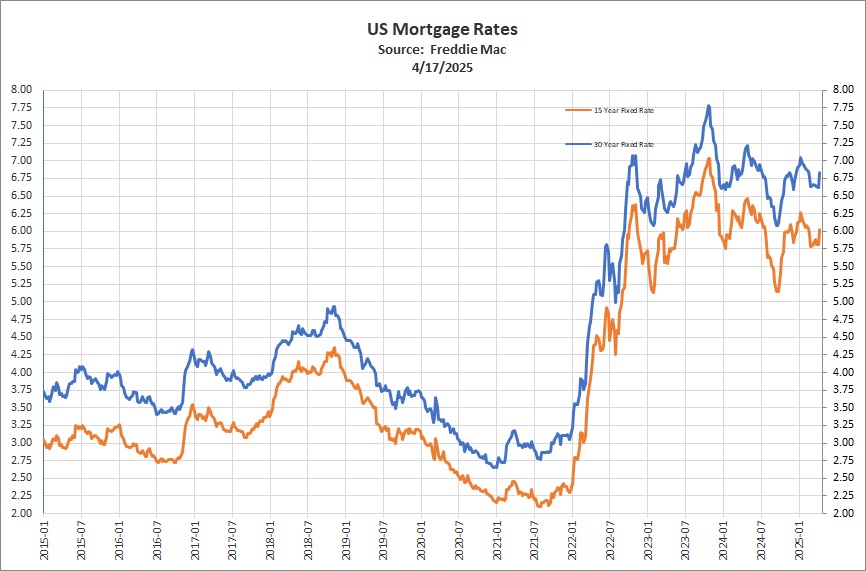
Mortgage Rates
“Following several weeks of decline, mortgage rates inched up this week,” said Sam Khater, Freddie Mac’s Chief Economist. “Housing market activity continues to hold up with purchase and refinance applications increasing by 18% and 42%, respectively, compared to the same time last year.”
The 30-year FRM averaged 6.30% as of September 25, 2025, up from last week when it averaged 6.26%. A year ago at this time, the 30-year FRM averaged 6.08%.
The 15-year FRM averaged 5.49%, up from last week when it averaged 5.41%. A year ago at this time, the 15-year FRM averaged 5.16%.
Selected Cryptocurrencies
| Symbol | Name | Price | 24h % | 7d % | Market Cap | Volume(24h) |
| BTC | Bitcoin | $112,308.63 | 2.62% | -0.36% | $2,237,379,494,575 | $45,964,648,075 |
| ETH | Ethereum | $4,120.25 | 3.25% | -1.63% | $497,328,298,924 | $30,540,647,084 |
| XRP | XRP | $2.86 | 3.16% | 1.52% | $171,362,565,792 | $4,166,867,925 |
| BNB | BNB | $1,006.37 | 3.66% | -1.66% | $140,072,501,283 | $2,843,844,140 |
| SOL | Solana | $207.62 | 3.91% | -6.47% | $112,870,621,222 | $5,350,739,530 |
| DOGE | Dogecoin | $0.23 | 2.38% | -3.57% | $35,023,287,238 | $1,926,762,813 |
| TRX | TRON | $0.33 | -0.94% | -2.41% | $31,546,814,166 | $480,663,475 |
| ADA | Cardano | $0.80 | 3.89% | -3.25% | $28,575,348,435 | $863,062,315 |
| HYPE | Hyperliquid | $46.54 | 7.62% | -5.41% | $15,670,140,597 | $388,679,895 |
| LINK | Chainlink | $21.26 | 3.68% | -0.66% | $14,417,722,083 | $545,621,002 |
| USDe | Ethena USDe | $1.00 | 0.05% | -0.02% | $14,404,516,699 | $671,247,156 |
| AVAX | Avalanche | $29.86 | 6.38% | -6.39% | $12,611,202,739 | $1,193,339,097 |
| XLM | Stellar | $0.37 | 3.80% | 2.56% | $11,717,309,764 | $183,150,432 |
| SUI | Sui | $3.25 | 4.50% | -3.72% | $11,601,082,734 | $841,455,456 |
| BCH | Bitcoin Cash | $553.28 | 2.77% | -3.38% | $11,028,149,047 | $365,841,744 |
| HBAR | Hedera | $0.21 | 3.20% | -1.31% | $9,103,294,136 | $156,923,441 |
| LEO | UNUS SED LEO | $9.62 | 0.62% | 1.46% | $8,875,428,024 | $920,341 |
| LTC | Litecoin | $105.94 | 2.60% | -0.09% | $8,089,268,120 | $416,796,458 |
Information current as of 5:30 AM PDT, Monday, September 29, 2025. Source: https://coinmarketcap.com
Check us out at https://beaconrwa.com and our affiliated website at https://reverse-mortgages.us.
Sources: Ryan Long, CFA, FocusPoint Solutions, American Association for Individual Investors (AAII), Associated Press, Barclays Capital, Bloomberg, Citigroup, Deutsche Bank, FactSet, Financial Times, Goldman Sachs, JPMorgan Asset Management,
MarketfieldAsset Management, Morgan Stanley, MSCI, Morningstar, Northern Trust, Oppenheimer Funds, PIMCO, Standard & Poor’s, StockCharts.com, The Conference Board, Thomson Reuters, T. Rowe Price, U.S. Bureau of Economic Analysis, U.S. Federal Reserve, Wall Street Journal, The Washington Post. Index performance is shown as total return, which includes dividends, with the exception of MSCI-EM, which is quoted as price return/excluding dividends. Performance for the MSCI-EAFE and MSCI-EM indexes is quoted in U.S. Dollar investor terms.
The information above has been obtained from sources considered reliable, but no representation is made as to its completeness, accuracy or timeliness. All information and opinions expressed are subject to change without notice. Information provided in this report is not intended to be, and should not be construed as, investment, legal or tax advice; and does not constitute an offer, or a solicitation of any offer, to buy or sell any security, investment or other product. FocusPoint Solutions, Inc. is a registered investment advisor.
Notes key: (+) positive/encouraging development, (0) neutral/inconclusive/no net effect, (-) negative/discouraging development.