
Your Weekly Update for Tuesday, September 2, 2025.
Beacon Rock Wealth Advisors is a dba of BR Capital, Inc. It is a financial planning and registered investment advisory firm in Camas, Washington. We are always available to answer your finance questions. Give us a call at (360) 735-1900 or send an email.
If you or someone you know is worried about retirement, send us an email or give us a call for a no-obligation Retirement and Social Security Analysis.
If this information is helpful to you, please forward this to a friend and ask them to subscribe at https://newsletters.beaconrwa.com/subscribe.
Have a great week!
Mike Elerath
CERTIFIED FINANCIAL PLANNERTM
CERTIFIED IN LONG-TERM CARE
Mike.Elerath@beaconrwa.com
Bill Roller
NMLS #107972
CHARTERED FINANCIAL ANALYST
CERTIFIED FINANCIAL PLANNERTM
CHARTERED MARKET TECHNICIAN
bill.roller@beaconrwa.com
For more information about Beacon Rock Wealth Advisors, check out our brochure here: https://beaconrwa.com/beaconrockbrochure/
Click on the image below to go to https://youtu.be/hAlLXGZLKOo to see the video from August 29 in which Mike Elerath and Bill Roller discuss the financial markets.

Please give the video a “Like” and check out our other videos and subscribe to the channel at https://www.youtube.com/@beaconrwa.
Summary
Markets were DOWN SLIGHTLY last week. The Dow Jones Industrial Average was DOWN 0.19% to 45,544.88 while the S&P500 ended DOWN 0.10% TO 6,460.26. The Nasdaq Composite FELL 0.19% to 21,455.55. The annual yield on the 30-year Treasury ROSE 3.3 basis point(s) to 4.917%.
Economic data for the week included U.S. GDP growth for the 2nd quarter being upgraded a bit, and continued growth in personal income and spending. On the weaker side were durable goods orders, home prices, and consumer sentiment.
Equities were flat in the U.S. but fell several percent overseas. Bonds were little-changed for the week. Commodities rose a bit across the board, led by gold.
Economic Notes
(+) The second estimate of U.S. GDP for Q2 showed a revision up from 3.0% to 3.3%, reinforcing the sharp improvement from Q1, but a first half of 2025 muddled with idiosyncrasies. Upward revisions were seen in personal consumption (by a few tenths) and business fixed investment (by nearly 4% to 6%, especially in intellectual property products/software), while revisions downward were seen in housing, government (from positive to negative), and inventories. Inflation readings were little-changed from the original.
The Atlanta GDPNow measure shows an estimate of 3.5% growth in Q3, led by contributions of consumer spending (1.6%), nonresidential fixed investment, inventories, and net exports, offset by continued weakness in residential investment. The Blue Chip economist consensus remains just under 1% for the quarter, within a range of about 0% and 2%.
(0) Personal income rose 0.4% in July, a tenth stronger than the prior month, but in line with expectations. This was driven by strength in employment comp, as well as proprietors’ income and rental income. Personal spending rose by 0.5%, also a tenth stronger than June and in line with consensus, led by nearly a 1% rise in real goods spending, while services were little changed. Over the past year, personal income and spending were each up around 5%, so positive in after-inflation real terms. The personal saving rate was largely unchanged at 4.4%. On the inflation side, the PCE price index rose 0.2% on a headline level, and a rounded 0.3% for core, removing food and energy inputs, both being in line with expectations. Year-over year, headline PCE rose 2.6% and core PCE rose 2.9%. This uptick was taken negatively, as a sign tariffs are making their way into consumer costs.
(-) Durable goods orders fell by -2.8% in July, slightly better than the -3.8% expected by median forecast but improved from the nearly -10% drop the prior month. Volatility in commercial aircraft orders over the past few months (drop in July and June after sharp spike in May) was significant. This was seen by durable goods ex-transports rising 1.1% in the month, as did core capital goods orders, reversing a decline the prior month. Core capital goods shipments rose nearly a percent. Year-over-year, total durable goods orders rose over 7%, led by both transportation/aircraft components mostly, but also computer equipment, while total shipments were up over 2%.
(-/0) The S&P Case-Shiller 20-city home price index fell by -0.3% on a seasonally-adjusted basis but was little changed on an unadjusted measure. By city, June gains were led by Chicago (1%) and Minneapolis, while San Francisco prices fell by a percent. Year-over-year, the 20-city index rose 2.1%, led by gains in New York City and Chicago (up 7% and 6%, respectively), while Tampa and San Francisco each declined -2%, now among several cities with negative 12-month results. Per the S&P, it was noted that national prices moved at the slowest pace in two years, with trends from the pandemic favoring the Sun Belt have now reversed toward “traditional industrial centers.” It was also noted that home price gains have now failed to keep up with broader inflation, which is “historically significant,” considering housing’s traditional hedge against such price pressures. However, relative affordability continues to push back and reversing pandemic-era strong gains to some extent, especially in “speculative” markets.
(-/0) The FHFA house price index declined -0.2% in June, on a seasonally-adjusted basis, and roughly flat for the 2nd quarter. For June, results were led by a gain in Middle Atlantic (NY/NJ/PA), up 1%, while the South Atlantic (DE south to FL) fell by -1%, mostly in FL. Over the trailing 12 months, the index decelerated to a rate of 2.9%, a sharp deceleration from the 5.4% pace for the prior year ending in June 2024. Every census region saw a gain for the year, led by the Middle Atlantic up 7%, due to strength in the NYC metro area, while the Pacific rose only 1%, with weakness around the suburban regions outside of Los Angeles and San Francisco.
(-) New home sales fell by -0.6% in July to a seasonally-adjusted annualized rate of 652k units, below the expected increase of 0.5%, but featured a half-percent revision higher for the prior month. Regionally, sales were led by a double-digit gain in the West, while those in the Midwest and South declined. On a year-over-year basis, new home sales fell by -8% nationally. The median new home sales price was $403,800, down about a percent from the prior month, down -6% from a year ago, and off -12% from their late 2022 peak. Inventory was little-changed from the prior month, at 9.2 months’ supply, but is 16% higher than a year ago. After a spike higher to over 1 mil. units during the pandemic, new home sales have fallen back to their pre-2020 range. Recent activity has included smaller home sizes, to make them more affordable to buyers in a period of higher interest rates, as well as incentives from builders to move inventory.
(-) The Conference Board index of consumer confidence fell by -1.3 points to 97.4 in August, but above the median forecast of 96.5, and after upward revisions for July. Weakness was seen in both assessments of present conditions and expectations for the future. The labor differential ticked down by over a point as more respondents noted that jobs were “hard to get” (albeit only 20% of the survey) than were “plentiful” (although that category remained at around 30%). Inflation expectations for the coming year ticked up by 0.5% to 6.2%, the first increase in several months. The Conference Board noted that confidence levels have remained in a similar range over the past few months, but “pessimism about future job availability inched up and optimism about future income faded slightly,” although stronger expectations for future business conditions improved.
(x) The final Univ. of Michigan index of consumer sentiment report for August showed a decline of -3.5 points to 58.2 (or nearly -6% from the July reading). Assessments of current economic conditions declined by over -9%, while expectations for the future fell a less severe -3%. Year-over-year, the total index remains down -14%, with the current conditions index up slightly, but future expectations having fallen by over -22%. Though, the total index is up 10% from April/May levels a few months ago. Inflation expectations for the next year ticked up from 4.5% to 4.8%, while long-term expectations ticked up a tenth to 3.5%. Per the survey sponsor, “perceptions of many aspects of the economy slipped,” as “buying conditions for durable goods subsided to their lowest reading in a year,” with “heightened concerns about high prices.”
(0/+) Initial jobless claims for the Aug. 23 ending week fell by -4k to 230k, similar to the 229k level expected by consensus. Continuing claims for the Aug. 16 week fell by -7k to 1.954 mil., just below the 1.966 mil. expected. There didn’t appear to be any major announcements on a state-by-state level, with overall levels remaining within recent range.
Question of the Week: How has the intensifying debate about Federal Reserve Bank independence affected financial markets?
It hasn’t yet, at least to a significant degree. But the situation remains fluid.
Early in the week, the latest Fed drama involved Gov. Lisa Cook, and mortgage fraud accusations from the administration, who announced that she would be fired, at least via social media. The accusations are based on her allegedly categorizing multiple residences as ‘primary’ in a short period of time, which tends to positively affect the interest rates charged. (From a home loan standpoint, lower rates tend to be applied to primary residences compared to second homes and rental properties, which are deemed riskier.) Cook blamed the mortgage issue on a clerical error, and followed up with a lawsuit in response to block her firing. Whether or not the President has the authority to fire a Fed governor elected to a lengthy term remains to be determined and may end up in the Supreme Court. Thus far, legal scholars seem to land on the side that members of the Fed don’t serve “at the pleasure” of the President, and as such, can’t be fired outright, as can, say, the Treasury Secretary, for example.
Financial markets have assumed much of the Fed member media activity involves attempts to replace current members with a more ‘dovish’ majority. However, as it appears that rate cuts could be reality in the near future, such efforts might be moot. Also, some of the members thought to be amenable to being currently dovish haven’t always been so and include a variety of mainstream economists that understand potential problems caused by an overheated economy driven by interest rates that become too stimulative.
The more negative impact on sentiment involves erosion in confidence in the Fed as an independent body. Their reputation for independence is one the Fed takes seriously in their public image of making objective, non-partisan monetary decisions. Then again, the bank has faced the threat of political interference many times in the past, with structure and personnel being criticized by both the right and left on a regular basis. Most politicians want lower rates, easier borrowing conditions for consumers and businesses, and want to keep the economy growing as much as possible, although too much growth fueled by easy lending can raise the potential for asset price bubbles. Interest rate decisions are not precise ones, and involve some ‘art’ and some ‘science,’ as it has been put by Fed members over the years. Even the well-quoted Taylor Rule, developed by a Stanford economist in the early 1990s in efforts to better quantify the ‘ideal’ Fed funds rate, has morphed into 30 different versions (which the curious can keep track of at https://www.atlantafed.org/cqer/research/taylor-rule.aspx). The most recent Taylor Rule measurement, as of Aug. 29, shows an average rate of 4.98%, actually landing above today’s Fed funds range of 4.25-4.50%, based on continued inflation pressures and an unemployment rate still near what’s considered to be full employment.
Market Notes
| Period ending 8/29/2025 | 1 Week % | YTD % |
| DJIA | -0.11 | 8.30 |
| S&P 500 | -0.08 | 10.79 |
| NASDAQ | -0.18 | 11.60 |
| Russell 2000 | 0.22 | 7.06 |
| MSCI-EAFE | -1.44 | 22.79 |
| MSCI-EM | -0.76 | 19.02 |
| Bloomberg U.S. Aggregate | 0.16 | 4.99 |
| U.S. Treasury Yields | 3 Mo. | 2 Yr. | 5 Yr. | 10 Yr. | 30 Yr. |
| 12/31/2024 | 4.37 | 4.25 | 4.38 | 4.58 | 4.78 |
| 8/22/2025 | 4.27 | 3.68 | 3.76 | 4.26 | 4.88 |
| 8/29/2025 | 4.23 | 3.59 | 3.68 | 4.23 | 4.92 |
U.S. stocks ended slightly lower in a pre-Labor Day light trading week that many consider to be the end of the summer season. (As volumes have tended to pick up right after the holiday, often with less optimistic sentiment in the month of September, at least traditionally.) The President’s announcement that he would be firing Fed Governor Cook led to concerns over the Fed’s reputation, as noted earlier, but not to a major degree. The big earnings news of the week was Nvidia, which reported over-50% revenue growth year-over-year, which is exceptional by most any metric, yet underwhelmed investors a bit. In other technology news, it was announced that the U.S. government will be taking a 10% equity stake in Intel, in efforts to boost domestic chip manufacturing (which is currently dominated by Taiwan, in a geopolitically precarious position). By Friday, a stronger PCE inflation report soured the mood a bit, as it pointed to price pressures making their way through the system. By sector, energy stocks saw gains of several percent, followed by financials and communications, while defensives utilities and consumer staples lost several percent. Real estate stocks were little changed.
Foreign stocks saw losses of several percent, lagging U.S. stocks for the week. Europe performed the worst of the group, with concerns over U.S. tariff policy impacts, renewed inflation concerns, political consternation in France, and perhaps some lost patience regarding a Ukraine-Russia peace deal. French yield spreads moved upward again after the prime minister called another confidence vote, as the government can’t agree on budget reforms. There were threats of a need for IMF funding, which could have been extreme, but provide a negative sentiment shock to markets. In emerging markets, gains in Brazil were offset by declines elsewhere, similar to the rest of the world.
Bonds were generally flat for the week, with U.S. governments outpacing corporates slightly, as interest rates were little-changed across the yield curve. Foreign developed bonds outperformed emerging markets by a bit as well.
Commodities rose across the board, albeit slightly, led by precious metals, up a few percent to outpace the other groups. Crude oil prices bounced around within a tight range, ending just slightly higher at $64/barrel, with Ukraine attacks on Russian oil infrastructure offset by OPEC+ supply increases elsewhere. Natural gas prices moved sharply higher, due to lower inventories in the shoulder season and cooling needs in parts of the country along with various predictions for upcoming winter weather.
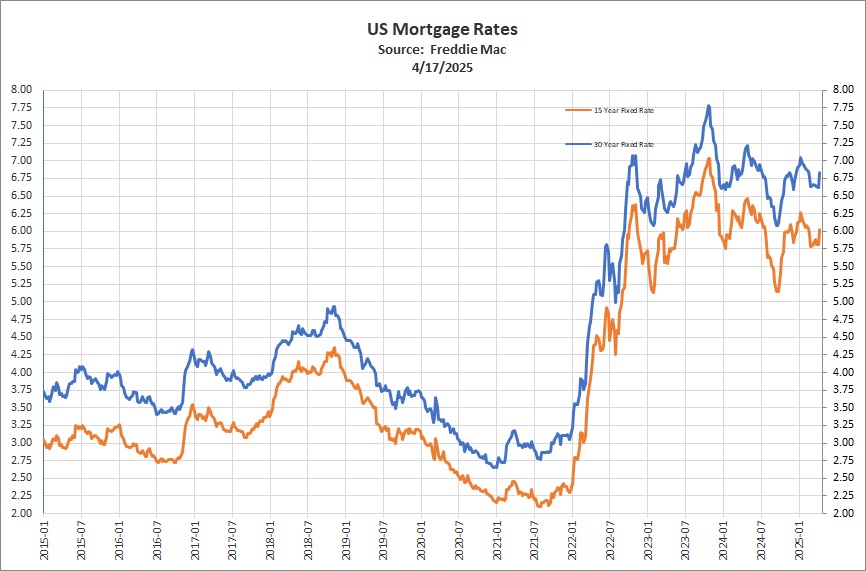
Mortgage Rates
“Mortgage rates are at a 10-month low,” said Sam Khater, Freddie Mac’s Chief Economist. “Purchase demand continues to rise on the back of lower rates and solid economic growth. Though many potential homebuyers still face affordability challenges, consistently lower rates may provide them with the impetus to enter the market.”
The 30-year FRM averaged 6.56% as of August 28, 2025, down from last week when it averaged 6.58%. A year ago at this time, the 30-year FRM averaged 6.35%.
The 15-year FRM averaged 5.69%, unchanged from last week. A year ago at this time, the 15-year FRM averaged 5.51%.
Selected Cryptocurrencies
| Symbol | Name | Price | 24h % | 7d % | Market Cap | Volume(24h) |
| BTC | Bitcoin | $109,751.42 | 0.91% | -0.08% | $2,185,721,641,038 | $64,209,726,807 |
| ETH | Ethereum | $4,336.72 | -1.24% | -1.93% | $523,466,107,550 | $33,549,076,079 |
| XRP | XRP | $2.79 | 1.01% | -3.52% | $166,467,215,858 | $6,100,048,908 |
| BNB | BNB | $847.91 | -0.52% | 0.80% | $118,019,582,512 | $2,443,728,565 |
| SOL | Solana | $201.71 | 1.20% | 7.36% | $109,109,517,131 | $6,216,379,619 |
| TRX | TRON | $0.34 | 0.10% | -2.45% | $31,995,247,014 | $799,283,996 |
| DOGE | Dogecoin | $0.21 | -2.14% | 0.44% | $31,861,453,068 | $2,038,976,473 |
| ADA | Cardano | $0.82 | -0.49% | -2.62% | $29,167,280,089 | $1,103,346,591 |
| LINK | Chainlink | $23.08 | -0.57% | -1.93% | $15,655,364,149 | $1,026,153,628 |
| HYPE | Hyperliquid | $44.26 | -0.96% | -2.11% | $14,782,466,253 | $231,852,969 |
| USDe | Ethena USDe | $1.00 | 0.00% | 0.00% | $12,439,118,602 | $143,998,159 |
| SUI | Sui | $3.25 | -0.13% | -3.79% | $11,609,074,654 | $953,149,917 |
| XLM | Stellar | $0.36 | 1.67% | -6.53% | $11,341,830,775 | $301,018,932 |
| BCH | Bitcoin Cash | $565.16 | 3.31% | 5.38% | $11,258,095,758 | $431,463,567 |
| AVAX | Avalanche | $23.98 | 1.00% | 2.49% | $10,128,693,818 | $687,696,755 |
| HBAR | Hedera | $0.22 | -0.87% | -7.65% | $9,176,230,287 | $242,622,064 |
| LEO | UNUS SED LEO | $9.57 | -0.33% | -0.29% | $8,839,478,059 | $597,809 |
| CRO | Cronos | $0.26 | -5.63% | 61.46% | $8,816,270,190 | $206,134,480 |
Information current as of 5:02 AM PDT, Tuesday, September 2, 2025. Source: https://coinmarketcap.com
Check us out at https://beaconrwa.com and our affiliated website at https://reverse-mortgages.us.
Sources: Ryan Long, CFA, FocusPoint Solutions, American Association for Individual Investors (AAII), Associated Press, Barclays Capital, Bloomberg, Citigroup, Deutsche Bank, FactSet, Financial Times, Goldman Sachs, JPMorgan Asset Management,
MarketfieldAsset Management, Morgan Stanley, MSCI, Morningstar, Northern Trust, Oppenheimer Funds, PIMCO, Standard & Poor’s, StockCharts.com, The Conference Board, Thomson Reuters, T. Rowe Price, U.S. Bureau of Economic Analysis, U.S. Federal Reserve, Wall Street Journal, The Washington Post. Index performance is shown as total return, which includes dividends, with the exception of MSCI-EM, which is quoted as price return/excluding dividends. Performance for the MSCI-EAFE and MSCI-EM indexes is quoted in U.S. Dollar investor terms.
The information above has been obtained from sources considered reliable, but no representation is made as to its completeness, accuracy or timeliness. All information and opinions expressed are subject to change without notice. Information provided in this report is not intended to be, and should not be construed as, investment, legal or tax advice; and does not constitute an offer, or a solicitation of any offer, to buy or sell any security, investment or other product. FocusPoint Solutions, Inc. is a registered investment advisor.
Notes key: (+) positive/encouraging development, (0) neutral/inconclusive/no net effect, (-) negative/discouraging development.