
Your Weekly Update for Monday, September 8, 2025.
Beacon Rock Wealth Advisors is a dba of BR Capital, Inc. It is a financial planning and registered investment advisory firm in Camas, Washington. We are always available to answer your finance questions. Give us a call at (360) 735-1900 or send an email.
If you or someone you know is worried about retirement, send us an email or give us a call for a no-obligation Retirement and Social Security Analysis.
If this information is helpful to you, please forward this to a friend and ask them to subscribe at https://newsletters.beaconrwa.com/subscribe.
Have a great week!
Mike Elerath
CERTIFIED FINANCIAL PLANNERTM
CERTIFIED IN LONG-TERM CARE
Mike.Elerath@beaconrwa.com
Bill Roller
NMLS #107972
CHARTERED FINANCIAL ANALYST
CERTIFIED FINANCIAL PLANNERTM
CHARTERED MARKET TECHNICIAN
bill.roller@beaconrwa.com
For more information about Beacon Rock Wealth Advisors, check out our brochure here: https://beaconrwa.com/beaconrockbrochure/
Click on the image below to go to https://youtu.be/CVxgfK7ooIs to see the video from September 5 in which Mike Elerath and Bill Roller discuss the financial markets.

Please give the video a “Like” and check out our other videos and subscribe to the channel at https://www.youtube.com/@beaconrwa.
Summary
Markets were SLIGHTLY MIXED last week. The Dow Jones Industrial Average was DOWN 0.30% to 45,400.86 while the S&P500 ended DOWN 0.33% TO 6,481.50. The Nasdaq Composite ROSE 1.14% to 21,700.39. The annual yield on the 30-year Treasury FELL 14.2 basis point(s) to 4.775%.
On a holiday-shortened week, economic data included stronger ISM services and manufacturing PMI surveys, while the August employment situation report came in again weaker than expected.
Equities experienced gains worldwide to varying degrees, largely upon hopes of easier Federal Reserve policy. Bonds gained as yields fell in response to weaker jobs data. Commodities were mixed to lower, with higher supplies in a variety of goods.
Economic Notes
(0) The ISM manufacturing PMI index rose by 0.7 of a point to 48.7 in August, just below the 49.0 level expected, and remaining a bit in contraction for the sixth straight month. Within the report, new orders rose over 4 points back into expansion, while employment also rose a half-point, but stayed in contraction. Production also fell several points back into contraction, while prices paid fell a point but remained solidly expansionary at around the 64 level. Tariffs continued to be mentioned nearly 20 times in the report by survey respondents, a few more times than in July, pointing to a continued business focus on negative effects from trade-driven higher costs and uncertainty about final policy. Manufacturing has been rolling along at just under neutral for some time now, with tariff concerns continuing to keep things under water. The S&P Global US manufacturing PMI was revised down by -0.3 to 53.0 in the final August report, bucking the trend in the other ISM report by staying in expansion.
(+) The ISM services/non-manufacturing PMI index for August rose by 1.9 points to 52.0, beating expectations calling for 51.0, and improving from neutral back into expansion. Several underlying indicators were strong as well, including business activity and new orders, each of which rose by several points further into expansion, along with improvement in employment, although that still remained in contraction overall. Overall, two-thirds of industries reported expansion. Prices paid fell by nearly a point, but remained strongly expansionary at the 69 level. Survey respondents noted that at least part of the pickup in activity was caused by “an attempt to get ahead of additional price increases while preparing for the holiday peak season,” as these are starting to appear in “cost of imported goods.” Decision making continues to be “currently dominated by tariff considerations,” which were mentioned 14 times in the report, several times more than the prior month. Perhaps most tellingly, respondents noted that it not their “intention” to pass along tariff costs, but it’s “getting harder as this goes on.” In a separate report, the final S&P Global US services PMI for August was revised up by 0.9 of a point to 54.5, although new business and employment each fell but remained in expansion.
(0) Construction spending declined by -0.1% in July, on par with expectations, and was an improvement on a sharper decline the prior month. While public residential spending rose nearly 2% to lead on the positive side, a drop in private nonresidential spending of -0.5% fared the worst of all groups. As construction costs rose by about 0.4% in the month, ‘real’ spending fell by about -0.5% in July.
(0) Initial jobless claims for the Aug. 30 ending week rose by 8k to 237k, above the 230k median forecast. Continuing claims for the Aug. 23 week, on the other hand, fell by -4k to 1.940 mil., well below the expected increase to 1.958 mil. Initial claims were disbursed by state, with large gains in places like CT, TN, and CA, which could be company and/or industry-specific, but less meaningful elsewhere. Overall levels remain contained and don’t point to claims pressure ramping up.
(-) The JOLTS job openings report for July showed a decline of -176k to 7.181 mil., below the 7.380 mil. expected, and near a multi-year low, with these levels seen in early Jan. 2021. It appeared that most of the decline was due to private education/health services (-181k). The job opening rate fell by -0.1% to 4.3%, while the hiring rate was unchanged at 3.3%. On the departure side, the layoff and quit rates were unchanged at 1.1% and 2.0%, respectively. Putting several data points together, it appears that the vacancy-to-unemployment ratio has fallen below 1 for the first time in a few years, pointing to an abundance of workers relative to companies looking for workers.
(-) The employment situation report for August was a disappointment, at least for those wanting a stronger jobs market, while it was positive news for those hoping for additional ammunition to help along with a September Fed rate cut. Nonfarm payrolls rose by a meager 22k, compared to the 75k expected by consensus. As has been expected lately, there were several revisions, with July payrolls revised up by 6k to 79k, while June was taken down substantially by -13k to 27k. On the positive side for August, job additions were seen in health care (47k, and in keeping with recent strength), leisure (28k, mostly hotels/restaurants), and retail trade (11k). These were offset by declines in professional/business services (-17k), federal government (-15k), mining/oil extraction (-6k), wholesale trade (-12k), and manufacturing (-12k, all from durable goods/transportation as non-durable goods saw a small gain). The U-3 unemployment rate ticked up another tenth to 4.3%, while the U-6 underemployment rate rose two-tenths to 8.1%, along with a rise in self-employed workers and multiple-job holders. Average hourly earnings rose by 0.3% for August, and 3.7% over the past 12 months. The average workweek length was unchanged again at 34.2 hours.
The overall report shows a weakening trend in labor, no doubt. The unemployment rate is several tenths above the recent low point of 4.0% in January, and above the cycle low of 3.4% in April 2023. In reviewing today’s rate in the context of ‘classic’ recession indicators, it’s now above the trailing 12-month and 36-month moving averages (each a recession signal), but it hasn’t again triggered the ‘Sahm Rule’ (a more nuanced calculation, which is no longer pointing to recession). An unemployment rate at this level is by no means ‘high,’ but the risks of a downturn in labor have risen, albeit with the caveats about it being a lagging indicator. However, there have been other measurement issues pointed out by some economists in regard to labor force size and difficulty in measuring recent changes caused by a drop-off in immigration (and deportations, whether actual counts or just the risk of, causing changes in behavior or job availability). This is not to mention a slowdown in hiring as companies hold out for more final trade/tariff announcements before making decisive hiring moves. Some of this also appears to result from skews in sampling techniques, and lower participation rates of those being sampled, seen in other economic surveys as well. At the same time, other data shows that the overall size of the labor force hasn’t changed that much, based on employment-to-population ratios for prime age workers. In real time at least, labor conditions continue to be difficult to measure for a variety of reasons, making the Fed’s job addressing labor a challenging a mandate as it’s ever been.
In an earlier final report, nonfarm productivity growth was revised up by 0.9% to an annualized rate of 2.2% for Q2. Year-over-year, growth was revised up by 0.2% to 1.5%. Similarly, since the 4th quarter of 2019, the last ‘normal’ quarter before the pandemic, productivity has grown at an annualized pace of 1.8%. Of course, hopes are that artificial intelligence will continue to boost these trends, albeit the tendency for technological innovations to help with a lag (as seen with innovations like the internet). Unit labor costs were revised down by -0.6% to a quarterly annualized rate of 1.0% in the final Q2 report, while the year-over-year rate was revised down by a tenth to 2.5%.
Market Notes
| Period ending 9/5/2025 | 1 Week % | YTD % |
| DJIA | -0.26 | 8.03 |
| S&P 500 | 0.37 | 11.20 |
| NASDAQ | 1.16 | 12.89 |
| Russell 2000 | 1.07 | 8.20 |
| MSCI-EAFE | 0.25 | 23.10 |
| MSCI-EM | 1.42 | 20.71 |
| Bloomberg U.S. Aggregate | 0.93 | 5.96 |
| U.S. Treasury Yields | 3 Mo. | 2 Yr. | 5 Yr. | 10 Yr. | 30 Yr. |
| 12/31/2024 | 4.37 | 4.25 | 4.38 | 4.58 | 4.78 |
| 8/29/2025 | 4.23 | 3.59 | 3.68 | 4.23 | 4.92 |
| 9/5/2025 | 4.07 | 3.51 | 3.59 | 4.10 | 4.78 |
U.S. stocks were up slightly, with growth and small cap again outperforming the broader S&P 500. Although it didn’t appear to affect markets too much, during the Labor Day weekend, the Court of Appeals for the Federal Circuit affirmed the Court of International Trade’s May ruling blocking the Trump tariffs placed under the IEEPA (which account for about half of the tariffs placed this year, or 8 percentage points). However, these could remain in place based on acts from the 1960s and 1970s on national security grounds, unfair trade practices, or via persistent trade deficits. However, no changes have been put into effect until next month, or a judgment or other notice comes from the Supreme Court, which could delay things further.
By sector, communications and consumer discretionary led with gains of several percent for the week, while most other areas were flat or experienced declines, led by energy and financials. Real estate was down a fraction of a percent. Within communications, shares of Alphabet soared by over 10% as a federal judge ruled that Google wouldn’t be forced to divest its popular Chrome internet browser to satisfy antitrust concerns.
Foreign stocks were mixed, with developed markets performing similar to U.S. stocks—with gains in Japan offsetting losses in Europe. In Europe, fears of weakening global growth weighed on the region, as did continued government uncertainty in France, and a more hawkish tone from the ECB, with rate cuts having likely come to an end. Emerging market stocks also saw gains, led by Mexico, Taiwan, and South Korea, which may benefit from an overturn or delay in certain U.S. tariff policies.
Bonds gained last week, with U.S. Treasuries and investment-grade corporates rising around a percent last week, along with a drop in long-term yields. This was largely driven by weaker labor market data, noted above, that raised the already-high odds of a Federal Reserve rate cut in September. High yield and floating rate bank loans also gained, albeit to a far lesser degree. Foreign bonds gained as well, despite little change in the dollar, although expectations continue for future dollar weakness along with a Fed cut. Conditions remain mixed overseas, with long-term yields in the U.K. rising to nearly 30-year highs as the Prime Minister announced a cabinet reshuffle, weighing on confidence.
Commodities were down for the most part, with negative results from energy and agriculture, only partially offset by a gain of several percent in precious metals. Crude oil prices fell -3% last week to $62/barrel, upon higher U.S. supplies reported, as well as expectations for OPEC+ to increase production as well (which they did over the weekend). A variety of agricultural contracts, such as wheat and soybeans, have been held down by a good harvest season, raising supply, coupled with tepid demand, at least relative to expectations.
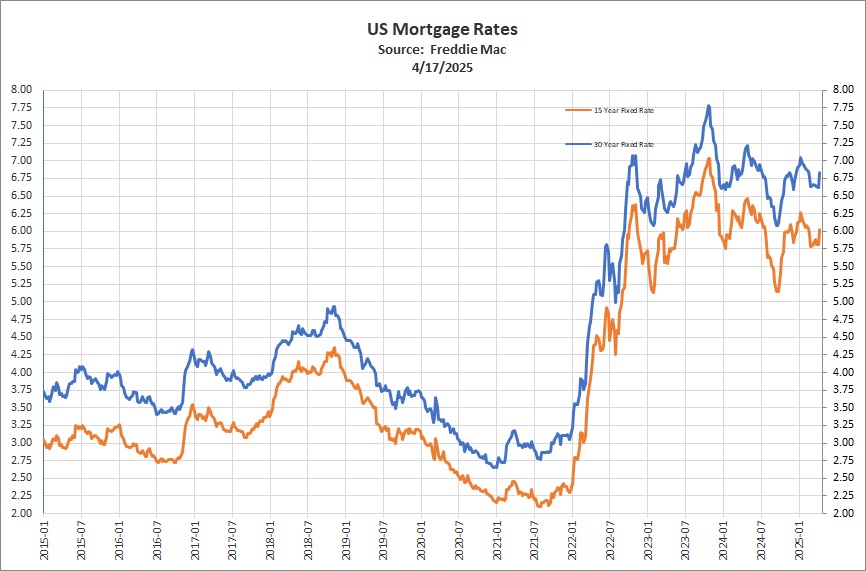
Mortgage Rates
“Mortgage rates continue to trend down, increasing optimism for new buyers and current owners alike,” said Sam Khater, Freddie Mac’s Chief Economist. “As rates continue to drop, the number of homeowners who have the opportunity to refinance is expanding. In fact, the share of market mortgage applications that were for a refinance reached nearly 47%, the highest since October.”
The 30-year FRM averaged 6.50% as of September 4, 2025, down from last week when it averaged 6.56%. A year ago at this time, the 30-year FRM averaged 6.35%.
The 15-year FRM averaged 5.60%, down from last week when it averaged 5.69%. A year ago at this time, the 15-year FRM averaged 5.47%.
Selected Cryptocurrencies
| Symbol | Name | Price | 24h % | 7d % | Market Cap | Volume(24h) |
| BTC | Bitcoin | $112,067.78 | 0.73% | 3.07% | $2,232,151,340,573 | $31,290,171,807 |
| ETH | Ethereum | $4,317.09 | 0.21% | -1.74% | $521,094,877,604 | $22,137,917,711 |
| XRP | XRP | $2.93 | 3.71% | 5.99% | $175,072,827,025 | $5,838,135,428 |
| BNB | BNB | $878.97 | 0.67% | 3.15% | $122,341,614,595 | $2,236,242,205 |
| SOL | Solana | $214.43 | 5.15% | 7.64% | $116,200,644,325 | $7,719,436,420 |
| DOGE | Dogecoin | $0.23 | 6.60% | 8.19% | $35,228,093,227 | $3,197,567,435 |
| TRX | TRON | $0.33 | 1.78% | -1.28% | $31,552,869,336 | $972,804,665 |
| ADA | Cardano | $0.85 | 2.51% | 4.05% | $30,515,534,640 | $1,076,163,610 |
| HYPE | Hyperliquid | $50.51 | 7.13% | 13.18% | $16,869,991,582 | $262,116,932 |
| LINK | Chainlink | $23.01 | 2.81% | -0.82% | $15,603,648,859 | $754,239,109 |
| USDe | Ethena USDe | $1.00 | 0.00% | 0.00% | $12,833,923,458 | $641,214,937 |
| SUI | Sui | $3.47 | 1.74% | 6.93% | $12,411,439,377 | $833,351,765 |
| BCH | Bitcoin Cash | $594.88 | -1.27% | 8.73% | $11,851,662,134 | $523,862,008 |
| XLM | Stellar | $0.37 | 2.84% | 3.75% | $11,695,254,872 | $279,586,250 |
| AVAX | Avalanche | $25.20 | 2.97% | 6.14% | $10,641,803,349 | $482,960,453 |
| HBAR | Hedera | $0.22 | 1.45% | 2.30% | $9,462,024,249 | $196,224,154 |
| LEO | UNUS SED LEO | $9.53 | 0.05% | -0.79% | $8,799,611,916 | $477,828 |
| LTC | Litecoin | $113.39 | -0.72% | 3.56% | $8,649,012,679 | $572,214,706 |
Information current as of 5:02 AM PDT, Monday, September 8, 2025. Source: https://coinmarketcap.com
Check us out at https://beaconrwa.com and our affiliated website at https://reverse-mortgages.us.
Sources: Ryan Long, CFA, FocusPoint Solutions, American Association for Individual Investors (AAII), Associated Press, Barclays Capital, Bloomberg, Citigroup, Deutsche Bank, FactSet, Financial Times, Goldman Sachs, JPMorgan Asset Management,
MarketfieldAsset Management, Morgan Stanley, MSCI, Morningstar, Northern Trust, Oppenheimer Funds, PIMCO, Standard & Poor’s, StockCharts.com, The Conference Board, Thomson Reuters, T. Rowe Price, U.S. Bureau of Economic Analysis, U.S. Federal Reserve, Wall Street Journal, The Washington Post. Index performance is shown as total return, which includes dividends, with the exception of MSCI-EM, which is quoted as price return/excluding dividends. Performance for the MSCI-EAFE and MSCI-EM indexes is quoted in U.S. Dollar investor terms.
The information above has been obtained from sources considered reliable, but no representation is made as to its completeness, accuracy or timeliness. All information and opinions expressed are subject to change without notice. Information provided in this report is not intended to be, and should not be construed as, investment, legal or tax advice; and does not constitute an offer, or a solicitation of any offer, to buy or sell any security, investment or other product. FocusPoint Solutions, Inc. is a registered investment advisor.
Notes key: (+) positive/encouraging development, (0) neutral/inconclusive/no net effect, (-) negative/discouraging development.