
Your Weekly Update for Monday, August 25, 2025.
Beacon Rock Wealth Advisors is a dba of BR Capital, Inc. It is a financial planning and registered investment advisory firm in Camas, Washington. We are always available to answer your finance questions. Give us a call at (360) 735-1900 or send an email.
If you or someone you know is worried about retirement, send us an email or give us a call for a no-obligation Retirement and Social Security Analysis.
If this information is helpful to you, please forward this to a friend and ask them to subscribe at https://newsletters.beaconrwa.com/subscribe.
Have a great week!
Mike Elerath
CERTIFIED FINANCIAL PLANNERTM
CERTIFIED IN LONG-TERM CARE
Mike.Elerath@beaconrwa.com
Bill Roller
NMLS #107972
CHARTERED FINANCIAL ANALYST
CERTIFIED FINANCIAL PLANNERTM
CHARTERED MARKET TECHNICIAN
bill.roller@beaconrwa.com
For more information about Beacon Rock Wealth Advisors, check out our brochure here: https://beaconrwa.com/beaconrockbrochure/
Click on the image below to go to https://youtu.be/Rsf-zhOZHBM to see the video from August 22 in which Mike Elerath and Bill Roller discuss the financial markets.

Please give the video a “Like” and check out our other videos and subscribe to the channel at https://www.youtube.com/@beaconrwa.
Summary
Markets were MIXED last week. The Dow Jones Industrial Average was UP 1.51% to 45,626.64 while the S&P500 ended UP 0.26% TO 6,466.35. The Nasdaq Composite FELL 0.59% to 21,49570. The annual yield on the 30-year Treasury FELL 4.2 basis point(s) to 4.884%.
Economic data included gains in existing home sales and housing starts, while the index of leading economic indicators continued to move in a negative direction. Fed Chair Powell’s comments at their Jackson Hole symposium pointed to higher chances of a September interest rate cut.
Equities gained globally, with hopes for lower U.S. policy yields, with an especially strong week for U.S. small cap. Bonds gained as yields fell across the Treasury curve. Commodities also saw price gains broadly in a variety of segments.
Economic Notes
(+) The S&P Global US manufacturing PMI preliminary August reading moved up by 3.5 points to 53.3, above the decline to 49.7 expected, and moving the index back from contraction to expansion. The underlying components also improved for the most part, with gains in new orders, output, and employment—all in expansion. Input and output prices were mixed for the month, but both remined sharply expansionary. The S&P sponsor noted “stronger demand conditions” by a variety of companies in Q3 and have passed tariff-related costs through to customers increasingly, rather than absorbing them.
(+) The S&P Global US services PMI preliminary August reading fell by -0.3 of a point to 55.4, relative to expectations calling for 54.2. New business and employment improved under the hood, both further into expansion, while prices paid also continued to expand to multi-year highs. Despite the decline, readings in the mid-50’s represent solid expansion relative to historical comparatives.
(+) Existing home sales rose by 2.0% in July to a seasonally-adjusted annualized rate of 4.01 mil. units, exceeding the -0.3% decline expected. Single-family rose 2%, while condos/co-ops were up nearly 3%. Regionally, the Northeast saw the strongest activity, up 9%, while the only decline was in the Midwest, down -1%. The year-over-year sales pace improved in July from flat to 0.8%. At the same time, the median existing home sales price decelerated to a year-over-year pace of 0.2% to $422,400, from a 1.4% gain the prior month. Inventories are up 16% over the past year, to a months’ supply rate of 4.6, just below the roughly 5.0 level considered to be a balanced housing market. Per the NAR, the July report showed a slight “improvement in housing affordability” is helping home sales, as “buyers have more choices” due to higher wage growth. Still, high home prices remain an issue, along with high mortgage financing rates.
(+/0) Housing starts rose 5.2% in July to a seasonally-adjusted pace of 1.428 mil. units, better than the -1.8% decline expected by consensus, and similar to the June rate of growth. These were led by multi-family, up 10%, while single-family starts rose just under 3%. Regionally, these were led by the Midwest and South by region, each up 20-35%, while starts and the West and Northeast each fell by nearly -30%. Relative to a year ago, overall starts are up 13%, led by multi-family up 24%, while single-family were up 8%. Building permits for July fell by -2.8% to a 1.354 mil. rate, a bit worse than the -0.5% decline expected. These were led downward by multi-family, declining -8%, with a small gain in single-family, with the Northeast leading the way. Homebuilder sentiment also deteriorated again in July, which has been in negative territory for a year and a half, as high home prices and mortgage rates continue to weigh on buying activity.
(-) Initial jobless claims for the Aug. 16 ending week rose by 11k to 235k, above the median forecast of 224k. Continuing claims for the Aug. 9 week rose by 30k to 1.972 mil., above the lesser rise to 1.960 mil. expected. Initial claims rose in KY and MA, while they fell a bit in FL, with no major trends apparent in either direction.
(-) The Conference Board’s Index of Leading Economic Indicators fell by -0.1% in July, which was a slight improvement on the -0.3% decline in June. Indicators for the month were mixed, with strength in S&P 500 stock prices, credit, and jobless claims offset by weakness in consumer expectations, ISM new orders, and building permits. Over the past six months ending in July, the LEI declined -2.7%, which was worse than the -1.0% for the prior six months of Jul. 2024 to Jan. 2025. For the semiannual time frame, the LEI was pulled down by consumer expectations and ISM new orders, which overwhelmed most other factors with less severe moves. Per The Conference Board, “Pessimistic consumer expectations for business conditions and weak new orders continued to weigh down the index,” and while the six-month indicator remained negative and improved a bit for July, it “was not enough to avoid triggering the recession signal again.” However, they don’t currently project a recession, but do expect the economy to weaken in the second half of the year, “as the negative impacts from tariffs become more visible,” with a year-over-year growth rate of 1.6% for 2025 and 1.3% in 2026.
(0) The FOMC minutes from the July meeting pointed to the “majority” of participations seeing upside risks to inflation, which outweighed downside risks to employment. However, the sticking point was that the meeting occurred just a few days before the July nonfarm payrolls report, which featured disappointing prior month revisions, and raised the odds of a Sept. cut. Committee members expressed a range of views on how tariffs will affect the economy—mostly on the timing, amounts, and longevity of those effects. Therefore, several members are relying on future inflation reports to provide more color on tariff price impacts. However, other members felt the committee shouldn’t wait for “complete clarity” on tariff inflation effects before making a potential change in policy. That said, it was noted that “several” members felt that the current Fed funds rate “may not be far” above the neutral rate. These minutes didn’t provide much information we didn’t already know, but did point to the divergence of committee views largely tied to tariff unknowables; hence, they’re difficult to easily resolve without more information. From the perspective of their regular monetary policy framework review, they adjusted some of the language from “shortfalls” to “deviations” in both directions from maximum employment and a return to “flexible” inflation targeting (instead of flexible “average” inflation targeting that allowed for inflation to run ‘hot’ or ‘cool’ after periods of the opposite).
Market Notes
| Period ending 8/22/2025 | 1 Week % | YTD % |
| DJIA | 1.59 | 8.42 |
| S&P 500 | 0.30 | 10.88 |
| NASDAQ | -0.55 | 11.80 |
| Russell 2000 | 3.32 | 6.82 |
| MSCI-EAFE | 0.84 | 24.58 |
| MSCI-EM | -0.41 | 19.93 |
| Bloomberg U.S. Aggregate | 0.43 | 4.82 |
| U.S. Treasury Yields | 3 Mo. | 2 Yr. | 5 Yr. | 10 Yr. | 30 Yr. |
| 12/31/2024 | 4.37 | 4.25 | 4.38 | 4.58 | 4.78 |
| 8/15/2025 | 4.30 | 3.75 | 3.85 | 4.33 | 4.92 |
| 8/22/2025 | 4.27 | 3.68 | 3.76 | 4.26 | 4.88 |
U.S. stocks saw moderate gains, with flattish returns most of the week, and investors waiting for Friday’s keynote speech from Fed Chair Powell at their annual Jackson Hole Symposium, where a variety of economic and monetary policy matters are discussed. The hope (from markets anyway) was for more concrete hints of September rate cuts. The speech was seen as dovish by markets, which pushed stocks higher by over a percent. Specifically, he noted that the underlying outlook and “shifting balance of risks may warrant adjusting our policy stance,” and that lower immigration “suggests that downside risks to employment are rising,” and potential risks could materialize quickly if they did occur.
For the week, small cap stocks strongly outperformed large cap, and value outperformed growth, each of which seen as being stronger beneficiaries of Fed rate cuts. By sector, energy, materials, and financials led the way up several percent, with the only laggard being technology, down over 1%, led by several Magnificent 7 stocks. Real estate also gained several percent for the week, with hopes for more accommodative interest rates in coming months.
Foreign stocks also saw gains, led by the U.K., which outperformed Europe and Japan, the latter being the only one to lose ground for the week. Sentiment appeared to be driven by strength in European business activity, easier U.S. Fed policy, as well as hopes for progress in the Russia-Ukraine peace talks. Emerging markets were flattish overall, with gains in China and Brazil offset by declines elsewhere.
Bonds gained across the board as yields fell across the U.S. Treasury curve, with governments, investment-grade credit, and high yield performing similarly. Foreign bonds performed in line with domestic, with little change in the value of the U.S. dollar for the week.
Commodities rose across the board, with all of the major groups up several percent, led by energy. Crude oil prices rose over a percent last week to $64/barrel, as domestic inventories fell, while natural gas prices declined over -7% as summer temperatures cooled off in much of the country and the high-demand summer season is coming to an end during the next few weeks.
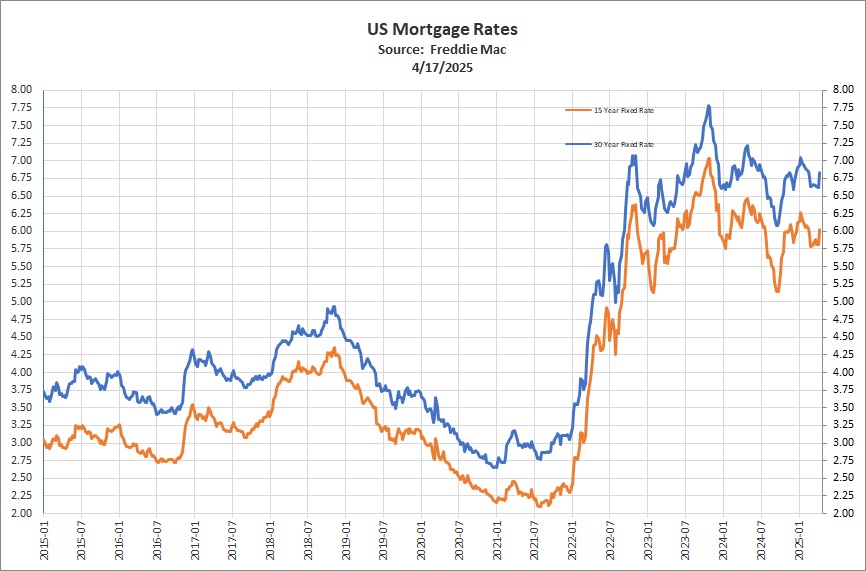
Mortgage Rates
“The 30-year fixed-rate mortgage remained flat this week,” said Sam Khater, Freddie Mac’s Chief Economist. “Over the summer, rates have come down and purchase applications are outpacing 2024, though a number of homebuyers continue waiting on the sideline for rates to further decrease.”
The 30-year FRM averaged 6.58% as of August 21, 2025, unchanged from last week. A year ago at this time, the 30-year FRM averaged 6.46%.
The 15-year FRM averaged 5.69%, down slightly from last week when it averaged 5.71%. A year ago at this time, the 15-year FRM averaged 5.62%.
Selected Cryptocurrencies
| Symbol | Name | Price | 24h % | 7d % | Market Cap | Volume(24h) |
| BTC | Bitcoin | $111,502.59 | -2.71% | -3.33% | $2,220,164,343,886 | $83,655,293,706 |
| ETH | Ethereum | $4,629.78 | -2.51% | 6.87% | $558,848,237,131 | $63,413,193,799 |
| XRP | XRP | $2.95 | -1.84% | -0.82% | $175,724,427,431 | $7,724,637,150 |
| BNB | BNB | $857.43 | -0.35% | 2.47% | $119,430,508,695 | $3,151,232,300 |
| SOL | Solana | $197.16 | -3.36% | 8.16% | $106,556,082,755 | $13,867,986,040 |
| TRX | TRON | $0.35 | -3.27% | 1.74% | $33,419,445,139 | $1,715,783,962 |
| DOGE | Dogecoin | $0.22 | -4.46% | -1.85% | $33,063,817,363 | $4,026,801,089 |
| ADA | Cardano | $0.87 | -3.11% | -4.58% | $30,960,222,217 | $2,870,051,271 |
| LINK | Chainlink | $24.40 | -4.31% | -2.93% | $16,548,689,815 | $2,228,096,065 |
| HYPE | Hyperliquid | $45.56 | 4.70% | 4.50% | $15,214,620,609 | $326,672,075 |
| XLM | Stellar | $0.40 | -2.65% | -3.18% | $12,390,094,902 | $393,249,469 |
| SUI | Sui | $3.47 | -4.15% | -2.69% | $12,199,466,643 | $2,022,457,384 |
| USDe | Ethena USDe | $1.00 | 0.00% | -0.08% | $12,089,504,004 | $262,439,269 |
| BCH | Bitcoin Cash | $564.41 | -5.26% | -0.04% | $11,241,003,825 | $384,373,190 |
| AVAX | Avalanche | $24.26 | -3.15% | 1.51% | $10,248,240,392 | $1,038,334,125 |
| HBAR | Hedera | $0.24 | -2.78% | -2.16% | $10,079,071,568 | $438,044,583 |
| LEO | UNUS SED LEO | $9.49 | -0.89% | 0.22% | $8,766,998,539 | $1,084,898 |
| LTC | Litecoin | $111.98 | -5.68% | -4.46% | $8,536,428,929 | $1,061,967,266 |
Information current as of 5:45 AM PDT, Monday, August 25, 2025. Source: https://coinmarketcap.com
Check us out at https://beaconrwa.com and our affiliated website at https://reverse-mortgages.us.
Sources: Ryan Long, CFA, FocusPoint Solutions, American Association for Individual Investors (AAII), Associated Press, Barclays Capital, Bloomberg, Citigroup, Deutsche Bank, FactSet, Financial Times, Goldman Sachs, JPMorgan Asset Management,
MarketfieldAsset Management, Morgan Stanley, MSCI, Morningstar, Northern Trust, Oppenheimer Funds, PIMCO, Standard & Poor’s, StockCharts.com, The Conference Board, Thomson Reuters, T. Rowe Price, U.S. Bureau of Economic Analysis, U.S. Federal Reserve, Wall Street Journal, The Washington Post. Index performance is shown as total return, which includes dividends, with the exception of MSCI-EM, which is quoted as price return/excluding dividends. Performance for the MSCI-EAFE and MSCI-EM indexes is quoted in U.S. Dollar investor terms.
The information above has been obtained from sources considered reliable, but no representation is made as to its completeness, accuracy or timeliness. All information and opinions expressed are subject to change without notice. Information provided in this report is not intended to be, and should not be construed as, investment, legal or tax advice; and does not constitute an offer, or a solicitation of any offer, to buy or sell any security, investment or other product. FocusPoint Solutions, Inc. is a registered investment advisor.
Notes key: (+) positive/encouraging development, (0) neutral/inconclusive/no net effect, (-) negative/discouraging development.