
Your Weekly Update for Monday, September 22, 2025.
Beacon Rock Wealth Advisors is a dba of BR Capital, Inc. It is a financial planning and registered investment advisory firm in Camas, Washington. We are always available to answer your finance questions. Give us a call at (360) 735-1900 or send an email.
If you or someone you know is worried about retirement, send us an email or give us a call for a no-obligation Retirement and Social Security Analysis.
If this information is helpful to you, please forward this to a friend and ask them to subscribe at https://newsletters.beaconrwa.com/subscribe.
Have a great week!
Mike Elerath
CERTIFIED FINANCIAL PLANNERTM
CERTIFIED IN LONG-TERM CARE
Mike.Elerath@beaconrwa.com
Bill Roller
NMLS #107972
CHARTERED FINANCIAL ANALYST
CERTIFIED FINANCIAL PLANNERTM
CHARTERED MARKET TECHNICIAN
bill.roller@beaconrwa.com
For more information about Beacon Rock Wealth Advisors, check out our brochure here: https://beaconrwa.com/beaconrockbrochure/
We were travelling last Friday, but click on the image below to go to https://youtu.be/-PBG4M8HCRk to see the video from September 12 in which Mike Elerath and Bill Roller discuss the financial markets.

Please give the video a “Like” and check out our other videos and subscribe to the channel at https://www.youtube.com/@beaconrwa.
Summary
Markets were UP last week. The Dow Jones Industrial Average was UP 1.05% to 46,315.27 while the S&P500 ended UP 1.22% TO 6,664.36. The Nasdaq Composite ROSE 2.21% to 22,631.48. The annual yield on the 30-year Treasury ROSE 7.7 basis point(s) to 4.756%.
Economic data include the Federal Reserve reducing policy short-term interest rates by a quarter-percent, as expected. Gains were seen in retail sales and industrial production, regional manufacturing surveys saw mixed results, while housing starts and homebuilder sentiment continued to weaken.
Equities rose in the U.S. and internationally for the most part, buoyed by easier central bank policy. Bonds were mixed to lower, along with higher longer-term rates. Commodities declined in several sectors.
Economic Notes
(0) The FOMC meeting ended with a quarter-percent rate cut, with newly-appointed governor Miran dissenting in favor of a half-percent cut. There has been rising debate about political influence on the FOMC, but concerns have vascillated over the years, most notably flaring up in the 1960s and 1970s. Global markets have been sensitive to the latest worries about of Fed independence, although worries seem to have remained on the back burner for now. Pessimists noted that dissents by Govs. Waller and Bowman in July were possible attempts to boost their respective candidacies for Fed chair in 2026, with Miran’s dissent last week in favor of a deeper cut being a nod to the administration. On the less conspiratorial side, internal FOMC member views have diverged for a while in assessing risks between inflation and labor, with each data point changing the goal posts a bit. Lately, inflation has taken a back seat to labor market concerns. At the post-meeting press conference, Chair Powell described the change in policy as a “risk management cut,” alluding to attempts to offset rising weakness in labor markets. This appears to be a shift in thinking from a focus on inflation only to more of a balanced view of inflation and labor risks, but financial markets took this a bit more hawkishly than expected. Based on past trends, this could be the first cut of several, but future data will dictate the speed and depth.
(+) Retail sales rose 0.6% in August, matching the increase of the prior month, and exceeded the 0.2% median forecast. Removing autos boosted the gain to 0.7%, similar to the core/control sales measure that omits the most volatile categories of gasoline, building materials, and autos. Under the hood, overall gains were led by non-store/internet retail, which gained 2%, in addition to clothing, sporting goods, and food services; the non-core segments of autos and gasoline were each up 0.5%. Declines were most pronounced in misc. retail and department stores, each down -1% as well as furniture stores. As is usually the case around this time of year, there appeared to be a combination of summer leisure spending along with back-to-school purchases. Over the past year, total retail sales were up 5%, led by autos on the core side, and nearly double that over the past quarter or so, pointing to ongoing strength in consumer behavior (in contrast to the pessimistic consumer sentiment out there, which has not led to less buying).
(+/0) Industrial production rose 0.1% in August, a bit better than the -0.1% expected and decline of the prior month. Manufacturing production fared a bit better, up 0.2%, led by a 6% rise in motor vehicle assemblies, with mining (including both metals and petroleum extraction) up nearly 1%, but weather-related utilities production down -2% for the month. Year-over-year, total industrial production was up just under 1%, with leadership in high-tech equipment (14%) and business equipment (4%) offsetting more modest results in other segments. Capacity utilization was unchanged at 77.4%. Manufacturing has certainly taken on more of a tech-related and artificial intelligence theme as data center buildout continues with hopes for AI-related productivity gains, although the timeframe for realization remains less clear.
(-) The New York Fed Empire manufacturing index fell by -20.6 points to a contractionary -8.7 level in September, below the median forecast of 5.0. The underlying segments within the report also showed weakness, as new orders fell by -35.0 points to the -19.6 contractionary level, a drop in shipments, and lesser decline in employment. Prices paid fell by -8 points to 46, which is the lowest level in six months, interestingly pointing to weaker inflation pressures. The 6-months-ahead business conditions index fell by -1.2 points to 14.8, remaining quite positive.
(+) The Philadelphia Fed manufacturing index, on the other hand, rose 23.5 points to 23.2, a strongly positive and expansionary result, compared to the near-neutral 1.7 level expected. New orders and shipments each rose 15-20 points, while employment ticked down a bit. Prices paid declined sharply, by -20 points to a contractionary level of 47. The 6-mo.-ahead business conditions index rose by over 6 points to 31.5. The New York and Philadelphia indexes have been historically useful on the margin to assess U.S. manufacturing activity in two large production regions. However, as of late, they have each experienced higher than average volatility, due to differences in inventory and labor conditions, and are moving in unique directions, which perhaps lessens their usefulness on a national basis.
(-) Housing starts declined by -8.5% in August to a seasonally-adjusted annualized pace of 1.307 mil. units, below the -4.4% decline expected by consensus, although it featured a minor revision upward for the prior month. By segment, multi-family starts fell -12% and single-family by -7%. Regionally, the West saw a sharp 30% gain, followed by the Northeast at 9%, while the South and Midwest saw double-digit declines to pull down the national figure. For the trailing 12 months, starts were down -6%, which hid a significant divergence between single-family starts down -12% and multi-family up 9%. Building permits fell by -3.7% to a rate of 1.312 mil. units, below the expected 0.6% increase, and the lowest level since June 2020. Here too, multi-family led the decline, down -6%, while single-family permits fell just over -2%. The West saw a 10% rise in permits, while they declined elsewhere. Over the past year, permits are down 10-12% for both the single- and multi-family sectors. Housing starts continue to be challenged, as builders continue to be focused on completing current projects, with still-high mortgage rates and overall affordability weighing on the market.
(-) On another housing note, the NAHB homebuilder sentiment index was steady at 32 in September, which represented the lowest reading in three years, although the level has stayed fairly consistent for the past five months. Poor sentiment continued, as a 50 reading notes a neutral level, while a score below that indicates more bearishness about conditions. By segment, current sales came in at 35, sales expectations were a bit better at 45, while prospective buyer traffic was worst at 21. Anecdotal comments noted that nearly 40% of builders were cutting prices, with an average price reduction of -5%, along with sales incentives.
(+) Initial jobless claims for the Sep. 13 ending week fell by a sharp -33k to 231k, below the 240k median forecast. Continuing claims for the Sep. 6 week fell by -7k to 1.920 mil., well under the 1.950 mil. expected by consensus. Interestingly, the Texas Workforce Commission confirmed that the prior week’s spike in TX claims reflected a sizeable number of fraudulent filings, which have since at least partially reversed; other areas of claim declines included MI, CA, CT, NJ, and IL. Some of the latter could be due to seasonal factors around Labor Day, but overall levels have calmed a bit.
(-) The Conference Board’s Index of Leading Economic Indicators fell by -0.5% in August, the largest monthly decline since April, and again triggered the recession signal. This followed a small 0.1% rise in July (which had been upwardly revised from the initially-reported -0.1% decline). Of the ten economic inputs, the stronger areas in August included stock prices and credit indicators, while larger declines were experienced in consumer expectations, average weekly hours, building permits, and ISM new orders. For the last six months, the LEI had fallen by -2.8%, a deeper decline than the -0.9% drop for the prior semiannual period of Aug. 2024 through Feb. 2025. Over the most recent six months, consumer expectations, ISM new orders, and building permits were the key negative drivers, being offset partially on the positive side by stock prices and credit. In their commentary, The Conference Board noted that, aside from the indicated manufacturing and consumer sentiment weakness, “labor market developments also weighed on the Index with an increase in unemployment claims and a decline in average weekly hours in manufacturing.” Also, that “the LEI suggests that economic activity will continue to slow,” based on the driver of “higher tariffs,” which have already reduced 1st half 2025 growth, and they expect will continue as a drag into the 2nd half of 2025 and the 1st half of 2026. While they don’t forecast a recession currently, they expect GDP to grow by only 1.6% this year, a sharp slowdown from the 2.8% of last year.
Question of the Week: How do financial markets tend to perform after Fed rate cuts?
Generally well, but it has depended on the environment, cycle, and reasons for the rate cuts—whether they’re done for ‘maintenance’ purposes (getting rates back to a ‘neutral’ level) or in response to a sharply slowing economy (with higher recession risk). Last week’s cuts and the debate beforehand appeared to be more of the former, but rising labor concerns point to rising elements of the latter.
U.S. stocks have tended to perform positively if the economy stays on track and a recession is avoided. It also depends on whether last week was viewed as a ‘starting’ rate cut, or just a continuation of 2024’s cuts after a long pause—the timing of cycles can be subject to interpretation. In just looking at the nine starting rate cuts since 1980, the 1-year average gain for all periods was just under +5%, which included -19% for the three recessions that flared up around when the Fed began cuts, and +16% for the six non-recessions. The 2-year average gain for stocks was a cumulative +21% for all periods, -14% for the three recessions, and +41% for the five non-recessions. (Figures use daily S&P 500 price returns, not including dividends, per Federal Reserve data and FPS calculations.)
Lower interest rates decrease borrowing costs and discount rates, used to determine the present value of future cash flows. Easier policy has tended to provide a boost toward a stronger economy and spending, corporate revenue, and finally earnings generally, as opposed to it being a headwind. However, if a recession hits, stocks have tended to go underwater for a stretch. Over time, stock prices have tended to follow earnings, and a recession runs the risk of pulling earnings growth down into the negative, which can affect the risk-taking sentiment toward stocks. Today’s earnings remain positive, as is GDP growth, which adds to the potential for better outcomes. Currency movements can be fickle as well, but falling interest rates have historically pointed to greater chances of a falling U.S. dollar, which can provide a tailwind for international investments and assets like commodities.
Bond returns tend to be driven by the direction of interest rate changes, in addition to starting yields. At face value, a rate cut would seem like a no-brainer for fixed income, but FOMC policy rates only impact the short-term end of the Treasury yield curve. Long-term rates have been driven by longer-term considerations like expected secular inflation and trend economic growth levels, as well as other factors like a term premium, discussed more often today with concerns about rising debt levels and deficits. That caveat aside, Fed cuts tend to lower short-term rates generally, which often steepens the curve. Longer rates can fall as well, though, and fall further, if recession risks are perceived to have increased or long-term assumptions evolve, as investors seek out ‘safe haven’ assets. It’s an inexact science, though, and the different responses on each end of the curve explain why odd events like inverted yield curves can happen.
For very conservative portfolios, those owning lower-risk financial vehicles like money market mutual funds and bank savings accounts will likely be less thrilled. Yields for these products tend to be variable, and tied to short-term Treasury rates, so have tended to fall quickly in response to Fed easing. Cash rates have enticing for a few years, upwards of 4% for many products, but a drop can make the after-inflation real rates less attractive on a longer-term basis. In past cycles, falling short rates have served to push some investors further out onto the fixed income yield curve into longer maturities to improve returns, into credit, or toward other assets like stocks if prospects are viewed as better. But, this again has depended on the environment, and naturally investor time horizon and risk tolerance.
Market Notes
| Period ending 9/19/2025 | 1 Week % | YTD % |
| DJIA | 1.10 | 10.28 |
| S&P 500 | 1.25 | 14.39 |
| NASDAQ | 2.22 | 17.76 |
| Russell 2000 | 2.19 | 10.88 |
| MSCI-EAFE | -0.18 | 24.30 |
| MSCI-EM | 1.19 | 26.99 |
| Bloomberg U.S. Aggregate | -0.19 | 6.20 |
| U.S. Treasury Yields | 3 Mo. | 2 Yr. | 5 Yr. | 10 Yr. | 30 Yr. |
| 12/31/2024 | 4.37 | 4.25 | 4.38 | 4.58 | 4.78 |
| 9/12/2025 | 4.08 | 3.56 | 3.63 | 4.06 | 4.68 |
| 9/19/2025 | 4.03 | 3.57 | 3.68 | 4.14 | 4.75 |
U.S. stocks continued a streak of gains, as the Fed lowered interest rates, which boosted small cap stocks, assumed to be especially helped by the dovish move. A phone call between the U.S. and Chinese presidents helped sentiment by Friday, with rising hopes for more solidified trade agreements, and resulting in an apparent agreement on TikTok. It was also an important options expiry week, which can add to volatile moves. In a new initiative, the administration has floated the idea of reducing quarterly corporate earnings releases to semiannually, more in keeping with several international regions. There are pros and cons to such a move, which would require SEC approval. A government shutdown remains a strong possibility, with Congress working on a draft package to extend the deadline from Sep. 30 to late November, as the new fiscal year begins on Oct. 1. A package was passed by the House on Friday, but not by the Senate. Negotiations continue into this week.
By sector, conditions were mixed for the week, with communications services and technology each up several percent, while consumer staples and materials saw declines of about a percent. Real estate also fell back more than a percent as interest rates ticked up. Communications stocks were led by Alphabet and Meta, while technology gains were led by Thursday’s announcement that Nvidia was taking a $5 bil. stake in Intel, boosting both stocks, as well as Apple following their annual new product roll-out.
Foreign stocks were little-changed in developed markets, with gains in Europe offset by weakness in the U.K. and little change in Japan. In addition to the U.S. Fed, the banks of Canada and Norway also cut rates, while the Bank of England and Bank of Japan each remained on hold. Emerging market stocks experienced gains, led by Turkey and Brazil.
Bonds were mixed, with U.S. Treasuries and investment-grade corporates falling back, along with higher yields, while high yield and floating rate bank loans saw small gains. A stronger dollar held down developed market bonds, while emerging market debt was mixed.
Commodities lost ground on average, with small gains in precious metals offset by declines in agriculture, industrial metals, and energy. Crude oil prices were little-changed, ending at just under $63/barrel. Drops in sugar and soybean prices were the primary downward contracts last week, due to a blend of weak U.S. soybean sales to China, tariff impacts on Brazil, and some mixed weather and labor news during harvest time.
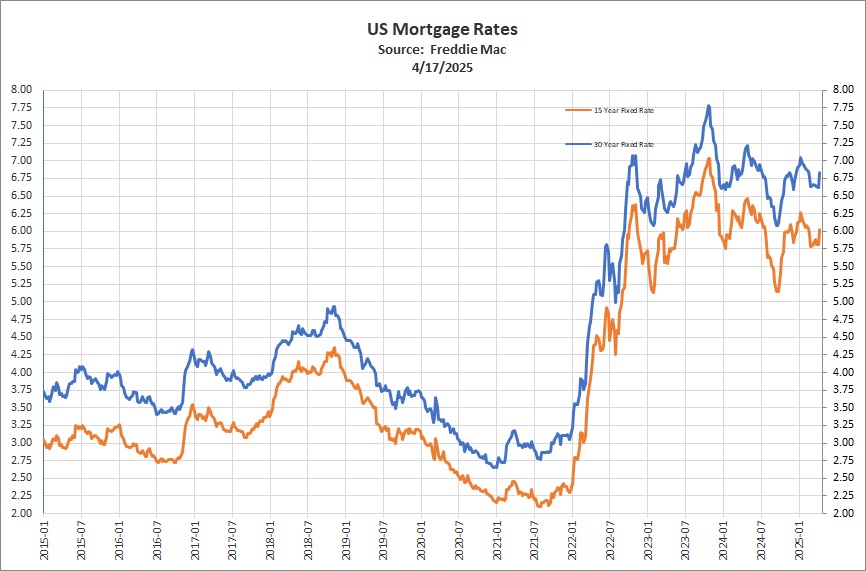
Mortgage Rates
“Mortgage rates decreased yet again this week, prompting many homeowners to refinance. In fact, the share of mortgage applications that were refinances reached nearly 60%, the highest since January 2022,” said Sam Khater, Freddie Mac’s Chief Economist.
The 30-year FRM averaged 6.26% as of September 18, 2025, down from last week when it averaged 6.35%. A year ago at this time, the 30-year FRM averaged 6.09%.
The 15-year FRM averaged 5.41%, down from last week when it averaged 5.50%. A year ago at this time, the 15-year FRM averaged 5.15%.
Selected Cryptocurrencies
| Symbol | Name | Price | 24h % | 7d % | Market Cap | Volume(24h) |
| BTC | Bitcoin | $112,657.23 | -2.69% | -1.92% | $2,244,503,447,551 | $53,814,866,728 |
| ETH | Ethereum | $4,187.52 | -6.35% | -7.33% | $505,449,723,740 | $49,144,998,555 |
| XRP | XRP | $2.82 | -5.47% | -5.81% | $168,664,480,106 | $7,718,962,272 |
| BNB | BNB | $1,023.54 | -3.11% | 11.22% | $142,463,837,237 | $4,373,532,028 |
| SOL | Solana | $221.88 | -7.52% | -6.28% | $120,547,238,481 | $9,346,018,386 |
| DOGE | Dogecoin | $0.24 | -10.17% | -9.09% | $36,292,757,710 | $4,934,066,203 |
| TRX | TRON | $0.34 | -0.82% | -1.31% | $32,313,050,426 | $1,210,016,998 |
| ADA | Cardano | $0.83 | -7.03% | -4.39% | $29,539,780,235 | $2,156,865,237 |
| HYPE | Hyperliquid | $49.17 | -6.60% | -8.19% | $16,419,259,209 | $567,415,053 |
| LINK | Chainlink | $21.42 | -7.81% | -8.39% | $14,528,703,082 | $1,241,956,445 |
| USDe | Ethena USDe | $1.00 | 0.06% | 0.01% | $14,135,531,267 | $421,717,656 |
| AVAX | Avalanche | $31.92 | -3.34% | 11.04% | $13,481,804,133 | $1,324,260,558 |
| SUI | Sui | $3.37 | -7.45% | -4.18% | $12,055,331,339 | $1,529,613,344 |
| XLM | Stellar | $0.36 | -7.11% | -5.74% | $11,411,472,111 | $319,036,853 |
| BCH | Bitcoin Cash | $572.43 | -4.86% | -3.62% | $11,407,983,150 | $469,306,757 |
| HBAR | Hedera | $0.22 | -8.43% | -6.82% | $9,226,517,998 | $308,969,715 |
| LEO | UNUS SED LEO | $9.48 | -0.31% | -0.60% | $8,748,256,396 | $1,647,850 |
| LTC | Litecoin | $106.04 | -8.02% | -6.78% | $8,094,228,139 | $825,725,429 |
Information current as of 5:30 AM PDT, Monday, September 22, 2025. Source: https://coinmarketcap.com
Check us out at https://beaconrwa.com and our affiliated website at https://reverse-mortgages.us.
Sources: Ryan Long, CFA, FocusPoint Solutions, American Association for Individual Investors (AAII), Associated Press, Barclays Capital, Bloomberg, Citigroup, Deutsche Bank, FactSet, Financial Times, Goldman Sachs, JPMorgan Asset Management,
MarketfieldAsset Management, Morgan Stanley, MSCI, Morningstar, Northern Trust, Oppenheimer Funds, PIMCO, Standard & Poor’s, StockCharts.com, The Conference Board, Thomson Reuters, T. Rowe Price, U.S. Bureau of Economic Analysis, U.S. Federal Reserve, Wall Street Journal, The Washington Post. Index performance is shown as total return, which includes dividends, with the exception of MSCI-EM, which is quoted as price return/excluding dividends. Performance for the MSCI-EAFE and MSCI-EM indexes is quoted in U.S. Dollar investor terms.
The information above has been obtained from sources considered reliable, but no representation is made as to its completeness, accuracy or timeliness. All information and opinions expressed are subject to change without notice. Information provided in this report is not intended to be, and should not be construed as, investment, legal or tax advice; and does not constitute an offer, or a solicitation of any offer, to buy or sell any security, investment or other product. FocusPoint Solutions, Inc. is a registered investment advisor.
Notes key: (+) positive/encouraging development, (0) neutral/inconclusive/no net effect, (-) negative/discouraging development.