
Your Weekly Update for Monday, November 24, 2025.
Beacon Rock Wealth Advisors is a dba of BR Capital, Inc. It is a financial planning and registered investment advisory firm in Camas, Washington. We are always available to answer your finance questions. Give us a call at (360) 735-1900 or send an email.
If you or someone you know is worried about retirement, send us an email or give us a call for a no-obligation Retirement and Social Security Analysis.
If this information is helpful to you, please forward this to a friend and ask them to subscribe at https://newsletters.beaconrwa.com/subscribe.
Have a great week!
Mike Elerath
CERTIFIED FINANCIAL PLANNERTM
CERTIFIED IN LONG-TERM CARE
Mike.Elerath@beaconrwa.com
Bill Roller
NMLS #107972
CHARTERED FINANCIAL ANALYST
CERTIFIED FINANCIAL PLANNERTM
CHARTERED MARKET TECHNICIAN
bill.roller@beaconrwa.com
For more information about Beacon Rock Wealth Advisors, check out our brochure here: https://beaconrwa.com/wp-content/uploads/2024/12/BeaconRockBrochure.pdf
Markets are closed on Thursday, November 27 in honor of Thanksgiving and will close at 10 AM on Friday, November 28!

We were travelling last week but click on the image below to go https://youtu.be/H5zyxH75oYM to see the video from November 14 in which Mike Elerath and Bill Roller discuss the financial markets.

Please give the video a “Like” and check out our other videos and subscribe to the channel at https://www.youtube.com/@beaconrwa.
Summary
Markets were DOWN last week. The Dow Jones Industrial Average was DOWN 1.91% to 46,245.41 while the S&P500 ended DOWN 1.95% TO 6,602.98. The Nasdaq Composite FELL 2.74% to 22,273.08. The annual yield on the 30-year Treasury FELL 3.2 basis point(s) to 4.715%.
Economic data began to slowly flow again, following the record-long government shutdown, although scheduling remains delayed for a variety of releases. Last week’s highlights included the employment situation report for September coming in a bit stronger than expected, a rise in existing home sales, and improvement in several PMI surveys. However, consumer sentiment remained weak.
Equities fell back globally due to investor concerns about technology stock valuations, potential economic slowing, and an uncertain Fed rate path. Bonds fared well as interest rates fell back. Commodities fell across the board, especially in energy.
Economic Notes
(+) The Atlanta Fed GDPNow measure, seeing few changes over the past few weeks due to lack of released data, shows a Q3-2025 growth rate of 4.2%. The accompanying Blue Chip economist consensus has also risen to the 2.5-3.0% range, having steadily improved since August. The bulk of GDP categories remained in the positive, led by personal spending at 2.3% of total growth, but also net exports, private fixed investment (data centers), and inventories. The sole negative input remains residential investment, which has been the case for months.
(0) The preliminary S&P Global U.S. manufacturing PMI report for November fell by -0.6 of a point to 51.9, just a tenth below expectations and continuing in the expansion category. Underlying data included a -3 point drop in new orders as well as output, although both remained expansionary. Employment rose slightly, by a point to a more expansionary 52 level, and future output rose by 4 points to a very expansionary 70. Their commentary noted that data “point to a relatively buoyant US economy” and rising “business confidence about prospects in the year ahead,” helped by “hopes for further interest rate cuts” and end of the government shutdown. This has led by better optimism about the economy and “reduced concerns” about the political environment. However, the “accumulation of unsold inventory” hints at potentially slower production in coming months. The rate of hiring “continues to be constrained” by worries over costs, which are “in turn linked to tariffs.” This was a more buoyant assessment than the ISM Manufacturing PMI, and shows some signs of light for 2026.
(0) The preliminary S&P Global U.S. services PMI report ticked up by 0.2 of a point to 55.0 in November, just above the expected 54.6 median forecast. The composition was mixed here as well, with new business up 2 points to 56, while employment fell by a fraction of a point to 51, staying in expansion. Input and output prices also rose several points each, both further into expansion. Services continue to plug along in the low- to mid-50’s, which is a normal expansionary zone with far less cyclicality and tariff effects compared to manufacturing sectors.
(+) The Empire manufacturing index for November rose by 8.0 points to 18.7, further into expansion, and in contrast to an expected decline down to 5.8. Gains were apparent across most segments, including new orders, shipments, and employment, all further into expansion. Prices paid fell back by -3 points to 49, now in contractionary territory. The six-months-ahead business conditions index fell by -11 points to 19, remaining in expansion, but less so than the Oct. high point.
(0) The Philadelphia Fed manufacturing index rose by 11.1 points in November to a still-contractionary -1.7 level. The underlying composition was mixed, as new orders fell a sharp -27 points to a contractionary -9, similar to shipments, down -15 to -9; however, employment rose a point to 6. Prices paid rose another 7 points to a strongly-expansionary 56 level, while prices received fell by -9 points to 17. The 6-months-ahead business conditions index rose by 13 points to the 50 level, the highest in nearly a year.
(+) Construction spending rose 0.2% in August, matching the prior month, and surpassed expectations of a -0.1% decline. By segment, public residential rose by 1.5% and private residential by 0.8%; these were offset by small declines in non-residential spending for both sources. As construction costs rose during that month, spending in real terms appeared unchanged.
(+) Existing home sales rose by 1.2% in October to a seasonally-adjusted annualized rate of 4.10 mil. units, a bit stronger than the 4.07 mil. expected. Sales rose in both single-family (1%) as well as condos/co-ops (5%), with the Midwest and South being the two regions seeing gains, while sales in the West fell by a percent. Year-over-year, sales have risen by 1.7%, and the existing home median sales price rose by 2.1% year-over-year to $415,200. Inventory fell a tenth to 4.4 months’ supply, which is 0.3 higher than a year ago, and still below the 5.0 level that the NAR defines as a ‘normal’ market. Anecdotally, the NAR noted that “rents are decelerating,” which they hope will reduce inflation measures and incent the Fed to “continue cutting rates,” which “will help bring more homebuyers into the market.” (Of course, the Fed funds rate and longer end of the Treasury yield curve, which mortgage rates tend to be based on, are two different things. That said, per data from Freddie Mac, mortgage rates have fallen from around 7% earlier this year to 6.3% last week, as the 10-year Treasury has fallen by -0.5%, so there has been some improvement.)
(-) The NAHB/Wells Fargo Housing Market Index for November ticked up by 1 point to 38, which remains well below the neutral level of 50. By component, current sales rose 2 points to 41, prospective buyer traffic rose a point to 26, while sales expectations for the coming six months fell three points to 51—the only element that was marginally positive. Also noted was that over 40% of builders were cutting prices, a post-Covid high, with an average price reduction of 6%. Two-thirds of builders reported using sales incentives of some sort. All points to a continued challenged housing market, with mortgage rates remaining at elevated levels compared to existing mortgage ‘lock-in’ and supply still low.
(-) The final Univ. of Michigan consumer sentiment report for November showed a drop of -2.6 points, or -4.9%, from October to 51.0. While expectations for the future rose by just over a percent, that was offset by a drop of -13% for assessments of current conditions. Year-over-year, overall sentiment remained down sharply, with the overall -29% decline consisting of -20% in current economic conditions and -34% in future expectations. Inflation expectations for the coming year inched down another tenth to 4.5%, but remained well above the recent low point of 3.3% in January, pre-tariffs. Expectations for the next five years fell more sharply from 3.9% to 3.4%—now just above the 3.2% January low point. Anecdotally, the survey sponsor noted a slight lift from the preliminary reading after the government shutdown ended, although “consumers remain frustrated” about the “persistence of” and feel “weighed down” by the current state of high prices, and weaker income prospects. Specifically, buying conditions for durables plunged more than other areas. Interestingly, based on CPI swap markets, 1-year inflation expectations have come back down to around 2.6%, where they began 2025, before they ramped up to the low- to mid-3’s for a while mid-year.
(+) Initial jobless claims for the Nov. 15 ending week came in at 220k, just below the 227k median forecast. Continuing claims for the Nov. 8 week were 1.974 mil., below the expected 1.950 mil. While the Fed shutdown paused the regular compiling of claims data, the underlying numbers come from states, so a backdating of those weeks shows minimal change, with no major signs of layoff or other labor market weakness based on that measure.
(+) The employment situation report for September was finally released (nearly two months late), with a stronger showing than expected, with a notation that the data collection rate ironically was higher than usual. Nonfarm payrolls rose by 119k, above the 51k expected, although the August gain was revised down (by -26k to a -4k net decline), as was July (by -7k to 72k). September gains were led by health care (43k), leisure/hospitality (47k), state/local government (22k), construction (19k), and social assistance (14k). The weakest segments were transportation/warehousing (-25k), professional services (-20k), durable goods manufacturing (-4k), and the federal government (-3k, with those on paid leave or receiving severance counting as ‘employed’). The U-3 unemployment rate ticked up a tenth of a percent from August to 4.4%, while the U-6 underemployment fell a tenth to 8.0%. Average hourly earnings rose by 0.2% for the month, taking the gain over the last 12 months to 3.8%. The average workweek length was unchanged at 34.2 hours. A view from private economists showed that segments most affected by immigration policy saw a decline in employment coupled with stronger wage increases, which is the pattern that would be expected.
The BLS noted earlier in the week that they won’t be releasing a separate Oct. 2025 employment situation report, due to problems collecting consistent data during the government shutdown period, but will roll up that data into a Nov. 2025 report to also be released late, on Dec. 16. That is several days after the FOMC’s December meeting, so it won’t be of much use for the committee’s already-challenged data-gathering efforts.
(0) The FOMC minutes from the October meeting were interesting, as would be expected when there were two dissents, one in each policy direction, which suggested a widening dispersion of member opinions. This was confirmed in the formal commentary, with indications of “strongly differing views.” Specifically, while “many” agreed with lowering the Fed funds rate in October, to “forestall the possibility” of labor conditions deteriorating further, “some” were on the fence and would have been fine with holding steady. December was discussed perhaps more than Chair Powell had implied, with “several” participants thinking that a year-end cut “could well be appropriate,” but also “many” participants supporting no change. Though, it was noted that “most” participants still saw more cuts likely “over time.” Importantly, “most” members were concerned that too fast a pace of rate cuts could “add to the risk of higher inflation” or be “misinterpreted” as a lack of FOMC commitment to their formal inflation target. On the other hand, the labor market was interpreted as being “less dynamic” than last year, with expectations of softening in coming months, although how much of that was secular vs. cyclical was another area of discussion (among the Fed and various economists).
The comments weren’t surprising considering the difficult quandary the Fed finds itself in, with two mandates, and a situation where the condition of each could push them in different directions. The pause in formal government data due to the shutdown hasn’t helped clarify matters, making releases over the next few weeks more closely-watched than usual, albeit most of the formal data now being stale. The lack of data clarity is the likely main reason why market odds of a Fed cut in December have come down, with staying put a cautious reaction until each path becomes clearer and seriousness of one or the other—inflation staying persistent and/or labor conditions weakening—starts to dominate. That could make the dot plot more divergent than earlier editions as well.
Question of the Week: Is artificial intelligence (AI) in a financial bubble?
This has been a question hovering over the stock market over the past few weeks, with sharp gains in certain technology stocks in particular having pulled back, significantly more so than the broader market. For perspective’s sake, a 40% run-up over a 7-month period (April 8 through last week for the S&P 500) would typically experience a few pullbacks, per normal market behavior, but declines of more than a few percent over the summer have been few. As it stands, stocks are only down about -5% from peak of late October. This represents a relatively minor drawdown expected to occur a few times a year regardless (with the next watched-for classic correction level of -10% tending to happen every year to year-and-a-half or so). Such has been the irony of market technicals over the past five or so years—there have been more -20% drawdowns than one might expect over that time (2020 pandemic and 2022 rate hikes), but long stretches without pullbacks, which can lull some less seasoned investors into complacency.
There have been other market uncertainties this year, not the least of which are tariffs and Fed monetary policy, but a key question about financial bubbles is not easy to answer in real time, as these have only tended to be described as such well after the fact. Financial historians remind us that bubbles have been not-uncommon occurrence in stock markets over the centuries, ultimately driven by investor psychology more than the numbers. They have been particularly noteworthy as related to the advent of new technologies, when future benefits are difficult to measure in advance (as are the hoped-for corporate profits), but the true price elevation has happened when the fear of missing out creeps in. Common comparisons today are: (1) the 1920s, a rapid period of industrialization in the U.S., led by broadening electrification and mass market adoption of the automobile, airplane, and radio; (2) the ‘Nifty 50’ period of the late 1960s and early 1970s, and (3) the late 1990s with rising adoption of the internet and mobile phone technology. Naturally, as periods of technological innovation were productivity-enhancing from a societal standpoint for the following decades, associated individual company stocks included both winners and losers (ultimately far more of the latter than the former as excitement about profits became more divergent). A market focus on ‘first adopters’ (who often spend the most money in infrastructure development) can eventually move toward into ‘second followers,’ that take advantage of a buildout yet are also less burdened by it, allowing an evolution in new and more profitable directions. The relative recency and similar technology-related focus is a key reason for comparisons between today and the tech boom of nearly 30 years ago. However, every situation is different enough to preclude precise head-to-head comparisons.
What else is there to look for? Bubbles have tended to manifest impacts beyond just initial new technology, which can create societal awe and excitement. Firstly, financial markets, especially stocks, tend to shoot upward in a direction that can eventually disregard rational fundamentals or even best case possibilities, in a classic moment of ‘it’s different this time’ or that ‘outdated’ valuation guidelines no longer matter. As such, the term ‘bubble’ hasn’t tended to be used while a new paradigm is playing out, as the possible deflation of any such bubble isn’t even on the horizon.
Today, confidence surveys and even market technicals have shown limited optimism for markets or the economy in general aside from a fairly narrow group of leaders, such as the Magnificent 7 stocks. Valuations have no doubt moved higher, especially in U.S. large cap, but haven’t reached the pinnacle P/E ratios of the 2000 era. Importantly this time, revenues and profit margins are far better from a fundamental base, although that’s not saying several of the stocks aren’t expensive.
Secondly, speculative fervor has been present in some areas of the market, but not broadly, and not consistently. The media has highlighted stories like meme stocks derived from internet posts (some in a contrarian or retaliatory way, as to ‘punish’ short sellers) or crypto, with both having been extremely volatile and not consistently profitable. Some of this speculation is thought to be a carryover from a pick-up in gaming and sports betting activity during the pandemic, misplaced to the stock market, which creates a challenge for those educating investors about long-term financial principles. Higher interest rates have perhaps kept a lid on more retail borrowing that could fuel such ideas. This is also related to concerns that lowering interest rates too much and too fast when it’s not required for the economy could fuel such speculation further.
Thirdly, there hasn’t yet been a rush to lever up and take on publicly-traded debt to finance the new technology. Infrastructure costs have largely been taken from Mag 7 existing free cash flows, which are robust enough to absorb it. However, in recent months, investors have become more fickle about this diversion of flows and ultimate payback periods following this flood of spending. However, this is changing, with debt starting to be raised for some of these infrastructure costs, including data centers, which have expensive requirements for hardware, software, transmission, and power. (Some of that is prudent balance sheet management, based on the cost of debt.) Other indirect debt has been placed in the private markets, which are less transparent to many investors. However, the high-level debt doesn’t appear to be large enough yet to raise eyebrows about repayment ability. (This is, of course, separate from some concerns in the private credit world regarding the defaults of several firms in other industries, but that has been discussed as either a normal late-cycle phenomenon as credit standards become less stringent or byproduct of private credit assuming the prior role of bank lending, where losses were also less transparent.) Perhaps as much as any other factor, excessive borrowing has catalyzed the downfall of historical booms, as a ‘Minsky moment’ occurs where a marginal unit of growth can’t be squeezed out of a marginal unit of borrowed funds, causing the financial sandpile to collapse. Again, this does not appear to be the industry consensus base case at this moment.
In summary, a variety of opinions are mixed about the bubble talk, with a consensus being that we might not be ‘there’ yet (assuming we ever do get ‘there’). And, perhaps most importantly, as sentiment remains tempered and the discussion of bubbles is top of mind, being inside a bubble while it’s been described as a bubble is uncommon, at least based on historical examples—especially with valuations still being evaluated rather skeptically. But, conditions continue to evolve. On the more immediate side, overall stock valuations have eased as pricing has pulled back, with the fundamental backdrop of earnings growth (arguably the most important factor in long-term stock market returns) still in the double digits for Q3, with robust expectations for 2026 as well, in both the U.S. and international markets. Add the cutting bias of the Fed (or absence of a hiking bias, at least), which is a historical positive. Removing high odds of a recession has also tended to remove a high drawdown probability from the stock market in the near-term, but that is always a moving target as well.
Market Notes
| Period ending 11/21/2025 | 1 Week % | YTD % |
| DJIA | -1.85 | 10.35 |
| S&P 500 | -1.91 | 13.56 |
| NASDAQ | -2.71 | 16.01 |
| Russell 2000 | -0.75 | 7.50 |
| MSCI-EAFE | -3.39 | 23.39 |
| MSCI-EM | -3.71 | 26.54 |
| Bloomberg U.S. Aggregate | 0.45 | 7.05 |
| U.S. Treasury Yields | 3 Mo. | 2 Yr. | 5 Yr. | 10 Yr. | 30 Yr. |
| 12/31/2024 | 4.37 | 4.25 | 4.38 | 4.58 | 4.78 |
| 11/14/2025 | 3.95 | 3.62 | 3.74 | 4.14 | 4.74 |
| 11/21/2025 | 3.90 | 3.51 | 3.62 | 4.06 | 4.71 |
U.S. stocks fell back last week, with markets attempting to digest a variety of news. Earlier in the week, Home Depot provided some cautious comments about the health of the consumer, who appeared to be scaling back some home remodeling purchases in light of economic uncertainty, and reduced guidance. The Nvidia earnings report took over the focus by midweek, with Wed. results surpassing expectations, and management noting that AI chip sales were “off the charts,” although sentiment reversed downward along with some AI skepticism. Some of the early-week choppiness was reversed with a strong early gain on Thurs., with a better-than-expected (albeit old) September nonfarm payroll report, which eventually soured hopes downward when a no-cut December looked like more of a possible reality. Friday’s recovery was helped by New York Fed President Williams support of lower interest rates, which sharply raised market odds of a December cut after all back over 50%.
By sector, communications (led by Alphabet, with AI update news), as well as defensive groups health care and consumer staples saw gains, as would be expected in a poor week for stocks, while technology suffered the sharpest losses (nearly -5%, mostly due to Microsoft and Nvidia), followed by energy and consumer discretionary (Amazon and Home Depot).
Foreign stocks fell back across the board, in keeping with about a percent rise in the U.S. dollar. The U.K. fared slightly better than Europe, Japan, and emerging markets. While economic results were generally decent, sentiment was driven by the U.S.-themed AI story and chances for Fed rate cuts. The Japanese government approved a ~$135 bil. in fiscal stimulus, which included spending and tax breaks, although that was outweighed by some debt load concerns. EM stocks were mixed, with global trade and commodity focused China and Brazil down, as were South Korea and Taiwan, in keeping with U.S. technology stocks.
U.S. Treasury and investment-grade fixed income both gained last week, in keeping with flows away from risk and lower rates across the yield curve, while high yield and floating rate ended with flattish returns. Foreign bonds were mixed, in keeping with the stronger dollar.
Commodities fell back across the board last week, with energy performing worst. Crude oil prices fell by -4% last week to $58/barrel, in keeping with the above-referenced concerns around the economy.
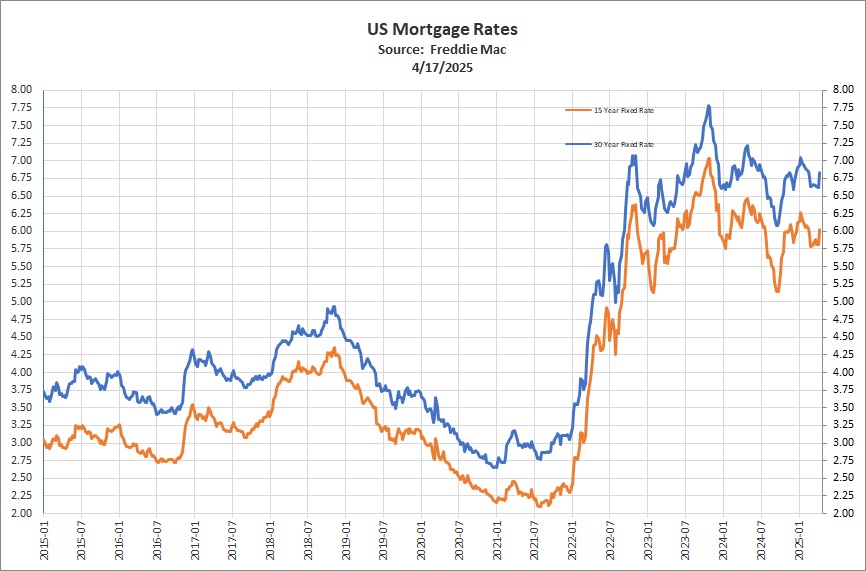
Mortgage Rates
“Mortgage rates have been shifting within a narrow ten-basis point range over the last month. This rate stability is a positive sign for both buyers and sellers, as it helps provide greater certainty in the housing market,” said Sam Khater, Freddie Mac’s Chief Economist.
The 30-year FRM averaged 6.26% as of November 20, 2025, up from last week when it averaged 6.24%. A year ago at this time, the 30-year FRM averaged 6.84%.
The 15-year FRM averaged 5.54%, up from last week when it averaged 5.49%. A year ago at this time, the 15-year FRM averaged 6.02%.
Selected Cryptocurrencies
| Symbol | Name | Price | 24h % | 7d % | Market Cap | Volume(24h) |
| BTC | Bitcoin | $86,268.83 | -0.15% | -9.04% | $1,721,327,246,129 | $67,094,301,260 |
| ETH | Ethereum | $2,812.87 | -0.46% | -10.97% | $339,501,285,478 | $23,412,469,102 |
| XRP | XRP | $2.08 | 2.53% | -7.37% | $125,749,550,517 | $4,294,567,665 |
| BNB | BNB | $840.92 | -0.51% | -9.12% | $115,826,829,243 | $2,017,118,124 |
| SOL | Solana | $129.97 | -0.36% | -7.76% | $72,675,625,127 | $4,392,084,679 |
| TRX | TRON | $0.28 | 0.43% | -5.71% | $26,171,978,176 | $534,194,900 |
| DOGE | Dogecoin | $0.15 | 1.31% | -9.18% | $22,226,647,955 | $1,519,397,124 |
| ADA | Cardano | $0.41 | -0.49% | -16.33% | $14,713,343,842 | $669,425,361 |
| BCH | Bitcoin Cash | $546.64 | -0.75% | 9.48% | $10,909,774,976 | $502,934,759 |
| HYPE | Hyperliquid | $30.86 | -0.28% | -19.36% | $10,392,772,952 | $429,485,250 |
| ZEC | Zcash | $541.64 | -4.52% | -19.45% | $8,843,152,135 | $1,055,730,604 |
| LINK | Chainlink | $12.54 | -0.33% | -10.24% | $8,744,404,844 | $557,406,353 |
| LEO | UNUS SED LEO | $9.46 | -0.28% | 2.91% | $8,723,007,735 | $656,521 |
| XLM | Stellar | $0.25 | 3.30% | -3.93% | $8,000,682,005 | $243,168,138 |
| USDe | Ethena USDe | $1.00 | 0.00% | 0.02% | $7,376,211,743 | $68,818,115 |
| XMR | Monero | $390.23 | -1.87% | -4.84% | $7,198,483,043 | $168,223,111 |
| LTC | Litecoin | $83.03 | -0.41% | -12.92% | $6,357,124,239 | $443,295,475 |
| HBAR | Hedera | $0.14 | 3.21% | -3.77% | $6,129,437,316 | $520,097,836 |
Information current as of 5:20 AM PST, Monday, November 24, 2025. Source: https://coinmarketcap.com
Check us out at https://beaconrwa.com. We recently updated our affiliated website at https://reverse-mortgages.us. If you know someone age 62 or over who is feeling stressed financially and considering a reverse mortgage please send them to this site. An excellent piece with general information about reverse mortgages is available here: https://reverse-mortgages.us/wp-content/uploads/2025/11/ReverseMortgageGuideBRWA.pdf
Sources: Ryan Long, CFA, FocusPoint Solutions, American Association for Individual Investors (AAII), Associated Press, Barclays Capital, Bloomberg, Citigroup, Deutsche Bank, FactSet, Financial Times, Goldman Sachs, JPMorgan Asset Management,
MarketfieldAsset Management, Morgan Stanley, MSCI, Morningstar, Northern Trust, Oppenheimer Funds, PIMCO, Standard & Poor’s, StockCharts.com, The Conference Board, Thomson Reuters, T. Rowe Price, U.S. Bureau of Economic Analysis, U.S. Federal Reserve, Wall Street Journal, The Washington Post. Index performance is shown as total return, which includes dividends, with the exception of MSCI-EM, which is quoted as price return/excluding dividends. Performance for the MSCI-EAFE and MSCI-EM indexes is quoted in U.S. Dollar investor terms.
The information above has been obtained from sources considered reliable, but no representation is made as to its completeness, accuracy or timeliness. All information and opinions expressed are subject to change without notice. Information provided in this report is not intended to be, and should not be construed as, investment, legal or tax advice; and does not constitute an offer, or a solicitation of any offer, to buy or sell any security, investment or other product. FocusPoint Solutions, Inc. is a registered investment advisor.
Notes key: (+) positive/encouraging development, (0) neutral/inconclusive/no net effect, (-) negative/discouraging development.