
Your Weekly Update for Monday, December 1, 2025.
Beacon Rock Wealth Advisors is a dba of BR Capital, Inc. It is a financial planning and registered investment advisory firm in Camas, Washington. We are always available to answer your finance questions. Give us a call at (360) 735-1900 or send an email.
If you or someone you know is worried about retirement, send us an email or give us a call for a no-obligation Retirement and Social Security Analysis.
If this information is helpful to you, please forward this to a friend and ask them to subscribe at https://newsletters.beaconrwa.com/subscribe.
Have a great week!
Mike Elerath
CERTIFIED FINANCIAL PLANNERTM
CERTIFIED IN LONG-TERM CARE
Mike.Elerath@beaconrwa.com
Bill Roller
NMLS #107972
CHARTERED FINANCIAL ANALYST
CERTIFIED FINANCIAL PLANNERTM
CHARTERED MARKET TECHNICIAN
bill.roller@beaconrwa.com
For more information about Beacon Rock Wealth Advisors, check out our brochure here: https://beaconrwa.com/wp-content/uploads/2024/12/BeaconRockBrochure.pdf
Click on the image below to go https://youtu.be/wFa6zEO6gW8 to see the video from November 28 in which Bill Roller discusseses the financial markets.

Please give the video a “Like” and check out our other videos and subscribe to the channel at https://www.youtube.com/@beaconrwa.
Summary
Markets were UP last week. The Dow Jones Industrial Average was UP 3.18% to 47,716.42 while the S&P500 ended UP 3.73% TO 6,849.09. The Nasdaq Composite ROSE 4.91% to 23,365.79. The annual yield on the 30-year Treasury FELL 5.0 basis point(s) to 4.665%.
On a short holiday week, economic data included gains in retail sales and durable goods orders, as well as higher producer price readings, decelerating home prices, and continued weak consumer confidence. However, the recent government reopening meant some data released was fairly stale at this point.
Equities rebounded into gains last week, led by the U.S. over international. Bonds also fared well as interest rates fell back amidst Fed member dovishness. Commodities also saw gains, mostly in metals.
Economic Notes
(0/+) Retail sales for September rose by 0.2%, about half the 0.4% gain expected, and a fraction of the 0.6% August increase. Removing autos (which fell -0.3%) bumped the gain to 0.3%, while core/control sales showed a decline of -0.1% (removing gasoline station sales, which rose 2%). In other non-core areas, strength appeared in misc. stores (3%), health/personal care (1%), and food/drinking places (1%), while sporting goods fell back the most sharply (-2.5%), followed by non-store/internet retail, with some likely back-to-school effects reversing (a reminder that this is now old data). Over the past 12 months, total retail sales rose 4.3%, which translates to positive ‘real’ growth after inflation.
(0/+) Durable goods orders rose by 0.5% in September, matching consensus expectations, although well below the 3% rise of August. Removing transportation, the result was little-changed at 0.6% (with defense aircraft orders up 30% in the month, but a lumpy series). Capital goods orders rose 0.9%, as did capital goods shipments by the same amount. Gains for the month were focused in electrical equipment and primary metals, which is in keeping with a flood of capex toward data center and AI-related construction. Over the past year, total durable goods rose 7%, while those excluding transportation were up 3% (as transportation grew 16%), and capital goods orders up 13%. For the technology-related reasons noted, and other sectors, this continues to show positivity.
(0) In another late data arrival, the Producer Price Index for September rose by 0.3%, on par with expectations. Removing food and energy, core PPI rose 0.1%. Both were up a bit from revised August data, which showed a -0.1% decline. Energy prices were a key driver, up 4% for the month, which carried into transportation costs as would be normally expected. On the other hand, capital equipment prices fell back by -4%. Year-over year, headline PPI rose 2.7%, while core PPI increased 2.6% (the latter being the slowest pace in 12 months). Over the year, final demand goods costs rose 3.3%, while services decelerated to 2.5%, which reverses a prior trend somewhat, and shows a likely impact of tariff additions.
(0/+) The FHFA house price index for the third quarter 2025 showed a rise of 0.2%, while the specific September monthly index was unchanged from August. For the quarter, East North Central (Great Lakes states) led with a 1% rise in prices, while the South Atlantic (DE south to FL) fared worst by falling -0.4%. Year-over-year, the national index ended up with a gain of 2.2%, representing a rapid decline from the 4-quarter pace of 4.5% in Q2-2024. Over the past year, the strongest home price increases were in the Middle Atlantic division (NY/NJ/PA, up 5.7%), while the Pacific region lagged with a -0.1% decline for the year. Specifically, some of the strongest results were again in Northern states, including IL, NY, CT, ND, and WI, which continued to run against the earlier pandemic trend of moves toward more expensive Sun Belt locales, several of which have now experienced year-over-year price declines, such as in FL, TX, CO, AZ, and CA.
(0) The S&P Cotality Case-Shiller 20-City Home Price Index for September rose by 0.1% on a seasonally-adjusted basis, but declined -0.5% on an unadjusted basis. Year-over-year, the index rose by 1.4%, with the individual city results diverging, as about half saw gains and the other half declined. Positive results were again dominated by northern locations, such as Chicago, New York City, Boston, and Cleveland—all of which saw price gains 4-5% for the year. Sun Belt cities Tampa, Phoenix, Dallas, and Miami lagged with the strongest declines. Importantly, home price appreciation over the past year trailed broader inflation, which has certainly been uncommon since the pandemic, but not necessarily uncommon historically looking back over multiple decades.
(-) The Conference Board’s index of consumer confidence fell by -6.8 points to 88.7 for November, close to a low for the year, and further than the expected minor decline to 93.3. By segment, assessments of present conditions fell by -4 points, while future expectations fell by a sharper -9 points. The labor differential ticked down slightly, which measures the gap between jobs being ‘plentiful’ (28%) versus ‘hard to get’ (18%), which the obvious majority falling in the somewhere in the middle. The measure of expected inflation over the next 12 months was unchanged at 5.7%—no doubt a still-very high reading, and unanchored from actual inflation but reflecting frustration and worries about a higher price level and further tariff impacts. The survey sponsor noted that “all five components” of the overall measure “flagged or remained weak,” and that the tone of write-in responses appeared to be slightly more negative than in October. As mentioned previously, consumer confidence continues to run at a depressed rate, reflecting frustration with high prices, uncertainty over the impact of tariffs, and likely, political differences (as seen in other consumer surveys). However, consumer spending behavior has continued upward, not as closely anchored to sentiment as in the past perhaps, although segments like higher grocery and staples prices have weighed on lower-income consumers more than those in higher income groups, which tend to react more in line with stock and real estate prices.
(0) Initial jobless claims for the Nov. 22 ending week fell by -6k to 216k, lower than the increase to 225k expected. Continuing claims for the Nov. 15 week rose by 7k to 1.960 mil., below the expectations of 1.963 mil. In the initial claims segment, a small rise in CA was offset by declines in GA and TX. Despite the weeks of non-compiled data, there has been little change in the underlying trend, implying a lack of general labor distress nationally at this point.
Market Notes
| Period ending 11/28/2025 | 1 Week % | YTD % |
| DJIA | 3.20 | 13.88 |
| S&P 500 | 3.74 | 17.81 |
| NASDAQ | 4.91 | 21.71 |
| Russell 2000 | 5.55 | 13.47 |
| MSCI-EAFE | 3.25 | 27.40 |
| MSCI-EM | 2.49 | 29.69 |
| Bloomberg U.S. Aggregate | 0.38 | 7.46 |
| U.S. Treasury Yields | 3 Mo. | 2 Yr. | 5 Yr. | 10 Yr. | 30 Yr. |
| 12/31/2024 | 4.37 | 4.25 | 4.38 | 4.58 | 4.78 |
| 11/21/2025 | 3.90 | 3.51 | 3.62 | 4.06 | 4.71 |
| 11/28/2025 | 3.88 | 3.47 | 3.59 | 4.02 | 4.67 |
U.S. stocks recovered back into positive territory last week, following negative performance the week prior, and wrapping up a more volatile November where the S&P 500 only gained 0.2%, but continued a string of seven straight positive months. Stocks gained sharply early in the week as odds of a December Fed rate cut were further absorbed by markets. These odds have been largely driven by dovish or hawkish comments from various FOMC members, with the voting odds now tilted again toward easing. The maxim of “Don’t Fight the Fed” can be powerful when markets are in the midst of rate cuts.
Every sector saw positive results last week, led by over-5% gains in communications (Meta and Alphabet) and consumer discretionary (Tesla and Amazon), followed by technology. Laggards included energy and more defensive areas of health care and consumer staples, which still saw nearly 2% gains. Real estate also gained just under 2% for the week. Within the closely-watched AI segment of technology, the prior week’s announcement by Google that it’s developed a fast and less energy-intensive in-house chip specifically for AI boosted that company’s sentiment, while it caused bullishness for Nvidia to waver a bit (whose chips remain the industry standard for general AI purposes). The discussion about the two continued throughout the week.
Analyst estimates for 2026 are beginning to come out, and unsurprisingly, they tend to congregate around the range of an 8% increase (not far from the long-term average return of the S&P 500). However, there are always a variety of potential concerns to get past, with the current batch including inflation (and how the Fed handles it, either through slowing rate cuts or even hikes in the worst case as the Fed funds futures markets hint at), AI capex (if the acceleration in current spending trends slow), a deteriorating labor market/rising unemployment rate, and a flare up again in trade concerns (notably with China).
Foreign stocks slightly underperformed U.S. last week, despite the tailwind of a weaker U.S. dollar. Results were largely similar, with Europe slightly outperforming other segments, as inflation reports in Europe came in cooler than expected. Within EM, Brazil, Taiwan, and Mexico outperformed other groups. Plans for a potential Ukraine-Russia peace agreement continued to lie in the background, although little new has been proposed, with potential for a deal remaining lukewarm.
Bonds gained as interest rates ticked down across the U.S. Treasury yield curve, as investors interpreted Fed comments more dovishly in regard to future rate cuts. Investment-grade, high yield, and floating rate corporates all outperformed Treasuries slightly for the week, while foreign bonds generally benefited from a weaker U.S. dollar.
Commodities saw gains in all categories last week, led by precious metals and industrial metals. Crude oil rose 2% for the week to $59/barrel, as the trading range has fallen to around $55-65 from a higher range during the summer. Supplies remain high, with demand not quite keeping up to offset it.
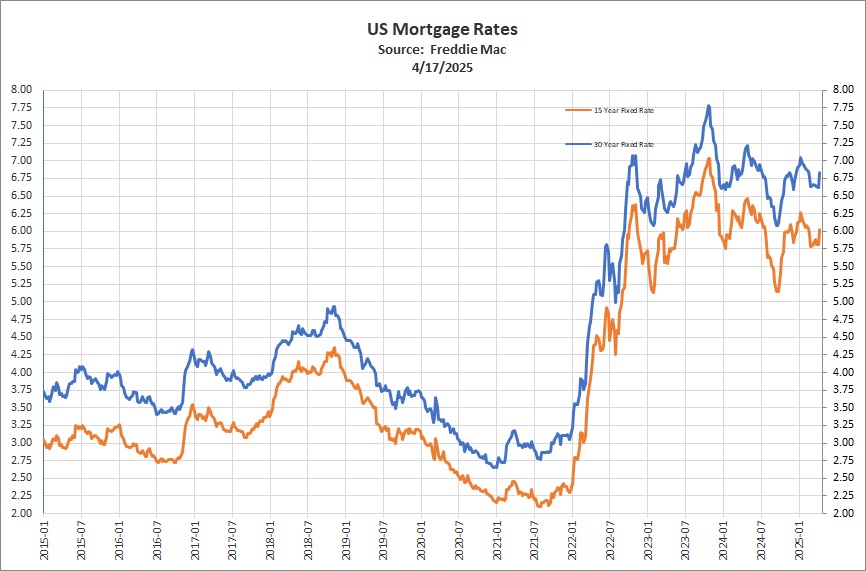
Mortgage Rates
“Heading into the Thanksgiving holiday, mortgage rates decreased,” said Sam Khater, Freddie Mac’s Chief Economist. “With pending home sales at the highest level since last November, homebuyer activity continues to show resilience as we near the end of the year.”
The 30-year FRM averaged 6.23% as of November 26, 2025, down from last week when it averaged 6.26%. A year ago at this time, the 30-year FRM averaged 6.81%.
The 15-year FRM averaged 5.51%, down from last week when it averaged 5.54%. A year ago at this time, the 15-year FRM averaged 6.10%.
Selected Cryptocurrencies
| Symbol | Name | Price | 24h % | 7d % | Market Cap | Volume(24h) |
| BTC | Bitcoin | $85,286.03 | -6.73% | -0.75% | $1,701,989,700,300 | $65,246,024,267 |
| ETH | Ethereum | $2,818.79 | -6.87% | 0.63% | $340,215,487,050 | $26,172,937,040 |
| XRP | XRP | $2.02 | -7.64% | -1.42% | $122,396,627,929 | $4,155,297,817 |
| BNB | BNB | $821.79 | -6.88% | -1.84% | $113,190,694,357 | $2,411,018,984 |
| SOL | Solana | $126.73 | -7.84% | -2.06% | $70,927,798,206 | $5,216,089,650 |
| TRX | TRON | $0.28 | -1.48% | 0.33% | $26,225,702,940 | $728,554,383 |
| DOGE | Dogecoin | $0.14 | -9.07% | -5.92% | $20,685,764,519 | $1,547,560,922 |
| ADA | Cardano | $0.38 | -10.03% | -6.44% | $13,614,930,808 | $797,513,622 |
| BCH | Bitcoin Cash | $521.76 | -4.15% | -3.73% | $10,414,757,855 | $641,940,539 |
| HYPE | Hyperliquid | $30.29 | -8.51% | -0.93% | $10,199,846,227 | $373,726,848 |
| LEO | UNUS SED LEO | $9.69 | -1.10% | 2.48% | $8,894,462,682 | $777,291 |
| LINK | Chainlink | $12.10 | -7.72% | -2.75% | $8,433,350,239 | $644,508,952 |
| XMR | Monero | $412.90 | -1.30% | 5.32% | $7,616,777,390 | $231,342,809 |
| XLM | Stellar | $0.23 | -9.24% | -6.56% | $7,400,779,971 | $178,514,613 |
| USDe | Ethena USDe | $1.00 | -0.02% | 0.03% | $7,138,917,159 | $94,913,793 |
| LTC | Litecoin | $76.66 | -9.06% | -7.42% | $5,871,289,699 | $604,184,454 |
| ZEC | Zcash | $352.40 | -20.12% | -34.38% | $5,785,219,400 | $1,171,889,220 |
| HBAR | Hedera | $0.13 | -8.83% | -8.46% | $5,568,666,230 | $199,916,176 |
Information current as of 4:55 AM PST, Monday, December 1, 2025. Source: https://coinmarketcap.com
Check us out at https://beaconrwa.com. We recently updated our affiliated website at https://reverse-mortgages.us. If you know someone age 62 or over who is feeling stressed financially and considering a reverse mortgage please send them to this site. An excellent piece with general information about reverse mortgages is available here: https://reverse-mortgages.us/wp-content/uploads/2025/11/ReverseMortgageGuideBRWA.pdf
Sources: Ryan Long, CFA, FocusPoint Solutions, American Association for Individual Investors (AAII), Associated Press, Barclays Capital, Bloomberg, Citigroup, Deutsche Bank, FactSet, Financial Times, Goldman Sachs, JPMorgan Asset Management,
MarketfieldAsset Management, Morgan Stanley, MSCI, Morningstar, Northern Trust, Oppenheimer Funds, PIMCO, Standard & Poor’s, StockCharts.com, The Conference Board, Thomson Reuters, T. Rowe Price, U.S. Bureau of Economic Analysis, U.S. Federal Reserve, Wall Street Journal, The Washington Post. Index performance is shown as total return, which includes dividends, with the exception of MSCI-EM, which is quoted as price return/excluding dividends. Performance for the MSCI-EAFE and MSCI-EM indexes is quoted in U.S. Dollar investor terms.
The information above has been obtained from sources considered reliable, but no representation is made as to its completeness, accuracy or timeliness. All information and opinions expressed are subject to change without notice. Information provided in this report is not intended to be, and should not be construed as, investment, legal or tax advice; and does not constitute an offer, or a solicitation of any offer, to buy or sell any security, investment or other product. FocusPoint Solutions, Inc. is a registered investment advisor.
Notes key: (+) positive/encouraging development, (0) neutral/inconclusive/no net effect, (-) negative/discouraging development.