
Your Weekly Update for Monday, March 9, 2026.
Beacon Rock Wealth Advisors is a dba of BR Capital, Inc. It is a financial planning and registered investment advisory firm in Camas, Washington. We are always available to answer your questions. Give us a call at (360) 735-1900 or send an email.
If you or someone you know is worried about retirement, send us an email or give us a call for a no-obligation Retirement and Social Security Analysis.
If this information is helpful to you, please forward this to a friend and ask them to subscribe at https://newsletters.beaconrwa.com/subscribe.
Have a great week!
Bill Roller
NMLS #107972
CHARTERED FINANCIAL ANALYST
CERTIFIED FINANCIAL PLANNERTM
CHARTERED MARKET TECHNICIAN
bill.roller@beaconrwa.com
For more information about Beacon Rock Wealth Advisors, check out our brochure here: https://beaconrwa.com/beaconrockbrochure/
Click on the image below to go to https://youtu.be/Xq23uEVoTkM to see the video from March 9 in which Bill Roller presents the financial update for the week.

Please give the video a “Like” and check out our other videos and subscribe to the channel at https://www.youtube.com/@beaconrwa.
Summary
Markets were DOWN last week. The Dow Jones Industrial Average was DOWN 3.01% to 47,501.55 while the S&P500 ended DOWN 2.02% to 6,740.02. The Nasdaq Composite FELL 1.24% to 22,387.68. The annual yield on the 30-year Treasury ROSE 12.2 basis point(s) to 4.755%.
Economic data for the week included improvements in manufacturing and services surveys, flattish retail sales, and disappointing nonfarm payrolls. Several of these were influenced by weather and idiosyncratic factors.
Equities fell back strongly across the globe, more internationally than in the U.S., with the military actions in the Middle East weighing on sentiment. Bonds also fell back along with rising yields as higher energy prices stoked inflation fears. Commodities saw strong gains, led by the most dramatic single-week move for crude oil in decades.
Economic Notes
(-) Retail sales declined in January by -0.2%, which was slightly better than expectations of -0.3%. Removing the more volatile components, core/control retail sales rose 0.3%, matching expectations. While non-store/internet sales saw a gain, declines were seen in gas stations (-3%), health/personal care (-3%), and autos (-1%). As areas like sporting goods and clothing saw sharp monthly declines, no doubt severe winter weather was a major driver in the negativity. In total, retail sales rose 3.2% for the past year, which, being in keeping with inflation, resulted in a near-zero ‘real’ retail sales gain.
(0/+) The ISM manufacturing index for February fell by -0.2 of a point to 52.4, but beat the median expectation of 51.5, and remained in expansion. Under the hood, new orders fell by -1.3 points to 55.8, still solidly expansionary, while production gains also tempered a bit. On the other hand, supplier deliveries and employment rose a bit, with the latter just a few tenths of a point under the neutral 50 level. Prices paid remained a problem, though, rising 11.5 points to a very expansionary 70.5. For the month, 12 of the 18 categories showed expansion, with order backlogs also recently having moved into expansion after spending over three years in contraction. Manufacturing has remained in expansion for several months, which is a positive and related to continued strong expectations for economic growth. Anecdotal commentary from respondents was mixed, with mentions of strength in certain parts of the economy, and weakening in others, along with the irony of some tariff (in metals) making the U.S. less competitive, not more.
(+) The ISM services-non manufacturing index rose by 2.3 points to a level of 56.1, as opposed to a drop to 53.5 expected. This represented a movement further into expansion and the highest level in over three years, with 14 of 18 major industries showing expansion. Under the hood, new orders were up 5.5 points to 58.6, far further into expansion, along with smaller increases in business activity and employment. Prices paid fell by nearly -4 points to 63, but remained solidly expansionary. The anecdotal commentary seemed a bit more positive, with several industries having adapted to tariffs, while other are mixed, with the business climate being described as “solid,” with some hurdles in real estate and those related to winter weather.
(-) Initial jobless claims for the Feb. 28 ending week were unchanged at 213k, just below the 215k median forecast. Continuing claims for the Feb. 21 week rose by 46k to 1.868 mil., above the lesser rise to 1.845 mil. Aside from increases in NY and MI, initial claims were little-changed elsewhere. Both remain well within recent ranges.
(-) The employment situation report for February came in far below expectations, but with a variety of caveats. However, this may not take away from the pressure on the Federal Reserve to again acknowledge perceived weakness in labor markets, if such numbers continue. Nonfarm payrolls fell by -92k, well below the median forecast calling for a gain of 55k. This was in addition to downward revisions totaling -69k for the prior months of Dec. and Jan. For February, declines were led by health care (-28k), which was artificially depressed due to a labor strike at Kaiser Permanente, and reversed the sharp gain of the prior month. Information jobs also fell back (-11k) as did those in the Federal government (-10k). There appeared to be some effects elsewhere due to winter weather, as well as the BLS’ new birth-death methodology, which affects assumptions about private small business creation. The U-3 unemployment rate ticked up a tenth to 4.4%, while the U-6 underemployment rate fell by -0.2% to 7.9%. Average hourly earnings rose by 0.4% for the month, and 3.8% for the trailing year. The average workweek length was unchanged at 34.3 hours.
In a separate report, preliminary Q4 nonfarm productivity came in at a quarterly annualized rate of 2.8%, surpassing the 1.9% expected, but not quite reaching the over-5% number of Q3. Over the trailing year, the rise was also 2.8%, up by 0.4% from Q3’s figure. Productivity was revised up over the past year in each quarterly, largely as the result of benchmark revisions in jobs data, which were also tied to immigration changes over the past two years. The productivity statistic is a calculated byproduct of total domestic output not accounted for by employment changes—essentially, how productive those workers were. It continues to run at a higher rate than the 1.5% pace or so pre-pandemic. The preliminary unit labor costs measure for Q4 rose by 2.8% also on quarterly annualized basis, which kept the trailing 12-month increase at 1.3%.
Market Notes
| Period ending 3/6/2026 | 1 Week % | YTD % |
| DJIA | -2.92 | -0.86 |
| S&P 500 | -1.99 | -1.32 |
| NASDAQ | -1.22 | -3.58 |
| Russell 2000 | -4.03 | 1.92 |
| MSCI-EAFE | -6.73 | 2.68 |
| MSCI-EM | -6.88 | 6.94 |
| Bloomberg U.S. Aggregate | -0.96 | 0.77 |
| U.S. Treasury Yields | 3 Mo. | 2 Yr. | 5 Yr. | 10 Yr. | 30 Yr. |
| 12/31/2025 | 3.67 | 3.47 | 3.73 | 4.18 | 4.84 |
| 2/27/2026 | 3.67 | 3.38 | 3.51 | 3.97 | 4.64 |
| 3/6/2026 | 3.69 | 3.56 | 3.72 | 4.15 | 4.77 |
U.S. stocks began the week with a fairly benign response on Monday after the prior weekend’s joint U.S.-Israel attacks on Iran. However, Tuesday saw a rapid deterioration in sentiment as attacks on both Iran and Lebanon intensified, along with Iran’s threats to close the Strait of Hormuz, which is one of their main remaining tactical threat tools (via stealthier means, as their navy was decimated). Economic data was mixed, with decent ISM results coupled with a weaker nonfarm payroll report. The key questions in a nutshell: (1) How much damage and/or disruption, at the very least, will be absorbed by oil infrastructure in the Middle East, (2) How long will the conflict last, and (3) What will the new reality look like?
By sector, only energy saw minor gains, while declines were most pronounced in cyclical materials stocks (-7%), but also consumer staples, health care, and industrials (all nearly -5%), with concerns over energy price impacts on inflation. Real estate fell back by 2% upon higher interest rates.
Foreign stocks fared worse than the U.S., with more local energy supply sensitivity to the Middle East conflict. All key developed regions and emerging markets were down in the -5% to -7% range, with little differentiation between groups during the dramatic sell-off. Emerging markets were down across the board as well, with China and India faring a bit better than South Korea and South Africa, the latter of which have suffered from greater volatility in both directions more recently due to sector-specific factors. From their highs on Feb. 25, U.S. stocks (as represented by the S&P 500) are only down -3% on net, while foreign stocks (MSCI EAFE) have fallen back by -7%.
Bonds fell back on the week, as higher energy prices resulted in inflation fears, and correspondingly higher yields. Along with rising rates, floating rate bank loans were the only group that ended positively. A stronger dollar held back unhedged foreign bonds to a greater degree.
Commodities experienced a historic week, with the GSCI index up over 15%. Energy prices jumped dramatically due to uncertainty surrounding the near-term outcome of the U.S.-Israel-Iran military action, which include reduced shipments through the Strait of Hormuz and Iranian attacks on oil infrastructure of neighbors. West Texas crude oil spot prices jumped 35% on the week to $91/barrel, representing the biggest single-week surge since 1985. With the threat of the Strait of Hormuz closing, and bottled-up ship traffic, being a chokepoint for not only crude oil but also natural gas, prices for the latter in Europe jumped by 40% Tues. morning alone. The commodities asset class has proven its worth as a unique diversifier during a time of international crisis, as it has historically, with the forward path for energy prices in particular cloudy and dependent on a final resolution to the conflict of uncertain length. Interestingly, gold fell back by a few percent despite a usual hedge against military activity, due to already high long positioning, while more speculative silver, palladium, and platinum prices fell back by nearly -10% for the week.
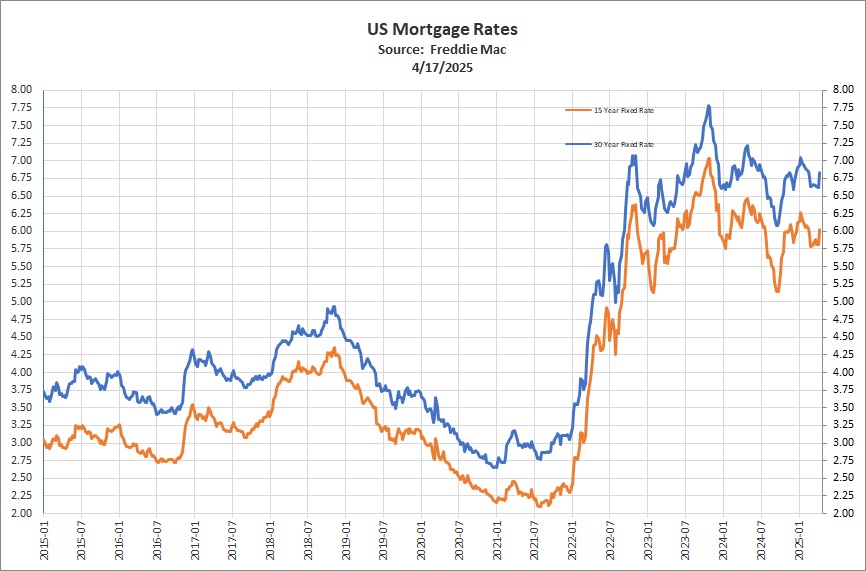
Mortgage Rates
“Mortgage rates held steady at 6% this week, hovering near their lowest level since 2022,” said Sam Khater, Freddie Mac’s Chief Economist. “In fact, rates are down nearly a full percentage point from this time in 2024, spurring activity from buyers, sellers and owners. As a result, refinance activity is up, and purchase applications are ahead of last year’s pace.”
The 30-year FRM averaged 6.00% as of March 5, 2026, slightly up from last week when it averaged 5.98%. A year ago at this time, the 30-year FRM averaged 6.63%.
The 15-year FRM averaged 5.43%, slightly down from last week when it averaged 5.44%. A year ago at this time, the 15-year FRM averaged 5.79%.
Selected Cryptocurrencies
| Symbol | Name | Price | 24h % | 7d % | Market Cap | Volume(24h) |
| BTC | Bitcoin | $67,640.49 | 0.19% | 2.19% | $1,352,805,200,173 | $41,991,956,669 |
| ETH | Ethereum | $1,991.79 | 2.09% | 2.39% | $240,394,180,959 | $20,974,833,692 |
| BNB | BNB | $626.47 | 0.91% | 0.94% | $85,426,577,800 | $1,473,792,532 |
| XRP | XRP | $1.34 | -0.92% | -0.19% | $82,586,253,248 | $2,191,212,620 |
| SOL | Solana | $83.57 | 0.77% | -0.47% | $47,706,668,055 | $3,450,040,749 |
| TRX | TRON | $0.29 | -0.47% | 1.40% | $27,033,309,877 | $593,513,758 |
| DOGE | Dogecoin | $0.09 | 1.03% | -1.59% | $15,285,528,805 | $1,124,420,295 |
| ADA | Cardano | $0.25 | 0.05% | -6.25% | $9,193,521,560 | $488,701,936 |
| BCH | Bitcoin Cash | $448.39 | -0.31% | 2.51% | $8,970,061,260 | $263,404,099 |
| LEO | UNUS SED LEO | $9.05 | 0.23% | 0.01% | $8,341,756,418 | $687,316 |
| HYPE | Hyperliquid | $30.93 | 1.39% | 1.30% | $7,978,829,714 | $235,102,567 |
| XMR | Monero | $344.63 | 0.05% | -1.73% | $6,357,339,072 | $71,330,891 |
| LINK | Chainlink | $8.76 | 1.16% | 0.82% | $6,206,800,993 | $667,768,698 |
| USDe | Ethena USDe | $1.00 | 0.00% | 0.00% | $5,929,118,223 | $196,649,703 |
| CC | Canton | $0.15 | -3.39% | -8.80% | $5,602,705,783 | $78,890,507 |
| DAI | Dai | $1.00 | 0.01% | 0.01% | $5,366,108,378 | $117,145,591 |
| XLM | Stellar | $0.15 | -0.84% | -2.93% | $4,922,625,319 | $94,609,077 |
| USD1 | World Liberty Financial USD | $1.00 | -0.03% | 0.01% | $4,601,522,817 | $1,726,485,694 |
4:35 AM PDT, Monday, March 9, 2026. Source: https://coinmarketcap.com

If you know someone age 62 or over who is feeling stressed financially and considering a reverse mortgage please send them this excellent piece with general information about reverse mortgages at: https://beaconrwa.com/reversemortgageguidebrwa/
Sources: Ryan Long, CFA, FocusPoint Solutions, American Association for Individual Investors (AAII), Associated Press, Barclays Capital, Bloomberg, Citigroup, Deutsche Bank, FactSet, Financial Times, Goldman Sachs, JPMorgan Asset Management,
MarketfieldAsset Management, Morgan Stanley, MSCI, Morningstar, Northern Trust, Oppenheimer Funds, PIMCO, Standard & Poor’s, StockCharts.com, The Conference Board, Thomson Reuters, T. Rowe Price, U.S. Bureau of Economic Analysis, U.S. Federal Reserve, Wall Street Journal, The Washington Post. Index performance is shown as total return, which includes dividends, with the exception of MSCI-EM, which is quoted as price return/excluding dividends. Performance for the MSCI-EAFE and MSCI-EM indexes is quoted in U.S. Dollar investor terms.
The information above has been obtained from sources considered reliable, but no representation is made as to its completeness, accuracy or timeliness. All information and opinions expressed are subject to change without notice. Information provided in this report is not intended to be, and should not be construed as, investment, legal or tax advice; and does not constitute an offer, or a solicitation of any offer, to buy or sell any security, investment or other product. FocusPoint Solutions, Inc. is a registered investment advisor.
Notes key: (+) positive/encouraging development, (0) neutral/inconclusive/no net effect, (-) negative/discouraging development.