
Your Weekly Update for Monday, March 2, 2026.
Beacon Rock Wealth Advisors is a dba of BR Capital, Inc. It is a financial planning and registered investment advisory firm in Camas, Washington. We are always available to answer your questions. Give us a call at (360) 735-1900 or send an email.
If you or someone you know is worried about retirement, send us an email or give us a call for a no-obligation Retirement and Social Security Analysis.
If this information is helpful to you, please forward this to a friend and ask them to subscribe at https://newsletters.beaconrwa.com/subscribe.
Have a great week!
Bill Roller
NMLS #107972
CHARTERED FINANCIAL ANALYST
CERTIFIED FINANCIAL PLANNERTM
CHARTERED MARKET TECHNICIAN
bill.roller@beaconrwa.com
For more information about Beacon Rock Wealth Advisors, check out our brochure here: https://beaconrwa.com/beaconrockbrochure/
Click on the image below to go to https://youtu.be/-7ctdpGQFBA to see the video from March 1 in which Bill Roller presents the financial update for the week.

Please give the video a “Like” and check out our other videos and subscribe to the channel at https://www.youtube.com/@beaconrwa.
Summary
Markets were DOWN last week. The Dow Jones Industrial Average was DOWN 0.25% to 49,625.97 while the S&P500 ended UP 1.07 to 6,909.51. The Nasdaq Composite ROSE 1.51% to 22,886.07. The annual yield on the 30-year Treasury ROSE 2.7 basis point(s) to 4.725%.
Economic data for the week included a stronger-than-expected report for producer price inflation, moderate gains in housing prices and construction spending, as well as some improvement in consumer confidence.
Equities were mixed, showing weakness in the U.S., but strength internationally. Bonds gained as investors moved away from risk. Commodities also gained, continuing recent strong trends in metals.
Economic Notes
(-) The Producer Price Index rose by 0.5% in January, exceeding the median forecast calling for 0.3%. Removing food and energy, core PPI rose a stronger 0.8%, also exceeding expectations of 0.3%. On a headline basis, momentum was driven down by energy prices down -2.7% and food by -1.5%. Overall, goods prices fell by -0.3%, while services prices rose by 0.8%. In the latter, gains in passenger airfares and health care were significant contributors, but there is always a caveat for the January report for PPI and CPI concerning end-of-year prices bumps, which are common and elevate the monthly figure more than normal. Year-over-year, headline and core PPI rose by 2.9% and 3.6%, respectively, continuing to show higher growth. By segment, final demand goods rose 1.6%, while services rose 3.4%, in keeping with consumer price trends as well.
(0) Construction spending rose by 0.3% for December, which included a -0.2% decline for November, which had been delayed due to the government shutdown. For December, private spending rose 0.5% in total, including residential up 1.5% but non-residential down -0.7%. Public spending fell -0.5% overall, with residential down -2.7% and non-residential down -0.4%. Total construction spending was down -0.4% over the past 12 months on a nominal basis, with a -1.2% drop in residential offset a bit by a 0.3% rise in non-residential, with power leading the way (as part of the AI) theme, as well as transportation.
(+/0) The FHFA house price index rose 0.1% in December and 0.8% in Q4 of 2025. Quarterly results were led by East North Central (Great Lakes states, up 1.5%) while Pacific (0.3%) saw the weakest gains. The national index rose 1.8% for the calendar year, which was significantly lower than the 4.6% reading for 2024, and continuing a steady deceleration over the past several years since 2021. By census region, the largest one year gains of around 5% were in East North Central and Middle Atlantic (NJ/NY/PA), followed by a 4% rise in West North Central (ND to MO). The Mountain (MT to AZ) and Pacific regions lagged with declines of about a half-percent each. By state, ND, DE, and IL each saw home price gains over 6% for the year to lead the individual results, while prices in FL fell by nearly -3% for the year. Home price gains remain positive but have now fallen below the rate of broad inflation, taking the ‘real’ appreciation into the negative, which is unusual for residential real estate, but reflects a continued give-back of strong pandemic gains.
(0) The S&P Cotality Case-Shiller 20-city home price index rose 0.5% in December on a seasonally-adjusted basis but fell -0.1% on an unadjusted basis. Year-over-year, the 20-city index rose 1.4% nationally, which also displayed negative after-inflation real growth. Leaders included over-5% gains in Chicago and New York City, followed by Cleveland, up 4%; laggards were Tampa and Denver, each down several percent. Per S&P, 2025 results saw the weakest full-year gain since 2011, with continued deceleration in this index as well. Also noted was the continued outperformance of Midwest and Northeast markets, while Sun Belt city prices continued to correct. High mortgage rates were blamed as a key culprit for the overall cooling, as has been noted many times.
(+) The Conference Board index of consumer confidence rose by 2.2 points in February to 91.2, above expectations calling for a slight drop to 87.1, following a January reading that had been revised up by over 4 points. While assessments of present conditions fell by -2 points, expectations for the future rose by nearly 5 points. The labor differential ticked up a fraction of a point along with increases in the extremes of jobs being plentiful yet also harder to get. Inflation expectations for the coming 12 months fell by a tenth to a still-elevated 5.5% level. The narratives written in by respondents noted a continued pessimistic tone on the economy, with negativity focused on “prices,
(+) Initial jobless claims for the Feb. 21 ending week rose by 4k to 212k, below the median forecast calling for 216k. Continuing claims for the Feb. 14 week fell by -31k to 1.833 mil., well below the 1.858 mil. expected. Despite some other national measures of layoffs rising in recent months, that trend hasn’t been reflected in the claims data.
Market Notes
| Period ending 2/27/2026 | 1 Week % | YTD % |
| DJIA | -1.28 | 2.12 |
| S&P 500 | -0.42 | 0.68 |
| NASDAQ | -0.94 | -2.39 |
| Russell 2000 | -1.15 | 6.20 |
| MSCI-EAFE | 1.24 | 10.09 |
| MSCI-EM | 2.82 | 14.83 |
| Bloomberg U.S. Aggregate | 0.54 | 1.75 |
| U.S. Treasury Yields | 3 Mo. | 2 Yr. | 5 Yr. | 10 Yr. | 30 Yr. |
| 12/31/2025 | 3.67 | 3.47 | 3.73 | 4.18 | 4.84 |
| 2/20/2026 | 3.69 | 3.48 | 3.65 | 4.08 | 4.72 |
| 2/27/2026 | 3.67 | 3.38 | 3.51 | 3.97 | 4.64 |
U.S. stocks fell back last week, as tariff/trade announcements from the prior weekend and continued concerns over the impact of artificial intelligence on certain sectors and particular high profile companies continued to weigh on investor minds. By sector, defensives gained on a negative week, as would be expected, led by utilities, health care and consumer staples, all up over 2%, as well as energy, which benefited from recent geopolitical concerns about oil prices. Lagging were cyclicals financials and technology down by roughly -2% each. In tech, NVDIA’s earnings beat consensus, but not by enough to turn sentiment higher, as the bar had been set fairly high. An unmistakable trend has been a shift in investor sentiment away from AI-related tech software toward physical assets, and ‘value’ stocks, some of which has been related to the massive data center infrastructure build-out, but also strong materials prices, and general anticipated positive cyclical effects from fiscal/tax measures.
Stocks started down Monday morning, as Europe pushed back on the 15% global tariff announced over the prior weekend, being in violation of their treaty. Uncertainty about implementation for the updated tariffs continues, with 15% quoted by the administration, but 10% seemingly in place in practice across the board. Per work done by the Penn Wharton Budget Model, considering substitution effects, the weighted average effective rate has fallen from 9.8% to 9.1% (and from 13.3% to 11.5% if substitution effects weren’t considered) after the Supreme Court decision and administration’s announcement (relative to a pre-policy change 2.4% rate in Jan. 2025), so there has been little change in effective rates in the last few weeks so far. The concern lies with the emergency measures, albeit temporary, and risky politically, with affordability remaining a key concern. Stocks took another negative turn Friday as a hotter-than-expected PPI report cast more doubt on inflation being under control. Obviously markets were closed prior to the joint U.S.-Israel strikes on Iran, which could have ramifications on market sentiment for the coming week, at least in the near term. (Historically, it’s worth pointing out that even more dramatic and longer-lasting wars have created little more than dents in the upward-sloping chart of U.S. stock prices over the past century, with less severe military actions creating even less of an impact.)
Foreign stocks outgained U.S., experiencing a positive week, led by the U.K. and Japan, while Europe declined slightly. Emerging markets were led by South Korea and Taiwan (related to technology component demand), as well as South Africa (closely tied to strength in metals/mining stocks). With concerns over AI’s impact on some technology stocks in the U.S. and last year’s strong returns have kept sentiment and flows skewed towards foreign diversification as well as hard assets.
Bonds experienced a positive week, with U.S. treasuries outperforming corporates, along with interest rates falling across the yield curve. Foreign bonds gained as well, with minimal currency impacts as the U.S. dollar was little-changed for the week. While less of a concern in more transparent public debt markets, some of the AI disruption seen in equities has drifted into areas of private credit, of which one of the larger owned sectors is software, where the natural concern is less about terminal value, but more so about repayment of debt and over what timeframes any problems could surface.
Commodities gained again across the board, continuing technical strength, and led by precious metals (due to a spike in silver prices) and industrial metals. Crude oil rose about a percent last week to $67/barrel, as U.S.-Iran negotiations continued with hopes for a deal, although that all fell apart with joint U.S.-Israel military air strikes on Iran over the weekend that were on the more severe side. Due to Iran’s status as a fairly large producer (exports of 1.5+ mil. barrels/day), general political instability there, retaliatory strikes on neighbors, and threats to close the Strait of Hormuz (through which one-fifth of global oil passes, mostly to Asia), chances of a crude oil price spike were high going into this week (with oil futures up over 8% early Monday). Conversely, natural gas prices fell back again by over -4% last week along with milder U.S. weather expected after a severe winter storm passed.
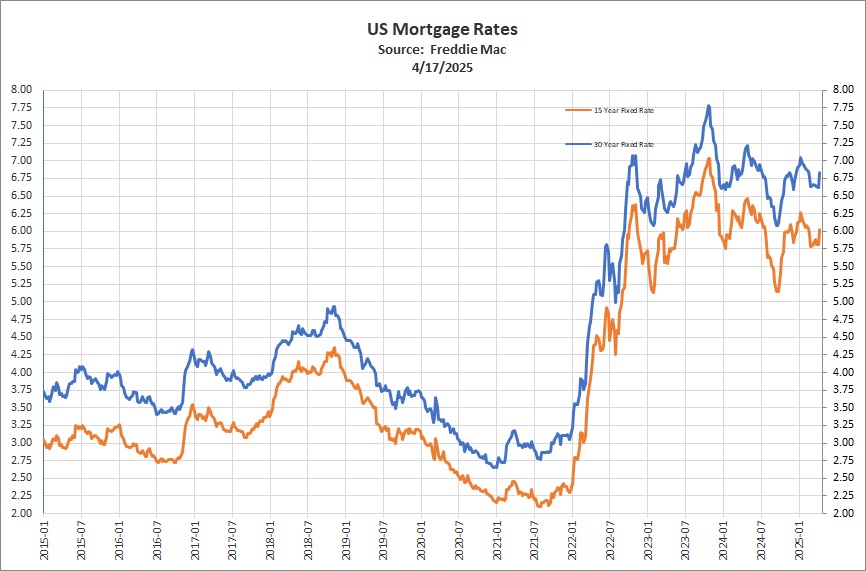
Mortgage Rates
“For the first time in three and a half years, the 30-year fixed-rate mortgage dropped into the 5% range, falling even lower than last week’s milestone,” said Sam Khater, Freddie Mac’s Chief Economist. “This rate, combined with the improving availability of homes for sale, is meaningful and will drive more potential buyers into the market for spring homebuying season.”
The 30-year FRM averaged 5.98% as of February 26, 2026, down from last week when it averaged 6.01%. A year ago at this time, the 30-year FRM averaged 6.76%.
The 15-year FRM averaged 5.44%, up from last week when it averaged 5.35%. A year ago at this time, the 15-year FRM averaged 5.94%.
Selected Cryptocurrencies
| Symbol | Name | Price | 24h % | 7d % | Market Cap | Volume(24h) |
| BTC | Bitcoin | $65,976.02 | -0.61% | -0.78% | $1,319,312,215,965 | $41,617,675,811 |
| ETH | Ethereum | $1,939.70 | -1.96% | 0.73% | $234,107,199,154 | $20,987,714,970 |
| BNB | BNB | $621.68 | -0.05% | 1.88% | $84,771,580,346 | $1,716,386,254 |
| XRP | XRP | $1.34 | -1.90% | -5.05% | $82,341,981,098 | $2,638,578,175 |
| SOL | Solana | $83.68 | -1.66% | 3.56% | $47,673,104,993 | $4,095,370,316 |
| TRX | TRON | $0.28 | 0.20% | -1.68% | $26,677,251,842 | $420,750,521 |
| DOGE | Dogecoin | $0.09 | -2.11% | -6.19% | $15,445,685,100 | $1,077,204,224 |
| ADA | Cardano | $0.27 | -2.35% | -1.20% | $9,778,439,610 | $525,856,384 |
| BCH | Bitcoin Cash | $440.61 | -1.36% | -18.35% | $8,813,197,008 | $345,054,198 |
| LEO | UNUS SED LEO | $9.05 | 0.12% | 11.60% | $8,339,619,045 | $2,365,598 |
| HYPE | Hyperliquid | $30.42 | -1.27% | 10.05% | $7,853,890,838 | $368,121,455 |
| XMR | Monero | $341.02 | -0.29% | 7.18% | $6,290,876,350 | $93,189,172 |
| CC | Canton | $0.16 | -1.84% | -0.14% | $6,134,814,610 | $26,447,397 |
| LINK | Chainlink | $8.65 | -2.40% | 1.11% | $6,127,708,902 | $729,362,000 |
| USDe | Ethena USDe | $1.00 | 0.00% | -0.01% | $6,013,020,049 | $56,281,813 |
| DAI | Dai | $1.00 | 0.02% | -0.02% | $5,365,626,669 | $118,050,395 |
| XLM | Stellar | $0.15 | -2.26% | -2.45% | $5,051,875,146 | $119,920,002 |
| USD1 | World Liberty Financial USD | $1.00 | 0.01% | 0.00% | $4,657,589,244 | $1,785,736,885 |
4:45 AM PST, Monday, March 2, 2026. Source: https://coinmarketcap.com

If you know someone age 62 or over who is feeling stressed financially and considering a reverse mortgage please send them this excellent piece with general information about reverse mortgages at: https://beaconrwa.com/reversemortgageguidebrwa/
Sources: Ryan Long, CFA, FocusPoint Solutions, American Association for Individual Investors (AAII), Associated Press, Barclays Capital, Bloomberg, Citigroup, Deutsche Bank, FactSet, Financial Times, Goldman Sachs, JPMorgan Asset Management,
MarketfieldAsset Management, Morgan Stanley, MSCI, Morningstar, Northern Trust, Oppenheimer Funds, PIMCO, Standard & Poor’s, StockCharts.com, The Conference Board, Thomson Reuters, T. Rowe Price, U.S. Bureau of Economic Analysis, U.S. Federal Reserve, Wall Street Journal, The Washington Post. Index performance is shown as total return, which includes dividends, with the exception of MSCI-EM, which is quoted as price return/excluding dividends. Performance for the MSCI-EAFE and MSCI-EM indexes is quoted in U.S. Dollar investor terms.
The information above has been obtained from sources considered reliable, but no representation is made as to its completeness, accuracy or timeliness. All information and opinions expressed are subject to change without notice. Information provided in this report is not intended to be, and should not be construed as, investment, legal or tax advice; and does not constitute an offer, or a solicitation of any offer, to buy or sell any security, investment or other product. FocusPoint Solutions, Inc. is a registered investment advisor.
Notes key: (+) positive/encouraging development, (0) neutral/inconclusive/no net effect, (-) negative/discouraging development.