
Your Weekly Update for Tuesday, February 17, 2026.
Beacon Rock Wealth Advisors is a dba of BR Capital, Inc. It is a financial planning and registered investment advisory firm in Camas, Washington. We are always available to answer your questions. Give us a call at (360) 735-1900 or send an email.
If you or someone you know is worried about retirement, send us an email or give us a call for a no-obligation Retirement and Social Security Analysis.
If this information is helpful to you, please forward this to a friend and ask them to subscribe at https://newsletters.beaconrwa.com/subscribe.
Have a great week!
Bill Roller
NMLS #107972
CHARTERED FINANCIAL ANALYST
CERTIFIED FINANCIAL PLANNERTM
CHARTERED MARKET TECHNICIAN
bill.roller@beaconrwa.com
For more information about Beacon Rock Wealth Advisors, check out our brochure here: https://beaconrwa.com/beaconrockbrochure/
Summary
Markets were DOWN last week. The Dow Jones Industrial Average was DOWN 1.23% to 49,500.03 while the S&P500 ended DOWN 1.369% TO 6,836.17. The Nasdaq Composite FELL 2.10% to 22,546.67. The annual yield on the 30-year Treasury FELL 15.7 basis point(s) to 4.698%.
Economic data for the week included a strong January jobs report, albeit with methodological nuances, flattish retail sales, and weaker weather-impacted existing home sales. Consumer inflation came in cooler than expected, mostly due to lower energy prices.
Equities were mixed, with tech-related declines in the U.S. offset a bit by continued strength in international stocks. Bonds fared positively from movement away from risk and a weaker U.S. dollar. Commodities were mixed, with gold strength and energy weakness.
Economic Notes
(+) The Consumer Price Index for January rose by 0.2% on a headline level, and 0.3% for core, removing the impacts of food and energy. Energy commodity prices falling by -3.3% was a key factor in the headline figure, while food and shelter each rose 0.2%. In other key segments, transportation services rose 1.4%, led by airfares up 7%. Audio/video product prices also rose over 2% for the month. Representing the turn of the calendar year with annual price increases included, especially in certain services, January prices have tended to adjust at a faster pace than other months, although this report was mixed. This also included seasonal factor adjustments to basket weights.
Year-over-year, headline and core CPI decelerated to 2.4% and 2.5%, respectively. Energy commodity prices are down -7% for the trailing 12 months, a significant contributor to lower inflation for the period. Services were up 3.2%, with durables up 0.4%, and nondurable prices up 1.3%. While other areas have also decelerated, there remain several headwinds, including shelter (3%), medical care services (4%), motor vehicle repair (5%), and utility gas service (10%), the latter of which is indirectly related to power grid buildout for AI data centers and the dispersion of these costs among businesses and consumers. Looking at an even deeper core picture “All items less food, shelter, and energy” was up only 2.1% for the past year, with “All items less medical care” up 2.3%. In short, cheaper oil costs played a role, but there also appears to be slow deceleration continuing in a variety of areas, with some services still sticky.
(0) Retail sales came in unchanged for December, relative to expectations for a 0.4% gain, and down from the prior month’s revised 0.6% increase. The majority of segments declined for the month, led by autos down -0.2%, as well as furniture, apparel, and electronics, while building materials rose over a percent. Removing the more volatile segments of autos, gasoline, and building materials, core/control retail sales fell by -0.1%, also disappointing compared to the 0.4% expected. Seasonal adjustments were also at play, especially over the holidays, with non-store/online sales up by an unadjusted 17% for the single month, which skews the results somewhat. Over the trailing 12 months, total retail sales rose 2.4%, hampered by autos down -1%, with core up 3.6%, with the latter up slightly from a real growth standpoint.
(-) Existing home sales declined by -8.4% in January to a seasonally-adjusted rate of 3.91 mil. units, below the -4.6% decline expected. This was the lowest sales rate since Sept. 2024. Single-family home sales fell by -9%, while condos/co-ops were down -3%. Every region experienced at least a mid-single digit decline, led by the West, down -10%, and the South, where weather played a larger role. Year-over-year, sales nationally fell by 4.4%. The price of existing homes rose 0.9% on a year-over-year basis to $396,800, continuing a pace of positivity, albeit at a decelerated rate. Inventory fell by -0.8%, taking months’ supply to 3.7, still well below the roughly 5.0 level indicative of a ‘normal’ market. While a weak month, and a “disappointing” month, as described by the NAR, the “below-normal temperatures and above-normal precipitation” potentially weighed on results, making it more difficult to assess the underlying trend. However, they felt “affordability conditions are improving.” The NAR noted that the average 30-year fixed-rate mortgage ticked down to 6.10% in January, compared to 6.96% a year ago, indeed showing some improvement on that front.
(0) Initial jobless claims for the Feb. 7 ending week fell by -5k to 227k, just above the 223k median forecast. Continuing claims for the Jan. 31 week rose by 21k to 1.862 mil., above the 1.850 mil. expectation. Claims continue to be mixed by state in relatively tempered amounts, and don’t point to major layoff activity, other than perhaps some weather-related hiccups.
(+) The employment situation report for January, released a week late, came in stronger than expected. Nonfarm payrolls rose by 130k, far stronger than the expected 65k, and included revisions downward for December (-2k to 48k) and November (-15k to 41k). Gains were apparent in health care (82k), social assistance (42k), professional/business services (34k), as well as construction (33k). On the negative side, declines were seen in federal government employment (-34k) and financial activities (-22k). The U-3 unemployment rate fell by another -0.1% to 4.3%, while the U-6 underemployment rate fell by -0.4% to 8.0%. Average hourly earnings rose by 0.4% for January, taking the year-over-year change to 3.7%. Average weekly hours ticked up by 0.1 to 34.3. The annual benchmark revision was also included, covering the period of Apr. 2024 and Mar. 2025, and brought payrolls during the period down by -898k, as well as the birth-death model (business formation) estimates for Apr. 2025 to Dec. 2025. As it stands, these brought nonfarm employment in 2025 down from 584k to 181k (only 15k per month) on a seasonally-adjusted basis. Nonfarm payrolls are one of the more convoluted economic data series, prone to large near-term standard errors (+/- 100k on a monthly basis), and obvious tendencies toward large revisions after the fact, when the data is no longer as relevant to financial markets. The birth-death model changes may have also contributed to higher volatility in the January series, which could result in revisions lower later. Over the past year, immigration policy changes have adjusted the population size to a greater degree than normal, also resulting in revision effects and likely less precision. In fact, Fed Chair Powell noted in Dec. that he felt payroll growth was overstated by about 60k a month, so these mental adjustments were already embedded to some degree. Fed rate cut probabilities fell for March on the stronger labor news, but continue to point to two cuts in 2026, and no action in 2027.
Market Notes
| Period ending 2/13/2026 | 1 Week % | YTD % |
| DJIA | -1.15 | 3.14 |
| S&P 500 | -1.35 | 0.00 |
| NASDAQ | -2.08 | -2.95 |
| Russell 2000 | -0.85 | 6.73 |
| MSCI-EAFE | 1.94 | 7.81 |
| MSCI-EM | 3.25 | 10.81 |
| Bloomberg U.S. Aggregate | 0.89 | 1.28 |
| U.S. Treasury Yields | 3 Mo. | 2 Yr. | 5 Yr. | 10 Yr. | 30 Yr. |
| 12/31/2025 | 3.67 | 3.47 | 3.73 | 4.18 | 4.84 |
| 2/6/2026 | 3.68 | 3.50 | 3.76 | 4.22 | 4.85 |
| 2/13/2026 | 3.68 | 3.40 | 3.61 | 4.04 | 4.69 |
U.S. stocks fell back again last week, as uncertainty over AI’s impact on software company revenues over time continued to weigh on sentiment for technology-related stocks, in a pattern of ‘sell now’ and ‘figure out the details’ later, not uncommon in equities. By Wed., a stronger-than-expected jobs report was taken favorably by markets, in that the economy remained in decent shape, until the realization of perhaps fewer Fed interest rate cuts, which dampened the mood a bit. Friday’s CPI report coming in cooler than expected helped the mood slightly, but not outweighing the AI concerns. By sector, utilities saw a sharp gain of over 7% as interest rates fell and investors sought save havens, followed by materials and energy. Financials declined by -5%, particularly in the areas of insurance and asset management, also thought to be under threat of being undermined by AI tools. Real estate fared positively, up a few percent, along with lower interest rates.
Foreign stocks were led upward by Japanese stocks, which rose sharply out of the gate Monday morning, following Prime Minister Takaichi’s LDP decisive party win, which is hoped will continue to push ahead a pro-corporate agenda to improve global competitiveness. However, fiscal stimulus like tax cuts leading to additional debt has weighed on Japanese bond markets by pushing interest rates higher. Emerging markets fared decently, with gains in South Korea, Taiwan, and commodity-oriented countries, while China and India saw declines.
U.S. Treasury and investment-grade corporate bonds gained last week, due to higher volatility in equities as well as slower consumer inflation. High yield and senior floating rate bank loans underperformed, with flattish returns. International bonds saw gains across the board, along with a weaker U.S. dollar last week.
Commodities were mixed again last week, with gains in agriculture and precious metals, offset by declines in industrial metals and energy. Crude oil fell over a percent last week to $63/barrel, with little news to move the needle. Natural gas prices corrected by over -8% as more extreme winter weather shows signs of normalizing in the U.S.
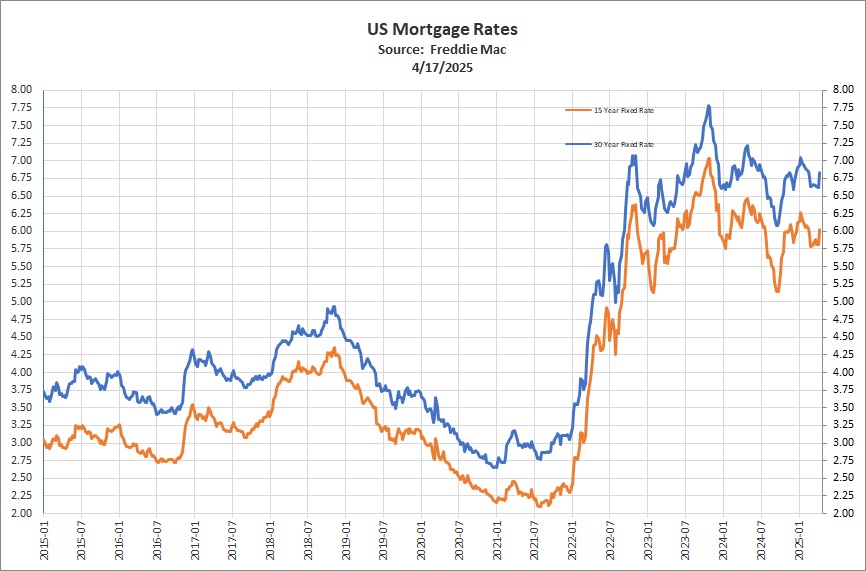
Mortgage Rates
“Bolstered by strong economic growth, a solid labor market and mortgage rates at three-year lows, housing affordability continues to measurably improve. These factors have caught the attention of many prospective homebuyers, driving purchase application activity higher than a year ago,” said Sam Khater, Freddie Mac’s Chief Economist.
The 30-year FRM averaged 6.09% as of February 12, 2026, down from last week when it averaged 6.11%. A year ago at this time, the 30-year FRM averaged 6.87%.
The 15-year FRM averaged 5.44%, down from last week when it averaged 5.50%. A year ago at this time, the 15-year FRM averaged 6.09%.
Selected Cryptocurrencies
| Symbol | Name | Price | 24h % | 7d % | Market Cap | Volume(24h) |
| BTC | Bitcoin | $68,075.86 | -0.69% | -0.93% | $1,360,893,437,905 | $31,512,494,512 |
| ETH | Ethereum | $1,982.49 | 0.49% | -1.49% | $239,271,721,680 | $17,900,282,769 |
| XRP | XRP | $1.45 | -2.54% | 3.33% | $88,733,172,839 | $2,257,106,739 |
| BNB | BNB | $622.75 | -0.14% | -0.27% | $84,917,779,831 | $1,323,647,609 |
| SOL | Solana | $85.01 | -0.47% | 1.03% | $48,294,845,859 | $3,139,156,125 |
| TRX | TRON | $0.28 | 0.00% | 1.32% | $26,612,849,839 | $587,426,248 |
| DOGE | Dogecoin | $0.10 | -0.96% | 7.64% | $16,924,172,832 | $979,862,531 |
| BCH | Bitcoin Cash | $564.93 | 0.53% | 7.86% | $11,296,489,414 | $370,819,512 |
| ADA | Cardano | $0.28 | -0.61% | 7.67% | $10,202,625,963 | $379,808,858 |
| LEO | UNUS SED LEO | $8.68 | 2.46% | 0.99% | $8,002,216,237 | $1,729,376 |
| HYPE | Hyperliquid | $29.54 | -2.81% | -0.40% | $7,656,516,235 | $195,421,172 |
| USDe | Ethena USDe | $1.00 | 0.00% | 0.05% | $6,298,657,402 | $135,817,391 |
| LINK | Chainlink | $8.81 | -0.38% | 3.62% | $6,244,025,981 | $507,114,155 |
| CC | Canton | $0.16 | -0.19% | -0.26% | $6,162,367,648 | $11,062,480 |
| XMR | Monero | $329.61 | 0.19% | 0.99% | $6,080,349,056 | $66,641,797 |
| XLM | Stellar | $0.17 | -2.09% | 6.90% | $5,461,743,975 | $98,559,989 |
| DAI | Dai | $1.00 | -0.03% | -0.02% | $5,363,923,575 | $104,016,306 |
| USD1 | World Liberty Financial USD | $1.00 | 0.06% | 0.01% | $5,150,141,925 | $2,548,982,190 |
5:30 AM PST, Tuesday, February 17, 2026. Source: https://coinmarketcap.com

If you know someone age 62 or over who is feeling stressed financially and considering a reverse mortgage please send them this excellent piece with general information about reverse mortgages at: https://beaconrwa.com/reversemortgageguidebrwa/
Sources: Ryan Long, CFA, FocusPoint Solutions, American Association for Individual Investors (AAII), Associated Press, Barclays Capital, Bloomberg, Citigroup, Deutsche Bank, FactSet, Financial Times, Goldman Sachs, JPMorgan Asset Management,
MarketfieldAsset Management, Morgan Stanley, MSCI, Morningstar, Northern Trust, Oppenheimer Funds, PIMCO, Standard & Poor’s, StockCharts.com, The Conference Board, Thomson Reuters, T. Rowe Price, U.S. Bureau of Economic Analysis, U.S. Federal Reserve, Wall Street Journal, The Washington Post. Index performance is shown as total return, which includes dividends, with the exception of MSCI-EM, which is quoted as price return/excluding dividends. Performance for the MSCI-EAFE and MSCI-EM indexes is quoted in U.S. Dollar investor terms.
The information above has been obtained from sources considered reliable, but no representation is made as to its completeness, accuracy or timeliness. All information and opinions expressed are subject to change without notice. Information provided in this report is not intended to be, and should not be construed as, investment, legal or tax advice; and does not constitute an offer, or a solicitation of any offer, to buy or sell any security, investment or other product. FocusPoint Solutions, Inc. is a registered investment advisor.
Notes key: (+) positive/encouraging development, (0) neutral/inconclusive/no net effect, (-) negative/discouraging development.