
Your Weekly Update for Monday, July 21, 2025.
Beacon Rock Wealth Advisors is a dba of BR Capital, Inc. It is a financial planning and registered investment advisory firm in Camas, Washington. We are always available to answer your finance questions. Give us a call at (360) 735-1900 or send an email.
If you or someone you know is worried about retirement, send us an email or give us a call for a no-obligation Retirement and Social Security Analysis.
If this information is helpful to you, please forward this to a friend and ask them to subscribe at https://newsletters.beaconrwa.com/subscribe.
Have a great week!
Mike Elerath
CERTIFIED FINANCIAL PLANNERTM
CERTIFIED IN LONG-TERM CARE
Mike.Elerath@beaconrwa.com
Bill Roller
NMLS #107972
CHARTERED FINANCIAL ANALYST
CERTIFIED FINANCIAL PLANNERTM
CHARTERED MARKET TECHNICIAN
bill.roller@beaconrwa.com
For more information about Beacon Rock Wealth Advisors, check out our brochure here: https://beaconrwa.com/beaconrockbrochure/
Click on the image below to go to https://youtu.be/G2AlUovvBWw to see the video from July 18 in which Mike Elerath and Bill Roller discuss the financial markets.

Please give the video a “Like” and check out our other videos and subscribe to the channel at https://www.youtube.com/@beaconrwa.
Summary
Markets were MIXED last week. The Dow Jones Industrial Average was OFF 0.07% to 44,342.19 while the S&P500 ended UP 059% TO 6,296.79. The Nasdaq Composite ROSE 1.51% to 20,895.66. The annual yield on the 30-year Treasury ROSE 4.4 basis point(s) to 5.001%.
Economic data included gains in industrial production, retail sales, housing starts, and consumer sentiment. Inflation came in a bit higher than expected on the consumer side, surpassing the minimal change in producer inflation.
Equities were mixed globally, with gains in the U.S. and emerging markets offset by declines in foreign developed. Bonds were little-changed, along with minimal change in yields. Commodities were also mixed, as crude oil prices fell back.
Economic Notes
(+) Industrial production rose 0.3% in June, beating expectations calling for a 0.1% increase, in addition to an upward revision for the prior month. The manufacturing production component rose by 0.1%, held down by a drop in motor vehicle assemblies, although business equipment production rose. Utilities led the way overall, up 2.8%, driven by summer cooling needs, and reminding us of the seasonal elements of economic growth at times. Capacity utilization ticked up a tenth to 77.6%.
(+) Retail sales rose 0.6% in June, exceeding the meager 0.1% increase expected. Removing autos trimmed the gain to 0.5%, and core/control sales remained at a strong 0.5%, pointing to broad contributions in the non-cyclical segments. For the month, the strongest gains were in autos (over 1%), followed by building materials, restaurants/bars, and misc. stores and clothing; these offset declines in department store sales. Over the past year, total retail sales were up 4%, which represented some degree of real growth in addition to still-above average inflation, with much of the rise led by auto sales.
(0/-) The Consumer Price Index rose 0.3% in June on a seasonally-adjusted basis, which was generally on par with expectations, but the fastest pace since January. Removing food and energy, core CPI rose 0.2%. Commodity prices and tariffs were acknowledged as being a key culprit behind the increase, although there were other factors as well. Within the headline number, energy commodity prices rose 1% to lead all segments, while food prices rose 0.3%, although it varied widely by the type of food. Within core, price gains were more pronounced in medical care services (0.6%), apparel (0.4%), shelter (0.2%), as well as household furnishing and sporting goods. On the other hand, price declines were sharpest in lodging (-2.9%), used cars/trucks (-0.7%), and new cars/trucks (-0.3%).
Year-over-year, headline CPI reaccelerated to a 2.7% rise, as did core CPI to a 2.9% pace. For the full year, services gained 3.8%, while durable and non-durable goods each rose a much more tempered 0.6-0.7%. In reviewing the often-interesting alternative definitions of inflation, “All items less food, shelter, and energy” rose only 2.2% for the past year, and “All items less shelter” rose only 2.0%—providing a different perspective on internal drivers. While tariffs don’t appear to have made their way through significantly into CPI yet, investors will be closely watching potential signs of price creep over the next several months. Per the assessments of a variety of economists, continued elevated tariff levels, as in an additional 10% on the initial rate early in the year, could add a half to a full percent to CPI for a time as price levels adjust upward. There continues to be confusion among the public between actual ‘inflation’ (being the continual upward growth of prices) and simply higher ‘price levels’ (which is a higher plateau of pricing for various items, caused by inflation in the past, brought on by the dramatic experience of the last five years). Regardless of the more precise definitions, it hasn’t made consumers happy.
(0/+) The Producer Price Index was unchanged in June, falling under the 0.2% expected, and well below the 0.3% of the prior month. Core PPI, ex-food and energy, was also flat, versus expectations of a similar 0.2%. Within the details of the report, prices were pulled down by transportation, such as passenger airfares, and pointing out continued dispersion under the hood. Year-over-year, headline and core PPI rose at rates of 2.3% and 2.6%, respectively. The year featured services prices rising 2.7%, while those for goods rose 1.7%. PPI readings remain above desired levels, but are a bit closer to target than consumer inflation at this point.
(+) Housing starts rose 4.6% in June to a seasonally-adjusted annualized rate of 1.321 mil. units, above the 3.5% median forecast, and reversing a sharp decline the prior month. By category, multi-family starts rose a dramatic 30%, rebounding from a -25% drop in May, while single-family starts fell by -5% in June. Regionally, starts in the Northeast rose 73% to lead the way, while they fell elsewhere in the low single-digits. Over the past year, total starts were down -0.5%, reflecting a mixed building environment, with single-family down -10% but multi-family up 27%, as those projects make their way through the system. Building permits rose by 0.2% to a rate of 1.397 mil. seasonally-adjusted annualized units, beating the expected -0.5% decline. Here, too, multi-family led with a gain of 7%, while single-family fell by -4%, and were led by a gain in the South while they declined elsewhere. Over the past year, the trend in permits was similar to that of starts, with single-family being lower and multi-family higher. Housing remains challenged by continued high mortgage rates, which has kept some buyers on the sidelines, even though some inventory has loosened up in recent months.
(+) The preliminary Univ. of Michigan index of consumer sentiment for July rose by 1.1 points to 61.8, exceeding the median forecast of 61.5. The headline figure was led by consumer assessments of current conditions, which rose by 2 points, while expectations for the future rose by a half-point. Inflation expectations for the coming 1 year fell sharply from the prior month, from 5.0% to 4.4%, as did those for the next 5 years, from 4.0% to 3.6%. Those inflation numbers remain elevated but show some easing in worries about price levels pushed upwards by high tariffs. Anecdotal comments noted that “Consumers are unlikely to regain their confidence in the economy unless they feel assured that inflation is unlikely to worsen,” noting that a respite could come from better stability in trade policy. Interviews with respondents revealed “little evidence” about other factors influencing sentiment, including the recent tax bill.
(0) Initial jobless claims for the Jul. 12 ending week fell by -7k to 221k, below the 233k median forecast. Continuing claims for the Jul. 5 week ticked up by 2k to 1.956 mil., below the 1.965 mil. expected. Claims were minor, and mixed by state, and not pointing to any unusual seasonal or layoff activity. As has been the case for some time, initial claims have stayed within a normal range for over three years, while continuing claims have been inching higher, albeit slowly.
Market Notes
| Period ending 7/18/2025 | 1 Week % | YTD % |
| DJIA | -0.05 | 5.20 |
| S&P 500 | 0.61 | 7.83 |
| NASDAQ | 1.51 | 8.60 |
| Russell 2000 | 0.24 | 1.19 |
| MSCI-EAFE | -0.29 | 18.83 |
| MSCI-EM | 1.68 | 18.02 |
| Bloomberg U.S. Aggregate | 0.04 | 3.22 |
| U.S. Treasury Yields | 3 Mo. | 2 Yr. | 5 Yr. | 10 Yr. | 30 Yr. |
| 12/31/2024 | 4.37 | 4.25 | 4.38 | 4.58 | 4.78 |
| 7/11/2025 | 4.41 | 3.90 | 3.99 | 4.43 | 4.96 |
| 7/18/2025 | 4.40 | 3.88 | 3.96 | 4.44 | 5.00 |
U.S. stocks experienced a positive week, as positive economic data and in-line inflation were coupled with a decent start to earnings season that outweighed continued trade uncertainty. As the week began, markets began to digest the potential 30% tariff on the EU, which would put a significant strain on European growth, but perhaps not as much as the headline figure suggests.
By sector, gains were strongest in technology (helped by Nvidia receiving permission to sell AI chips to China) and utilities; these were offset by declines in energy, healthcare, and materials. Real estate also gained a fraction of a percent. Earnings season for Q2 began to ramp up, with 12% of firms now having reported, per FactSet, and higher-profile early positive surprises from JP Morgan Chase and Citigroup in the financial sector, as well as Pepsi and Netflix. Of firms reporting, nearly 85% have shown positive revenue and/or earnings surprises, with the blended earnings growth rate having risen to 5.6% from just under 5% at quarter-end and again led by communication and technology. With a substantial number of reports in the coming weeks, expected growth remains just below long-term trend levels.
Threats from the U.S. administration about firing Fed Chair Powell continued, although most were walked back. Speculation about the purpose of such comments involves a desire to lower interest rates to improve the refinancing prospects of U.S. debt, and improve deficits to counter the increase in spending from the recent tax bill. It could also serve to encourage an early resignation by Powell, which would allow the President to nominate a more ‘friendly’ Fed Chair amenable to more dovish policy. The candidate list continues to evolve, with current Treasury Secretary Bessent potentially taking the lead over Kevin Hassett (Director of the National Economic Council) and Kevin Warsh (former Fed governor). The latter two are well-known in conservative circles, albeit not always necessarily dovish in tone from the standpoint of always being pro-lower interest rates. Last week, Fed Governor Waller argued his support for a July Fed cut, which was taken with a grain of salt it appeared, as other members continue to hint at cuts later in the fall.
Foreign stocks performed negatively for the week, held back by a stronger U.S. dollar in developed market regions and no concrete progress on a U.S.-European trade deal. On the other hand, emerging markets saw gains of nearly 2%, led by strength in China and Taiwan, which offset weakness elsewhere.
Bonds were little-changed last week, in keeping with minimal changes in yields across the U.S. Treasury curve. Investment-grade corporates and high yield outperformed, with slightly positive returns. Foreign bonds also saw flattish returns, other than unhedged debt, which fell back due to a sharply higher U.S. dollar.
Commodities were mixed, as gains in agriculture and industrial metals were offset by declines in energy. Crude oil prices fell by nearly -2% last week to $67/barrel, with OPEC+ production increases, while natural gas prices rose 8% upon especially hot summer weather as we move into a peak cooling period.
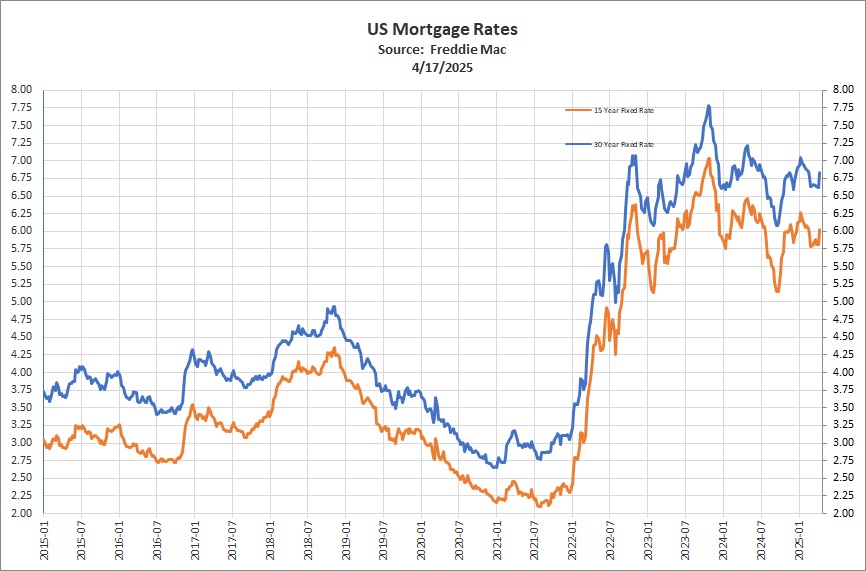
Mortgage Rates
“The 30-year fixed-rate mortgage inched up this week and continues to stay within a narrow range under 7%. While overall affordability headwinds persist, rate stability coupled with moderately rising inventory may sway prospective buyers to act,” said Sam Khater, Freddie Mac’s Chief Economist.
The 30-year FRM averaged 6.75% as of July 17, 2025, up from last week when it averaged 6.72%. A year ago at this time, the 30-year FRM averaged 6.77%.
The 15-year FRM averaged 5.92%, up from last week when it averaged 5.86%. A year ago at this time, the 15-year FRM averaged 6.05%.
Selected Cryptocurrencies
| Symbol | Name | Price | 24h % | 7d % | Market Cap | Volume(24h) |
| BTC | Bitcoin | $118,552.01 | 0.48% | -2.69% | $2,358,633,448,729 | $65,846,815,418 |
| ETH | Ethereum | $3,812.34 | 2.08% | 25.14% | $460,195,193,196 | $43,240,439,922 |
| XRP | XRP | $3.52 | 0.92% | 18.71% | $208,693,792,821 | $9,093,443,529 |
| BNB | BNB | $769.38 | 2.96% | 9.23% | $107,167,080,096 | $2,681,724,088 |
| SOL | Solana | $190.86 | 5.94% | 14.19% | $102,692,749,224 | $8,869,137,539 |
| DOGE | Dogecoin | $0.27 | 7.73% | 32.14% | $40,816,491,834 | $6,455,185,263 |
| ADA | Cardano | $0.91 | 7.39% | 21.80% | $32,281,665,042 | $2,250,328,261 |
| TRX | TRON | $0.31 | -0.97% | 3.89% | $29,784,557,102 | $1,161,698,983 |
| HYPE | Hyperliquid | $47.40 | 4.24% | -1.65% | $15,830,172,250 | $409,526,041 |
| XLM | Stellar | $0.48 | 4.51% | 5.32% | $15,091,189,648 | $948,112,324 |
| SUI | Sui | $4.01 | 1.06% | 1.62% | $13,867,130,886 | $1,702,633,740 |
| LINK | Chainlink | $19.90 | 3.64% | 22.36% | $13,495,081,278 | $1,171,913,794 |
| HBAR | Hedera | $0.28 | 4.84% | 18.72% | $12,071,490,487 | $759,338,562 |
| AVAX | Avalanche | $25.99 | 4.14% | 19.88% | $10,975,108,387 | $862,806,609 |
| BCH | Bitcoin Cash | $529.57 | -0.34% | 3.23% | $10,538,776,557 | $890,823,252 |
| SHIB | Shiba Inu | $0.00 | 3.17% | 13.37% | $9,177,844,376 | $597,557,789 |
| LTC | Litecoin | $117.39 | 0.92% | 21.15% | $8,933,326,608 | $1,404,314,709 |
| LEO | UNUS SED LEO | $8.99 | -0.20% | -0.21% | $8,298,247,977 | $5,283,684 |
Information current as of 5:20 AM PDT, Monday, July 17, 2025. Source: https://coinmarketcap.com
Check us out at https://beaconrwa.com and our affiliated website at https://reverse-mortgages.us.
Sources: Ryan Long, CFA, FocusPoint Solutions, American Association for Individual Investors (AAII), Associated Press, Barclays Capital, Bloomberg, Citigroup, Deutsche Bank, FactSet, Financial Times, Goldman Sachs, JPMorgan Asset Management,
MarketfieldAsset Management, Morgan Stanley, MSCI, Morningstar, Northern Trust, Oppenheimer Funds, PIMCO, Standard & Poor’s, StockCharts.com, The Conference Board, Thomson Reuters, T. Rowe Price, U.S. Bureau of Economic Analysis, U.S. Federal Reserve, Wall Street Journal, The Washington Post. Index performance is shown as total return, which includes dividends, with the exception of MSCI-EM, which is quoted as price return/excluding dividends. Performance for the MSCI-EAFE and MSCI-EM indexes is quoted in U.S. Dollar investor terms.
The information above has been obtained from sources considered reliable, but no representation is made as to its completeness, accuracy or timeliness. All information and opinions expressed are subject to change without notice. Information provided in this report is not intended to be, and should not be construed as, investment, legal or tax advice; and does not constitute an offer, or a solicitation of any offer, to buy or sell any security, investment or other product. FocusPoint Solutions, Inc. is a registered investment advisor.
Notes key: (+) positive/encouraging development, (0) neutral/inconclusive/no net effect, (-) negative/discouraging development.