
Your Weekly Update for Monday, December 29, 2025.
Beacon Rock Wealth Advisors is a dba of BR Capital, Inc. It is a financial planning and registered investment advisory firm in Camas, Washington. We are always available to answer your finance questions. Give us a call at (360) 735-1900 or send an email.
If you or someone you know is worried about retirement, send us an email or give us a call for a no-obligation Retirement and Social Security Analysis.
If this information is helpful to you, please forward this to a friend and ask them to subscribe at https://newsletters.beaconrwa.com/subscribe.
Have a great week!
Mike Elerath
CERTIFIED FINANCIAL PLANNERTM
CERTIFIED IN LONG-TERM CARE
Mike.Elerath@beaconrwa.com
Bill Roller
NMLS #107972
CHARTERED FINANCIAL ANALYST
CERTIFIED FINANCIAL PLANNERTM
CHARTERED MARKET TECHNICIAN
bill.roller@beaconrwa.com
For more information about Beacon Rock Wealth Advisors, check out our brochure here: https://beaconrwa.com/wp-content/uploads/2024/12/BeaconRockBrochure.pdf
Markets closed on Thursday, January 1 in honor of New Years Day!

Click on the image below to go https://youtu.be/MidsiYWLtAg to see the video from December 26 in which Mike Elerath and Bill Roller discuss the financial markets.

Please give the video a “Like” and check out our other videos and subscribe to the channel at https://www.youtube.com/@beaconrwa.
Summary
Markets were UP last week. The Dow Jones Industrial Average was UP 1.20% to 48,710.97 while the S&P500 ended UP 1.40% TO 6,929.94. The Nasdaq Composite ROSE 1.22% to 23,593.09. The annual yield on the 30-year Treasury FELL 0.8 basis point(s) to 4.820%.
Economic data included U.S. GDP for Q3 coming in stronger than expected, while industrial production was flattish, and durable goods and consumer sentiment weakened.
In a seasonally-light trading period, global stocks saw decent gains. Bonds ticked up slightly as yields fell. Commodities rose, led by precious and industrial metals.
Economic Notes
(+) The initial release of U.S. GDP for the 3rd quarter showed growth of 4.3%, well above expectations of 3.8%, as well as the 3.8% from Q2. As with other reports, GDP was significantly delayed, replacing the advance estimate from Oct. 30 and second estimate from Nov. 26, which were not released. Within the report, personal consumption rose 3.5% (accounting for 2.4% of the 4.3% total), mostly in services and non-durable goods, surpassing the 2.6% rise the prior quarter. Private investment declined -0.3% in the quarter (minimal impact on GDP on net), with sharp gains in equipment and intellectual property (over 5%) pulled down by drops of -5% in residential and -6% in non-residential structures. Government consumption rose 2% (adding 0.4% to the bottom line), mostly on the side of defense. Net exports added another 1.6% to the total growth figure, as export growth exceeded import growth. The GDP price index rose 3.8% on a quarter-to-quarter annualized pace. The Q3 PCE core price index, ex-food and energy, rose by an annualized 2.9%, exceeding the prior quarter by a few tenths.
Per the Atlanta Fed’s GDPNow indicator, the initial estimate for Q4 GDP growth has come in at 3.0%. While we’re near the end of Q4 already, the government data delays have just started to catch up. As with Q3, personal consumption is expected to lead (at 1.8% of the 3.0%), followed by gains in inventories (1%) and government spending (0.2%), and a correction backward in net exports. This all surpasses the Blue Chip economist consensus, which expects Q4 growth of 0.5-1.0%, but in a very wide range of views from -0.25% on the low side to 1.75% or so on the high side, near trend.
(-) Durable goods orders declined -2.2% in October, just beyond the -1.5% decline expected. Removing the lumpy series of aircraft orders, which declined sharply (-32% for defense, and -20% for non-defense), goods ex-transportation rose 0.2%. Core capital goods orders rose 0.5%, which was a few tenths stronger than expected. Core capital goods shipments rose 0.7%, roughly double the pace expected, but half the pace of the prior month. That category was led by gains in computers/electronics and industrial machinery, not quite offsetting the transportation impact. Total durable goods orders were up 4.8% over the past year, and 3.6%, with transportation excluded, which points to decent ‘real’ growth, and most categories solidly positive.
(0) In a combined multi-month catch-up report, industrial production showed a -0.1% decline for October but a 0.2% rise in November. Manufacturing production fell by -0.4% in Oct., and was unchanged in Nov. Mining production fell by -0.8% in Oct., but rose by 1.7% in Nov. Utilities production rose by 2.6% in Oct. but fell by -0.4% in Nov., with month-to-month variations usually being weather-related. Capacity utilization fell a tenth in Oct., but rose a tenth again in Nov., ending back where it was in Sept. at 76.0%. Over the full year, total industrial production was up 2.5%, just behind the rate of inflation. Leaders for the year were business equipment (11%) and utilities (5%), while motor vehicles/parts production fell by -6% and consumer goods production rose less than a percent.
(-) The Conference Board index of consumer confidence fell by -3.8 points in December to 89.1, representing the fifth consecutive monthly decline, although the November figure was revised upward slightly as the government shutdown came to an end. Assessments of present conditions fell by nearly -10 points, while expectations for the future (based on the short-term outlook for income, business, and labor market conditions) were unchanged. The labor market differential, measuring the difference between jobs seen as ‘plentiful’ versus ‘hard to get, also fell back by -2 points—and to the lowest level since Feb. 2021. That employment expectations segment was described as “gloomier,” and “the outlook for household incomes was less positive.” Inflation expectations for the coming year fell a tenth to 5.7%, obviously remaining quite elevated, and detached from reality, which implies consumers see price impacts from tariffs and residual pandemic inflation as still a significant burden (as opposed to the higher price level alone). While consumer confidence remains in the doldrums, it hasn’t necessarily translated into slower spending, as is often feared. However, the continued concern is that rising worries over labor market deterioration and/or layoffs could tip the balance into weaker consumer activity, particularly at the lower-income end of the spectrum.
(0) Initial jobless claims for the Dec. 20 ending week fell by -10k to 214k, below the expected no change at 224k. Continuing claims for the Dec. 13 week rose by 38k to 1.923 mil., above the 1.900 mil. expected. The recent more volatile showings for continuing claims (but not so much for initial claims) could be related to seasonal adjustments this time of year, particularly around Thanksgiving.
Question of the Week: What are some things to look for in 2026?
Without trying to provide a market forecast (difficult at best), there are a few areas that financial markets are likely to focus on going into the new year. Of course, it’s wise to prepare for change and the inevitable surprises—geopolitical and financial.
Geopolitics. This is the ultimate wildcard every year, where predictions are especially futile. Current areas of focus include the U.S.-China trade relationship, where tensions have seemed to have cooled for now with the year-long pause, but have a tendency to experience back-and-forth flare-ups. China controls the earth’s supply of rare earth metals for the most part, which are critical for niche functions in technology, and Taiwan remains an epicenter of both Chinese ambitions but also global semiconductor manufacturing. Europe has reasserted itself from a defense and infrastructure build standpoint, both in response to Russian aggression but also in efforts to stimulate sluggish domestic economic growth. The Russia-Ukraine war continues on, with hints at peace negotiations, but little progress so far. However, should a deal be reached, pending any removal of Russian sanctions, a potential pick-up in economic activity would be a focus, as would commodity supply dynamics (with materials being Russia’s largest global contribution). Now, there’s the potential for a ramped-up U.S. conflict with Venezuela, who’s primary world export is crude oil (although not always through traditional channels).
Federal Reserve. In 2025, market probabilities for rate cuts wavered based on how inflation and labor market data looked. Now at year-end, inflation has indeed stayed on a (very) slow track toward slowing, while labor markets have weakened, although they haven’t fallen off a cliff as one might see during a recession. Although odds change constantly, futures markets expect two rate cuts in 2026 (April and July), which would get rates down to 3.00-3.25%, right around the assumed neutral rate that is considered the perfect place of being neither loose nor tight. Of course, further labor market weakness could raise the odds for more and faster rate cuts, while persistent (or again rising) inflation could strengthen the case for keeping rates higher for longer. All else equal, Fed easing in some form has tended to certainly be more of a tailwind for financial assets than a headwind, although whether the ending point ends up at 3.00%, 3.25%, etc. may not be as critical if underlying data continues to look benign.
Labor markets. The Fed has been increasingly keying in on labor markets as the tipping point decision factor for policy easing looking ahead. Conditions have no doubt slowed, especially in payroll growth, although layoffs in most areas haven’t taken off significantly. The data assessments for late 2025 haven’t been made any easier by the delays of the government shutdown and impacts of immigration policy, which have altered the size of the workforce used in unemployment calculations. As these normalize, the picture should be clearer, but how much labor deteriorates remains an open question for the new year. There are also concerns over entry-level job impacts from AI, which appear to be concentrated in the areas of technology (e.g., coding) and customer service (e.g., chatbots), but job replacement doesn’t appear to be widespread at this moment. This becomes more of a multi-year secular question, although past technological breakthroughs have tended to ultimately create more new jobs than they’ve destroyed on net. As labor force growth has slowed, such technological help could provide a welcome offset.
Inflation. The Fed’s primary mandate of core PCE inflation has remained ‘stuck’ in the 3%-ish area for some time, after correcting down from pandemic excesses. Fears remain about tariffs potentially causing a one-time price impact as those costs are increasingly shifted from companies to consumers. Though, as individual tariff deals are made and/or the courts weigh on the validity of specific tariffs, such an impact remains in question. Current inflation levels are above the 2% core PCE (~2.25% Core CPI) that the Fed is targeting, but these aren’t catastrophic levels, and, in fact, are in line with U.S. inflation rates over the past 100+ years. How the Fed treats ongoing 2%+ inflation in its policy discussions remains an open question, as is whether it’s realistic to expect a sub-2% inflation environment as seen in the past secular cycle.
Artificial Intelligence (AI). Since the launch of higher-quality ChatGPT, AI has been the buzzword and stock market sentiment catalyst for the past few years. Stocks tied to AI have fared quite well at times, albeit also volatile, with assumptions that AI will give a substantial boost to economic productivity in the next decade and beyond. The reality has been more nuanced. While some sectors have seen greater adoption where there is low-hanging fruit, implementation in others is more complicated. In fact, industrials have been one of the larger beneficiaries as these tools have helped with product design/development, streamlining workflow processes and transportation logistics. Based on some estimates, only about a tenth of companies have been formally using AI, but that is obviously expected to only increase. As noted earlier, as has been a fear with every significant technological advance over the past few centuries, AI may not result in the dire outcome of widespread worker replacement, but could enhance productivity and create new, different, and more interesting jobs. Wrinkles at this point include the immense amount of capital spending on AI infrastructure (e.g., data center construction, chips, power, cooling), the timeframe for payoff on these massive investments, and uncertain lifespans for more advanced hardware assets assuming the upgrade cycle shortens. Hyperscaler tech firms have largely fueled this expansion through their own internally-generated massive free cash flows, but debt financing has also started to grow. That has some investors concerned, and raises worries about an ‘AI bubble’ emerging. Debate on that appears to be balanced on both sides, with the consensus of ‘not yet,’ as optimists point to it in the same humanity-changing status as electricity, while skeptics remain concerned about AI’s benefits potentially overpromising and underdelivering at training data gets tapped out. However, as with any technological change, market rotation could include the ‘beneficiaries’ of AI as opposed to just the hyperscalers.
Tariffs. In a continuation from speculation in early 2025, culminating in the Liberation Day announcements of April 8, markets have grown more sanguine. While the ending tariff rate is certainly several times higher than in 2024, treaty exceptions, and recent court challenges have buffered the damage a bit. Also, the tendency for companies to absorb a proportion of tariff costs so far has helped ease the burden on consumers, although not completely, and that is likely expected to change the longer any long-lasting tariffs persist. Court decisions in early 2026 could alter sentiment surrounding tariffs as a headwind to consumer spending and inflation. Then again, if the courts throw out certain tariffs on ‘emergency’ criteria (not to mention any potential required rebates), it remains to be seen whether the tariffs will be reviewed under more stringent and permanent criteria and reinstated or just forgotten about for now.
Fiscal tailwinds. A positive going into 2026 begins from provisions in the One Big Beautiful Bill Act from last year, which keeps previous tax reductions in place (like the 21% corporate rate) and adds additional benefits. These include tax deductions such as bonus depreciation and R&D expensing, but also procurement and demand subsidies in certain targeted sectors, and other ‘Made in America’ incentives. These could boost economic growth, revenues, and earnings right away.
Fundamentals. As is often said, earnings drive stock prices. Earnings have tended to take a hit during recessions, pulling earnings growth into the negative, explaining the poor stock price performance during those periods. But today, conditions look far better, with double-digit earnings expectations for both 2025 and 2026, per FactSet. Even if that high hurdle next year isn’t reached, a non-recession period of reasonable growth could add to the probability of a reasonable year for equities. Bond credit spreads are tight/expensive, but base yields are far higher than they were just a few years ago. As bond total returns tend to be closely tied to their starting yields over their duration, return contributions look to be better in balanced portfolios than they had been for many years.
Valuations. The picture here is a bit more mixed. U.S. large cap growth stocks have been running on the more expensive end of their history for quite some time, albeit with leading companies having fundamentals such as revenue and earnings growth that has also run at high levels. Even if valuations don’t change much in the new year, over multiple years, valuations have tended to ultimately mean-revert, which offers potentially less upside to that part of the market. More attractive areas from a purely valuation standpoint include U.S. large cap value stocks, U.S. small/mid cap stocks, real estate, and international stocks (which started to be discovered again by investors in a big way in early 2025 and have outpaced U.S. this year).
Diversification. Often unappreciated, as allocating broadly means an investor won’t ever be concentrated toward the single winner (assuming it could be identified in advance). But this is a time-tested way to reduce risks of extreme underperformance, smoothing the bumps, to keep financial return goals more closely on track.
Market Notes
| Period ending 12/26/2025 | 1 Week % | YTD % |
| DJIA | 1.20 | 16.47 |
| S&P 500 | 1.41 | 19.32 |
| NASDAQ | 1.23 | 22.96 |
| Russell 2000 | 0.21 | 15.13 |
| MSCI-EAFE | 1.20 | 31.28 |
| MSCI-EM | 2.14 | 32.87 |
| Bloomberg U.S. Aggregate | 0.21 | 7.31 |
| U.S. Treasury Yields | 3 Mo. | 2 Yr. | 5 Yr. | 10 Yr. | 30 Yr. |
| 12/31/2024 | 4.37 | 4.25 | 4.38 | 4.58 | 4.78 |
| 12/19/2025 | 3.62 | 3.48 | 3.70 | 4.16 | 4.82 |
| 12/26/2025 | 3.64 | 3.46 | 3.68 | 4.14 | 4.81 |
U.S. stocks gained a bit during a lighter holiday trading week, with the S&P 500 and Dow reaching more record highs, and large cap stocks outperforming small caps. Every sector ended positively, led by a mixed bag of materials (with strength in metals for the year, boosting mining names), technology, and financials, although communications was not far behind, all with returns approaching or over 2% for the week. Lagging was the more defensive group of consumer staples, which was up just a few basis points. Real estate also gained about 1.5% for the week.
Foreign stocks saw gains as well last week, helped by a drop in the value of the U.S. dollar. Results in the U.K. and emerging markets outgained Europe and Japan. Some of the positive European sentiment appeared due to calls for further interest rate cuts in the U.K., as well as the German central bank forecasting some recovery in 2026, after a long stretch of lackluster, flattish GDP growth. In emerging markets, gains in South Korea and Taiwan (along with strong AI sentiment), were followed by South Africa and Mexico.
Bonds gained slightly as U.S. Treasury yields fell by a few basis points across the curve, with investment-grade and high yield credit outperforming government bonds, as did floating rate bank loans. Foreign bonds ended higher, especially in local terms, as the dollar fell back during the week.
Commodities earned positive returns last week, led by precious metals (platinum and palladium mostly), followed by industrial metals and energy. Crude oil ended up a fraction of a percent to $57/barrel, but remained down over -20% year-to-date as global production remains high. As the U.S. has pursued additional Venezuelan tankers, prices for gold and crude oil had ticked higher early in the week. The former has tended to be reactive to any potential conflict, while the latter is sensitive to Venezuela’s relative size in global oil markets. Natural gas prices remained volatile, due to changing weather forecasts, being up over 5% for the week, but down -15% for the trailing month.
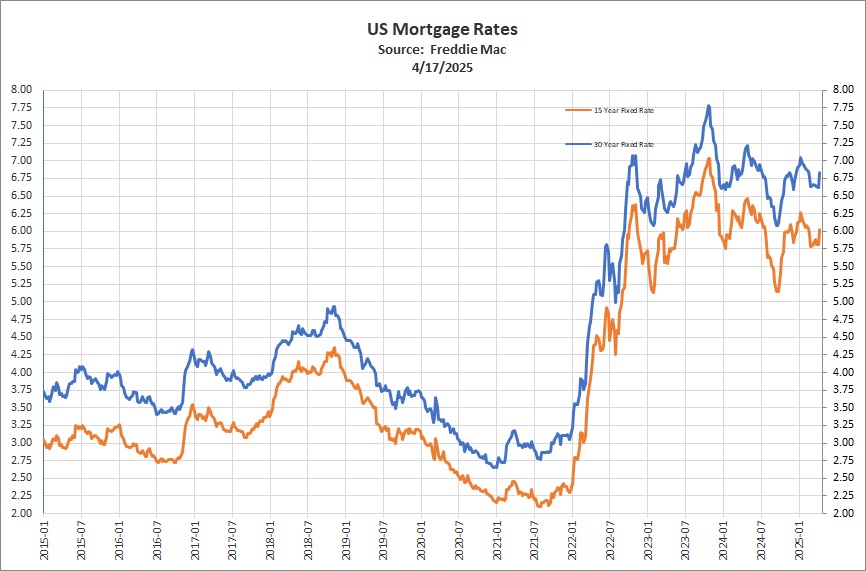
Mortgage Rates
“The average 30-year fixed-rate mortgage decreased further this week,” said Sam Khater, Freddie Mac’s Chief Economist. “Declining rates offer a timely and welcome gift for aspiring homebuyers.”
The 30-year FRM averaged 6.18% as of December 24, 2025, down from last week when it averaged 6.21%. A year ago at this time, the 30-year FRM averaged 6.85%.
The 15-year FRM averaged 5.50%, up from last week when it averaged 5.47%. A year ago at this time, the 15-year FRM averaged 6.00%.
Selected Cryptocurrencies
| Symbol | Name | Price | 24h % | 7d % | Market Cap | Volume(24h) |
| BTC | Bitcoin | $87,262.99 | -0.58% | -3.19% | $1,742,532,882,481 | $39,576,302,073 |
| ETH | Ethereum | $2,930.35 | -0.32% | -4.18% | $353,679,242,062 | $22,346,665,429 |
| BNB | BNB | $850.92 | -0.46% | -1.91% | $117,201,420,641 | $2,270,889,249 |
| XRP | XRP | $1.86 | -0.28% | -3.86% | $112,869,276,587 | $1,953,515,057 |
| SOL | Solana | $123.72 | -0.62% | -2.60% | $69,631,351,229 | $4,532,327,081 |
| TRX | TRON | $0.28 | -0.78% | -1.26% | $26,676,167,556 | $549,733,866 |
| DOGE | Dogecoin | $0.12 | -0.50% | -7.42% | $20,742,613,204 | $941,382,700 |
| ADA | Cardano | $0.36 | -1.60% | -2.39% | $13,112,377,402 | $673,229,284 |
| BCH | Bitcoin Cash | $600.15 | -3.20% | 1.19% | $11,987,302,858 | $652,299,277 |
| LINK | Chainlink | $12.37 | -0.74% | -2.87% | $8,761,454,366 | $431,995,970 |
| HYPE | Hyperliquid | $25.60 | -1.01% | 1.25% | $8,687,735,099 | $196,912,338 |
| ZEC | Zcash | $526.69 | 1.79% | 15.93% | $8,669,673,773 | $824,852,597 |
| XMR | Monero | $441.21 | -0.77% | -5.88% | $8,138,968,038 | $91,010,943 |
| LEO | UNUS SED LEO | $8.57 | 1.65% | 4.32% | $7,901,578,062 | $810,438 |
| XLM | Stellar | $0.22 | -1.70% | -2.27% | $7,095,243,462 | $121,692,556 |
| USDe | Ethena USDe | $1.00 | -0.03% | -0.08% | $6,293,134,204 | $115,698,162 |
| LTC | Litecoin | $77.51 | -2.17% | -0.57% | $5,943,893,429 | $350,883,057 |
| SUI | Sui | $1.44 | -0.89% | -1.74% | $5,417,404,302 | $590,097,825 |
Information current as of 4:40 AM PST, Monday, December 29, 2025. Source: https://coinmarketcap.com
Check us out at https://beaconrwa.com. We recently updated our affiliated website at https://reverse-mortgages.us. If you know someone age 62 or over who is feeling stressed financially and considering a reverse mortgage please send them to this site. An excellent piece with general information about reverse mortgages is available here: https://reverse-mortgages.us/wp-content/uploads/2025/12/ReverseMortgageGuideBRWA.pdf
Sources: Ryan Long, CFA, FocusPoint Solutions, American Association for Individual Investors (AAII), Associated Press, Barclays Capital, Bloomberg, Citigroup, Deutsche Bank, FactSet, Financial Times, Goldman Sachs, JPMorgan Asset Management,
MarketfieldAsset Management, Morgan Stanley, MSCI, Morningstar, Northern Trust, Oppenheimer Funds, PIMCO, Standard & Poor’s, StockCharts.com, The Conference Board, Thomson Reuters, T. Rowe Price, U.S. Bureau of Economic Analysis, U.S. Federal Reserve, Wall Street Journal, The Washington Post. Index performance is shown as total return, which includes dividends, with the exception of MSCI-EM, which is quoted as price return/excluding dividends. Performance for the MSCI-EAFE and MSCI-EM indexes is quoted in U.S. Dollar investor terms.
The information above has been obtained from sources considered reliable, but no representation is made as to its completeness, accuracy or timeliness. All information and opinions expressed are subject to change without notice. Information provided in this report is not intended to be, and should not be construed as, investment, legal or tax advice; and does not constitute an offer, or a solicitation of any offer, to buy or sell any security, investment or other product. FocusPoint Solutions, Inc. is a registered investment advisor.
Notes key: (+) positive/encouraging development, (0) neutral/inconclusive/no net effect, (-) negative/discouraging development.