
Your Weekly Update for Monday, October 27, 2025.
Beacon Rock Wealth Advisors is a dba of BR Capital, Inc. It is a financial planning and registered investment advisory firm in Camas, Washington. We are always available to answer your finance questions. Give us a call at (360) 735-1900 or send an email.
If you or someone you know is worried about retirement, send us an email or give us a call for a no-obligation Retirement and Social Security Analysis.
If this information is helpful to you, please forward this to a friend and ask them to subscribe at https://newsletters.beaconrwa.com/subscribe.
Have a great week!
Mike Elerath
CERTIFIED FINANCIAL PLANNERTM
CERTIFIED IN LONG-TERM CARE
Mike.Elerath@beaconrwa.com
Bill Roller
NMLS #107972
CHARTERED FINANCIAL ANALYST
CERTIFIED FINANCIAL PLANNERTM
CHARTERED MARKET TECHNICIAN
bill.roller@beaconrwa.com
For more information about Beacon Rock Wealth Advisors, check out our brochure here: https://beaconrwa.com/beaconrockbrochure/
Click on the image below to go to https://youtu.be/HrZDtPOsOWY to see the video from October 24 in which Mike Elerath and Bill Roller discuss the financial markets.

Please give the video a “Like” and check out our other videos and subscribe to the channel at https://www.youtube.com/@beaconrwa.
Summary
Markets were UP last week. The Dow Jones Industrial Average was UP 2.20% to 47,207.12 while the S&P500 ended UP 1.91% TO 6,791.69. The Nasdaq Composite ROSE 2.31% to 23,204.87. The annual yield on the 30-year Treasury FELL 1.8 basis point(s) to 4.585%.
Economic data remained sparce as the federal government shutdown continued, with the exception of CPI inflation, which remained high, but somewhat cooler than expected. Private sources included gains in manufacturing and services PMI, as well as existing home sales, while weakness continued in consumer confidence.
Equities rose globally, led by the U.S. and emerging markets. Bonds fared positively in the U.S. credit segment, but lagged internationally with a stronger dollar. Commodities were generally higher with additional Russian sanctions reducing potential crude oil supplies.
Economic Notes
As the U.S. government shutdown continued, missing data included new home sales and jobless claims. The private Conference Board’s Index of Leading Economic Indicators for September was also postponed due to lack of data.
(0/-) The Consumer Price Index (CPI) for September, released a few weeks late, showed a 0.3% rise on a headline level, and 0.2% for core, removing food and energy. Both were about a tenth lower than expected. Key contributors for the month included gasoline prices up 4%, in addition to gains in shelter, airfares (3%), recreation, household furnishings and operations, and apparel. Decliners included auto insurance, used cars/trucks, and communication. Despite an increase in shelter, it was the smallest rise in five years, due to declines in the South and New England.
Year-over-year, headline CPI rose 3.0%, a tenth higher than the prior month, with core CPI also coming in at 3.0%, which was down a tenth. For the trailing year, the highest inflation components included car repair, used cars/trucks, and utility/gas service. Shelter continued to run high, at a 3.6% rate, more so for owners’ equivalent rent than actual rent. Looking at alternative measures, “All items less food, shelter, and energy” came in at a more palatable 2.6%. Services inflation gained 3.6% for the trailing 12 months (again tied to housing and medical care), while durable and non-durable goods rose by only 1.8% and 2.0%, respectively, showing perhaps less tariff impact on consumers than expected so far.
This was considered a more critical report, necessitating the rush prior to government reopening, due to Sept. CPI being the government’s bogey for year-over-year changes to Social Security COLA and other tax-related limits. Based on Friday’s release, the Soc. Sec. COLA was announced at 2.8% for 2026, up from the 2.5% of last year. This was just above the 30-year average of 2.5%, but below the 50-year average of 3.6%, which included the inflationary 1970s.
(+) The preliminary S&P Global U.S. manufacturing PMI for October showed a rise of 0.2 of a point to 52.2, exceeding the no change expected, and remaining in expansion. New orders rose by several points, further into expansion, while output saw a small gain, but employment fell a point but stayed in expansionary territory. Input and output prices changes were mixed, but remained in solid expansion, around the 60 level. The preliminary S&P Global U.S. services PMI for October rose by 1.0 point to 55.2, moving further into expansion, and in contrast to the expected small decline. Under the hood, conditions remained strong, with new business and employment both rising further into expansion. Prices for both inputs and outputs were similarly mixed, remaining in the upper 50’s on average. Commentary from S&P noted that the data pointed to “sustained strong economic growth at the start of the fourth quarter,” as business activity was “picking up momentum across both manufacturing and services.” At the same time, confidence in the business outlook for the coming year has “deteriorated further,” and lies at “one of the lowest levels seen over the past three years,” with companies continuing to “worry about the impact of policies, most notably tariffs.”
(0/+) Existing home sales for September rose by 1.5% to a seasonally-adjusted annualized rate of 4.06 mil., in line with expectations. For the month, sales were led by a 5% gain in the West, rose a bit in the Northeast and South, but declined in the Midwest. Year-over-year, overall sales were up by 4.1%, led by the South, while the West lagged with flattish sales. The median existing home sales price rose by 1.5% for the year to $415,200. Inventory rose over 1% for the month and 14% over the past year, to 4.6 months’ supply. The NAR was again optimistic, noting that “falling mortgage rates are lifting home sales,” leading to “improving housing affordability” with stronger inventories. Affordability and financing costs are relative, with the Freddie Mac 30-year fixed rate average coming in at 6.35% for September, down from August’s 6.59%, but up from 6.18% a year ago.
(-) The final Univ. of Michigan index of consumer sentiment for October showed a -1.5 drop (or -2.7%) from the prior month to 53.6. Assessments of current conditions and expectations for the future fell to similar magnitudes, in the -2.5% to -3.0% range. However, year-over-year, future expectations fared far weaker with a -32% drop, partially offset by a -10% drop for present conditions, which resulted in a net -24% decline for the full sentiment index. Inflation expectations for the coming year fell by a tenth to 4.6%, obviously remaining quite high. However, long-term expectations for the coming five years rose by 0.2% to 3.9%, and was interestingly driven primarily by independents and Republicans, bucking recent trends.
Market Notes
| Period ending 10/24/2025 | 1 Week % | YTD % |
| DJIA | 2.24 | 12.49 |
| S&P 500 | 1.93 | 16.68 |
| NASDAQ | 2.31 | 20.78 |
| Russell 2000 | 2.51 | 13.92 |
| MSCI-EAFE | 1.25 | 27.19 |
| MSCI-EM | 2.05 | 31.69 |
| Bloomberg U.S. Aggregate | 0.17 | 7.41 |
| U.S. Treasury Yields | 3 Mo. | 2 Yr. | 5 Yr. | 10 Yr. | 30 Yr. |
| 12/31/2024 | 4.37 | 4.25 | 4.38 | 4.58 | 4.78 |
| 10/17/2025 | 4.00 | 3.46 | 3.59 | 4.02 | 4.60 |
| 10/24/2025 | 3.93 | 3.48 | 3.61 | 4.02 | 4.59 |
U.S. stocks started the week strongly, with hopes of both an end to the U.S. government shutdown (which didn’t happen), as well as stronger chances of progress between the U.S. and China, via expected upcoming meetings. By Friday, the delayed September U.S. CPI report came in a bit less inflationary than expected, which raised chances of the Federal Reserve continuing their easing plan this coming week, and perhaps again in December.
The bulk of stock sectors experienced gains for the week, led by technology, energy, and industrials. More defensive consumer staples and utilities were the only declining groups for the week. Real estate saw gains as well, along with general positive risk sentiment and assumed ongoing dovish Fed action this year.
Earnings season for Q3 continued along, with nearly 30% of S&P firms having now reported, per FactSet. The blended year-over-year earnings growth rate for the quarter now having reached 9.2%, about a percent above initial estimates. Profit margins remain elevated (over 12%), in technology, financials, and utilities especially, which has led to earnings leadership there. Markets appeared to shrug off some concern the prior week about credit in regional banking, particularly in sub-prime auto loans. Investors were on the lookout for bad loan ‘cockroaches,’ as JPMorgan CEO Jamie Dimon put it, noting that where there’s one, there are often many more. Bad loans are a common late cycle worry, for good reason in many cases, when loan standards become lax and defaults can more easily bubble to the surface. So far, this does not appear to be the case, but analysts are increasingly watchful, particularly in smaller regional banks where these are more likely.
Foreign stocks fared positively, although to a lesser degree than U.S., with the headwind of a stronger U.S. dollar for the week. The U.K. and emerging markets fared best, while Europe and Japan ended the week having undergone little change. U.K. markets were perhaps helped by a weaker-than-expected inflation report as well (albeit still at 3.8%) and stronger retail sales. In EM, although Brazil and China both saw gains, indexes were led by South Korea and Taiwan, which have a strong correlation to U.S. technology, which had also fared positively.
Bonds generally earned positive returns, despite little change in the U.S. Treasury yield curve. Corporates outperformed governments, in both investment-grade and high yield, with floating rate bank loans faring best. A stronger dollar held back developed market foreign hard currency bonds, while emerging markets fared positively.
Commodities generally gained ground, despite the normal headwind of a stronger dollar, with energy, industrial metals, and agriculture higher, offsetting a pullback in precious metals. Crude oil prices rose over 6% last week to over $61/barrel. The rebound was related to the U.S. administration announcing further sanctions on Russia’s two largest oil producers (Rosneft and Lukoil) following a lack of progress in Russia-Ukraine peace negotiations. As a significant percentage of Russia’s national revenue comes from petroleum, both the sanctions and diplomatic pressure on India and China to find other oil sources aside from Russia remains ongoing. The world remains well-supplied with oil, however, which has kept an upward price spiral at bay for the time being. Gold fell back by -5% on Tuesday, the largest drop in a decade, as tensions between the U.S. and China eased, in addition to a rising dollar. Gold is best thought of as a safe haven asset of sorts, where concerns over geopolitics, independence of the Federal Reserve monetary policy, U.S. government shutdown, and trade uncertainty have boosted the metal’s popularity over the past year, but easing of those same tensions pose a downside risk after such a rally.
Mortgage Rates
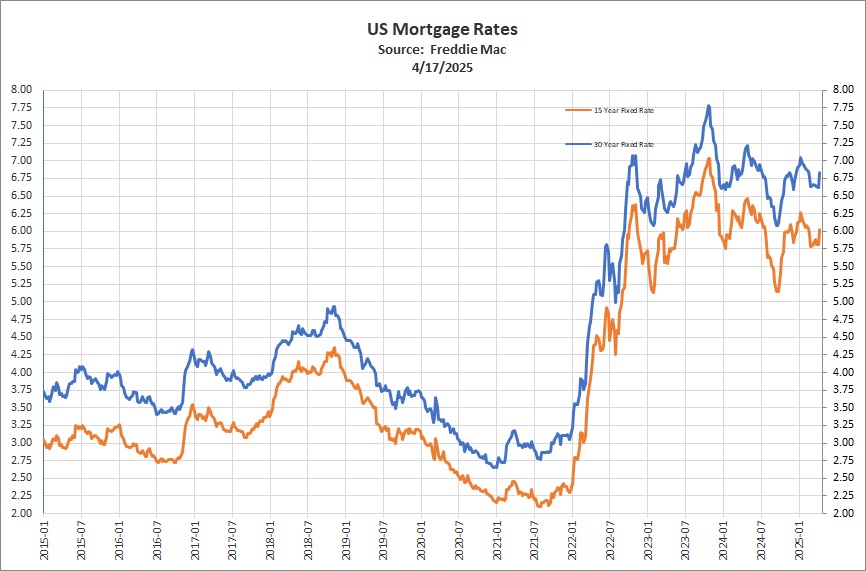
“Mortgage rates continued to trend down this week, hitting their lowest level in over a year,” said Sam Khater, Freddie Mac’s Chief Economist. “At the start of 2025, the 30-year fixed-rate mortgage surpassed 7%, while today it hovers nearly a full percentage point lower. This dynamic has kept refinancings high, accounting for more than half of all mortgage activity for the sixth consecutive week.”
The 30-year FRM averaged 6.19% as of October 23, 2025, down from last week when it averaged 6.27%. A year ago at this time, the 30-year FRM averaged 6.54%.
The 15-year FRM averaged 5.44%, down from last week when it averaged 5.52%. A year ago at this time, the 15-year FRM averaged 5.71%.
Selected Cryptocurrencies
| Symbol | Name | Price | 24h % | 7d % | Market Cap | Volume(24h) |
| BTC | Bitcoin | $115,209.62 | 1.43% | 3.81% | $2,297,353,943,602 | $58,332,983,911 |
| ETH | Ethereum | $4,158.10 | 2.82% | 3.10% | $501,876,311,908 | $39,316,069,146 |
| BNB | BNB | $1,175.10 | 3.54% | 5.58% | $161,857,611,687 | $3,952,971,871 |
| XRP | XRP | $2.62 | -0.89% | 7.24% | $157,714,581,148 | $4,404,936,993 |
| SOL | Solana | $199.69 | 0.94% | 4.05% | $109,747,074,068 | $6,506,639,214 |
| DOGE | Dogecoin | $0.20 | 0.64% | 1.54% | $30,796,631,219 | $2,155,370,176 |
| TRX | TRON | $0.30 | 0.27% | -7.12% | $28,400,170,978 | $918,858,858 |
| ADA | Cardano | $0.68 | 0.53% | 1.66% | $24,280,927,147 | $942,524,526 |
| HYPE | Hyperliquid | $47.45 | -0.77% | 23.42% | $15,978,028,074 | $571,026,089 |
| LINK | Chainlink | $18.48 | 0.84% | -2.55% | $12,880,327,721 | $837,038,719 |
| BCH | Bitcoin Cash | $561.72 | 3.15% | 16.59% | $11,203,353,741 | $744,496,533 |
| XLM | Stellar | $0.33 | -1.68% | -0.12% | $10,433,247,706 | $219,518,324 |
| USDe | Ethena USDe | $1.00 | 0.00% | -0.03% | $10,196,388,248 | $382,253,431 |
| SUI | Sui | $2.63 | 1.05% | 0.56% | $9,537,012,433 | $932,711,448 |
| AVAX | Avalanche | $20.51 | 0.89% | -0.86% | $8,749,963,368 | $543,447,950 |
| LEO | UNUS SED LEO | $8.97 | -0.05% | 0.02% | $8,275,048,651 | $550,939 |
| HBAR | Hedera | $0.18 | -0.03% | 0.65% | $7,595,558,294 | $194,383,538 |
| LTC | Litecoin | $99.10 | 0.34% | 4.98% | $7,576,856,167 | $656,516,173 |
Information current as of 4:45 AM PDT, Monday, October 27, 2025. Source: https://coinmarketcap.com
Check us out at https://beaconrwa.com and our affiliated website at https://reverse-mortgages.us.
Sources: Ryan Long, CFA, FocusPoint Solutions, American Association for Individual Investors (AAII), Associated Press, Barclays Capital, Bloomberg, Citigroup, Deutsche Bank, FactSet, Financial Times, Goldman Sachs, JPMorgan Asset Management,
MarketfieldAsset Management, Morgan Stanley, MSCI, Morningstar, Northern Trust, Oppenheimer Funds, PIMCO, Standard & Poor’s, StockCharts.com, The Conference Board, Thomson Reuters, T. Rowe Price, U.S. Bureau of Economic Analysis, U.S. Federal Reserve, Wall Street Journal, The Washington Post. Index performance is shown as total return, which includes dividends, with the exception of MSCI-EM, which is quoted as price return/excluding dividends. Performance for the MSCI-EAFE and MSCI-EM indexes is quoted in U.S. Dollar investor terms.
The information above has been obtained from sources considered reliable, but no representation is made as to its completeness, accuracy or timeliness. All information and opinions expressed are subject to change without notice. Information provided in this report is not intended to be, and should not be construed as, investment, legal or tax advice; and does not constitute an offer, or a solicitation of any offer, to buy or sell any security, investment or other product. FocusPoint Solutions, Inc. is a registered investment advisor.
Notes key: (+) positive/encouraging development, (0) neutral/inconclusive/no net effect, (-) negative/discouraging development.