Your Weekly Update for Monday, July 28, 2025.
Beacon Rock Wealth Advisors is a dba of BR Capital, Inc. It is a financial planning and registered investment advisory firm in Camas, Washington. We are always available to answer your finance questions. Give us a call at (360) 735-1900 or send an email.
If you or someone you know is worried about retirement, send us an email or give us a call for a no-obligation Retirement and Social Security Analysis.
If this information is helpful to you, please forward this to a friend and ask them to subscribe at https://newsletters.beaconrwa.com/subscribe.
Have a great week!
Mike Elerath
CERTIFIED FINANCIAL PLANNERTM
CERTIFIED IN LONG-TERM CARE
Mike.Elerath@beaconrwa.com
Bill Roller
NMLS #107972
CHARTERED FINANCIAL ANALYST
CERTIFIED FINANCIAL PLANNERTM
CHARTERED MARKET TECHNICIAN
bill.roller@beaconrwa.com
For more information about Beacon Rock Wealth Advisors, check out our brochure here: https://beaconrwa.com/beaconrockbrochure/
Click on the image below to go to https://youtu.be/AGW8xUswEuM to see the video from July 25 in which Mike Elerath and Bill Roller discuss the financial markets.

Please give the video a “Like” and check out our other videos and subscribe to the channel at https://www.youtube.com/@beaconrwa.
Summary
Markets were UP last week. The Dow Jones Industrial Average was UP 1.28% to 44,907.65 while the S&P500 ended UP 1.47% TO 6,389.59. The Nasdaq Composite ROSE 1.03% to 21,111.26. The annual yield on the 30-year Treasury FELL 7.2 basis point(s) to 4.929%.
Economic data for the week included strength in S&P services PMI, and new home sales; these offset weaker results in S&P manufacturing PMI, durable goods orders, existing home sales, and the well-watched index of leading economic indicators.
Equities saw gains around the world, led by Japanese stocks. Bonds also fared positively, as interest rates declined slightly, with foreign bonds led by a weaker dollar. Commodities fell back as oil and natural gas prices declined.
Economic Notes
(-) The preliminary S&P Global US manufacturing PMI for July fell by -3.4 points to 49.5, back into contraction, and well below the 52.7 median forecast. The underlying data was also lackluster, with new orders falling -4 points back into contraction, as did employment, while output fell several points, to the low end of expansion. Input and output prices declined by several points each, but remained high and expansionary—in the 60s. Commentary from S&P noted that weak report was “linked to a fading boost from tariff front-running,” while those responding to the survey continued to point to concerns around the impact of government policies, such as federal spending cuts and tariffs. In fact, business confidence has fallen to a low point relative to the past several years.
(+) By contrast, the preliminary S&P Global US services PMI ticked up by 2.3 points for July to 55.2, above the expected 53.0, and further into expansion. Strength in underlying components continued, including new business and employment moving further upward into expansion. Input and output prices also rose by 1-2 points, each further into expansion as well, ending around 60. Considering that services represent nearly 90% of economic activity by dollar value, this larger segment continues to be the behemoth driving the economy higher, more than offsetting the weakness in manufacturing.
(-/0) Durable goods orders fell by -9.3% in June, but by less than the -10.7% expected by consensus, along with a slight upward revision for the prior month. As is often the case, the monthly change was driven by a dramatic move in commercial aircraft orders, which fell by -$31 bil. after a spike in May from Qatar following a Presidential trip. So, absent that, durable goods orders ex-transportation rose by 0.2%, which was a bit better than expected. Core capital goods orders still fell by -0.7%, compared to a 0.1% gain expected. Core capital goods shipments rose 0.4%, twice expectations, and similar to the prior month. Over the past year, total durable goods orders are up 11%, most of which was transportation, without which they only rose 2%, which is flat to slightly negative after accounting for inflation.
(0) Existing home sales declined -2.7% in June to a seasonally-adjusted annualized pace of 3.93 mil. units, below the expected decline of -0.7%, although May’s results were revised up slightly. By segment, the decline was led by single-family, down -3%, while condos/co-ops were unchanged. Regionally, the West saw a small gain, while sales in other areas declined, mostly in the Northeast. Over the past 12 months, national existing home sales were flat. However, homes for sale have risen to 1.53 mil., up 16% from last year. The median existing home sales price is up 2% over the past year to $435,300, a record high. This was described by the NAR as being driven by “multiple years of undersupply,” as well as are “holding back” first time home buyer activity. Inventory is up to 4.7 months’ supply, up 0.7 from a year ago. Per Freddie Mac, as of Jul. 17, the average 30-year fixed rate mortgage has ticked up to 6.75%, little-changed from a year ago.
(+/0) New home sales rose by 0.6% to a seasonally-adjusted annualized rate of 627k units, but were short of the 4.3% rise expected, with the prior month’s sharp decline revised up slightly. At this point, the sales level lies largely where it did in 2019, before the pandemic surge. The bulk of monthly sales were taken up by the South region (390k) and West (131k), although the Midwest led with a 6% increase for the month, and Northeast lagged with a -28% decrease. Year-over-year, sales were down -6.6%, with the Midwest being the only region showing an increase over the year, and the Northeast lagging substantially. The median new home sales price fell by -4.9% over the past year to $401,800, and down nearly -13% from late 2022 peak levels. This largely represents changes in home size to accommodate a more expensive environment for buyers, although the price per square foot generally has also declined, showing some adjustment for affordability difficulties. This has been seen by the most expensive home ranges seeing lesser movement, while the $300-500k segment has seen greater pickup. Inventory is up 17% over last year, at 9.8 months’ supply.
(0) Initial jobless claims for the Jul. 19 ending week fell by -4k to 217k, below expectations for a slight gain to 226k. Continuing claims for the Jul. 12 week rose by 4k to 1.955 mil., just above the 1.954 mil. level expected. Initial claims rose in KY and MA, but fell in NY, CA, and MI. No unusual items were noted, with levels continuing to run within recent ranges, and not showing any negative pressures.
(-) The Conference Board’s Index of Leading Economic Indicators fell by -0.3% further in June, following an upward revision in May to no change (from the -0.1% originally posted). The monthly data was led downward by low consumer expectations, weak ISM new orders, and higher weekly jobless claims; these were offset a bit by a positive result for the S&P 500 stock index. For the first half of 2025, the LEI declined by -2.8%, which was worse than the -1.3% drop in the prior six-month period for the second half of 2024. Per The Conference Board, “the LEI’s six-month growth rate weakened, while the diffusion index over the past six months remained below 50, triggering the recession signal for a third consecutive month.” However, they do not forecast a recession, “although economic growth is expected to slow substantially in 2025 compared to 2024,” with real GDP expectations at 1.6% for 2025, and “the impact of tariffs becoming more apparent in H2,” leading to slowing consumer spending. This index doesn’t provide any new information that wasn’t already available, but the combination of metrics has been historically useful in predicting economic slowdowns and recessions.
Market Notes
| Period ending 7/25/2025 | 1 Week % | YTD % |
| DJIA | 1.28 | 6.55 |
| S&P 500 | 1.47 | 9.42 |
| NASDAQ | 1.02 | 9.71 |
| Russell 2000 | 0.95 | 2.14 |
| MSCI-EAFE | 1.92 | 21.12 |
| MSCI-EM | 0.70 | 18.85 |
| Bloomberg U.S. Aggregate | 0.37 | 3.60 |
| U.S. Treasury Yields | 3 Mo. | 2 Yr. | 5 Yr. | 10 Yr. | 30 Yr. |
| 12/31/2024 | 4.37 | 4.25 | 4.38 | 4.58 | 4.78 |
| 7/18/2025 | 4.40 | 3.88 | 3.96 | 4.44 | 5.00 |
| 7/25/2025 | 4.42 | 3.91 | 3.95 | 4.40 | 4.92 |
U.S. stocks saw another week of gains, following decent corporate earnings on net, and the U.S. administration’s trade agreements with Japan, Indonesia, and the Philippines, in addition to negotiations with the European Union ahead of the Aug. 1 deadline for 30% tariffs on the latter. (The European discussions appeared to be completed over the past weekend, resulting in a 15% tariff deal. The U.S. talks with China continue, with reports of another 3-month extension to provide additional time for a potential deal.)
Every sector ended in the positive last week, led by health care up over 3%, followed by materials, industrials, and communications, up over 2%. Consumer staples was the laggard, when ended roughly flat for the week. Real estate also gained over 2% along with lower long-term interest rates.
The second quarter earnings season continues to progress, with about a third of companies in the S&P 500 now having reported results as of late last week. Per FactSet, 80% of firms continue to post an earnings surprise and/or a revenue surprise. The blended year-over-year Q2 earnings growth rate has evolved up to 6.4%, up from an expected 4.9% at quarter-end. One area that’s been closely watched is profit margins, which were expected to take a hit from tariffs, with companies absorbing some of that cost, while passing the rest on to consumers (the ratio between the two remains one of the key questions of the current earnings environment). Currently, Q2 is expected to be the fifth straight quarter of over-12% net profit margins, at a blended 12.3% so far, which is similar to this time last year, but down from the 12.7% of Q1. Unsurprisingly, the most profitable companies remain focused in the information technology and communications sectors (partially accounting for their perpetually-elevated valuations), but also financials. Also, margins are expected to again improve by Q3 and Q4 this year, with some tailwinds from favorable tax policy and less uncertainty around tariff rates.
Foreign stocks outperformed U.S. for the week, led by a gain of over 5% in Japan, while emerging markets lagged with returns of under a percent. Japanese stocks were driven upward following the U.S. trade deal, which removed the headwind of forward-looking uncertainty about corporate and economic growth prospects. This outweighed the more uncertain political backdrop, after the ruling party lost its Upper House majority. European stock sentiment was driven upward a bit with positive hopes for U.S. trade negotiations, while the ECB’s decision to keep interest rates unchanged at 2% was widely expected, along with commentary that policymakers remain in “wait-and-watch” mode. Chinese stocks ended positively, up several percent, with a third round of U.S. trade talks to be held in Sweden. Foreign stock sentiment has been extensively driven by changes in European spending priorities, but obviously progress toward trade deals with the U.S., in both Europe and Asia.
Bonds gained as the intermediate- and long-term part of the curve saw a decline in yields. Returns were fairly in line between U.S. Treasuries, investment-grade corporates, and high yield. Foreign bonds were mixed, with unhedged seeing gains along with a drop in the value of the U.S dollar, and positive sentiment for emerging market debt.
Commodities fell back nearly across the board last week, led by energy and agriculture. Crude oil prices declined a few percent last week to $65/barrel, with continued upward supply pressures from OPEC+, an easing in restrictions allowing oil production in Venezuela, and continued trade tensions weighing on expectations for global demand growth. Natural gas prices dropped a more dramatic -12% upon higher storage levels and milder summer weather in the U.S.
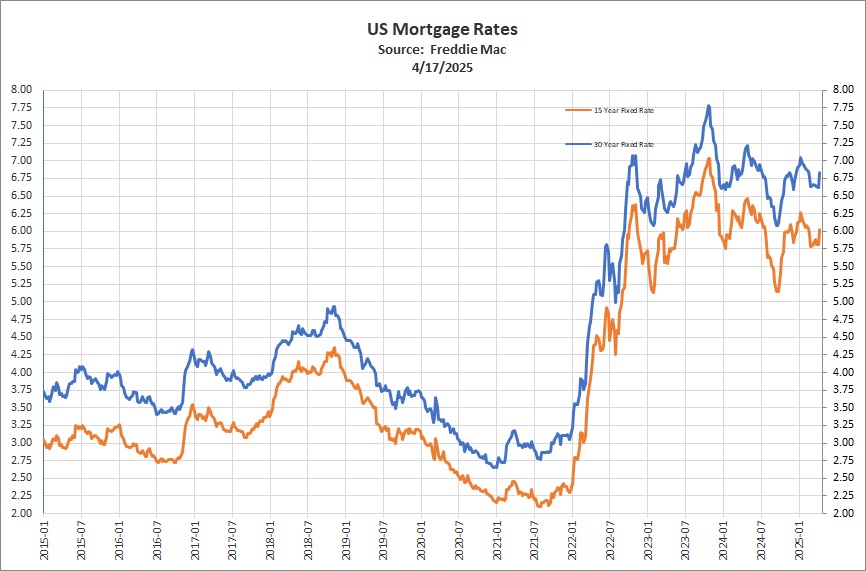
Mortgage Rates
“This week, the 30-year fixed-rate mortgage essentially remained flat at 6.74%,” said Sam Khater, Freddie Mac’s Chief Economist. “Overall, the backdrop for the housing market is positive as the economy continues to perform well with solid employment and income growth.”
The 30-year FRM averaged 6.74% as of July 24, 2025, down slightly from last week when it averaged 6.75%. A year ago at this time, the 30-year FRM averaged 6.78%.
The 15-year FRM averaged 5.87%, down from last week when it averaged 5.92%. A year ago at this time, the 15-year FRM averaged 6.07%.
Selected Cryptocurrencies
| Symbol | Name | Price | 24h % | 7d % | Market Cap | Volume(24h) |
| BTC | Bitcoin | $118,557.04 | 0.24% | -0.06% | $2,360,225,906,228 | $60,762,663,355 |
| ETH | Ethereum | $3,873.31 | 1.13% | 1.18% | $467,599,264,942 | $33,348,016,211 |
| XRP | XRP | $3.22 | 0.90% | -9.08% | $191,248,840,206 | $6,782,404,397 |
| BNB | BNB | $846.58 | 6.02% | 9.47% | $117,918,923,550 | $3,749,593,570 |
| SOL | Solana | $191.48 | 1.70% | -0.63% | $103,005,028,849 | $6,639,209,881 |
| DOGE | Dogecoin | $0.24 | 0.87% | -12.08% | $36,149,750,679 | $2,484,308,423 |
| TRX | TRON | $0.32 | 0.43% | 2.29% | $30,631,506,921 | $762,866,320 |
| ADA | Cardano | $0.83 | -0.21% | -8.37% | $29,263,205,135 | $1,154,966,131 |
| HYPE | Hyperliquid | $44.14 | 2.94% | -7.02% | $14,741,514,688 | $306,030,537 |
| SUI | Sui | $4.21 | -0.75% | 4.25% | $14,564,736,062 | $2,566,085,347 |
| XLM | Stellar | $0.44 | -0.32% | -9.45% | $13,658,696,651 | $395,852,444 |
| LINK | Chainlink | $18.97 | 0.63% | -6.05% | $12,868,566,697 | $619,211,194 |
| HBAR | Hedera | $0.28 | -0.62% | -1.05% | $11,953,588,419 | $636,291,828 |
| BCH | Bitcoin Cash | $587.24 | -1.04% | 10.49% | $11,688,237,661 | $877,610,533 |
| AVAX | Avalanche | $26.79 | 7.06% | 1.96% | $11,313,096,588 | $875,389,438 |
| LTC | Litecoin | $113.12 | -0.30% | -4.66% | $8,611,734,686 | $647,342,278 |
| TON | Toncoin | $3.37 | 2.14% | 0.90% | $8,347,683,565 | $170,225,317 |
| SHIB | Shiba Inu | $0.00 | -0.14% | -10.80% | $8,272,043,888 | $209,556,594 |
Information current as of 4:35 AM PDT, Monday, July 28, 2025. Source: https://coinmarketcap.com
Check us out at https://beaconrwa.com and our affiliated website at https://reverse-mortgages.us.
Sources: Ryan Long, CFA, FocusPoint Solutions, American Association for Individual Investors (AAII), Associated Press, Barclays Capital, Bloomberg, Citigroup, Deutsche Bank, FactSet, Financial Times, Goldman Sachs, JPMorgan Asset Management,
MarketfieldAsset Management, Morgan Stanley, MSCI, Morningstar, Northern Trust, Oppenheimer Funds, PIMCO, Standard & Poor’s, StockCharts.com, The Conference Board, Thomson Reuters, T. Rowe Price, U.S. Bureau of Economic Analysis, U.S. Federal Reserve, Wall Street Journal, The Washington Post. Index performance is shown as total return, which includes dividends, with the exception of MSCI-EM, which is quoted as price return/excluding dividends. Performance for the MSCI-EAFE and MSCI-EM indexes is quoted in U.S. Dollar investor terms.
The information above has been obtained from sources considered reliable, but no representation is made as to its completeness, accuracy or timeliness. All information and opinions expressed are subject to change without notice. Information provided in this report is not intended to be, and should not be construed as, investment, legal or tax advice; and does not constitute an offer, or a solicitation of any offer, to buy or sell any security, investment or other product. FocusPoint Solutions, Inc. is a registered investment advisor.
Notes key: (+) positive/encouraging development, (0) neutral/inconclusive/no net effect, (-) negative/discouraging development.